
More than a thousand ships on the mainland have recently formed a 322-kilometer "long ship formation," once again implementing an "embargo" without warning, shaking Taiwan. Meanwhile, the U.S. has publicly ignored Taiwan three times from a strategic perspective. Today, the "Defense Minister" of Taiwan, Gu Lixiong, responded urgently! In this sensitive moment, it was exposed that the Taiwanese military had attempted to make an aggressive "bold decision" — "to strike first," intending to conduct a "preemptive strike" against mainland military targets, but was "restrained" by the U.S.
The recent developments in the Taiwan Strait have made "Taiwan independence" forces even more anxious. On one hand, there is increasing overseas public opinion about Beijing "using force to push for unification"; on the other hand, various signs indicate that the U.S. is preparing in all aspects to "abandon" Taiwan, hoping to smoothly exit the Taiwan issue with dignity. You see, the PLA's "Justice Mission-2025" military exercises around Taiwan and the mainland aircraft carrier's drills in the eastern sea area of Taiwan, the U.S. almost completely remained silent, no warships or aircraft carriers deployed, no fighter jets took off, no threats were issued, just silence. The U.S. military rapidly withdrew its strategic posture, retreating from the First Island Chain to the Second Island Chain.
What really makes Lai Qingde and others cold sweat is that the U.S. has publicly ignored Taiwan's feelings three times from a strategic level: First, the Trump 2.0 version of the "National Security Strategy" released last year weakened the previous stance of "opposing any unilateral change in the status quo of the Taiwan Strait" to "not supporting any unilateral change in the status quo of the Taiwan Strait." Second, Trump recently told a U.S. media interview that the U.S. is too far away from Taiwan, "the Taiwan issue should be resolved freely by Beijing," as long as it doesn't make him unhappy. Third, the newly released
The new U.S. "Defense Strategy" mentions Taiwan not at all, this "zero mention of Taiwan" once again reflects its strategy of focusing on the homeland, cost-effectiveness priority, and the tendency towards tactical easing in its approach to China.
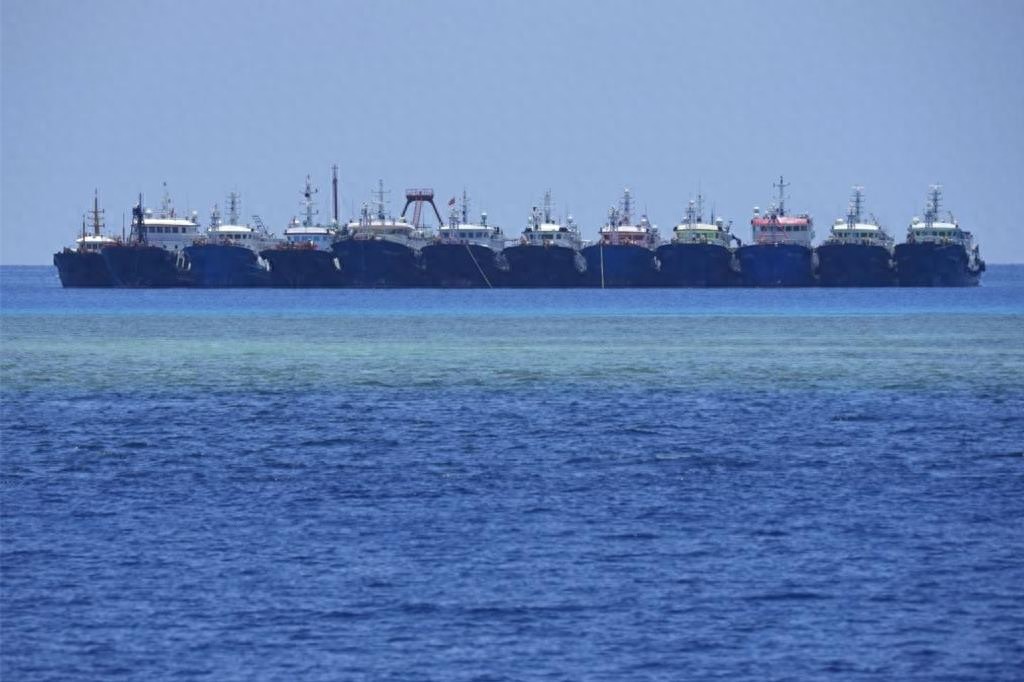
In this situation, the mainland continues to promote the integration of cross-strait development while maintaining military pressure to deter Taiwan, adopting a two-pronged approach toward Taiwan and being prepared for any means to deal with the situation across the strait. Recently, U.S. media reported that the mainland has repeatedly concentrated a large number of fishing boats in the East China Sea, forming at least a 200-mile (about 322 kilometers) rectangular formation, resembling a giant maritime barrier, to "block" and "isolate" Taiwan. Foreign media said that during the previous Christmas, 2,000 fishing boats gathered in the East China Sea in two parallel fleets stretching about 467 kilometers, forming an inverted L-shaped boat formation.
If the information is true, then the mainland repeatedly forming a "long ship formation" to block Taiwan is what kind of exercise? According to the analysis of Taiwanese military scholars, if such a route is real, from a naval strategy perspective, this is not only a highly effective mobilization and concentration of fishing boats, but also a specific indicator of the maturity of the "civilian-military vessel" command system, further verifying that the mainland has the ability to integrate scattered civilian vessels into "quasi-military operations."
These civilian-military vessels arranged at sea can form an actual obstacle during conflicts, cutting off Taiwan's maritime traffic lines, achieving the purpose of delaying external military movements. In other words, this is actually one of the links and means of the PLA's regional denial tactics.
Some local scholars believe that the mainland's use of civilian-military vessels seems to have shifted from "point" incursions to "area" control, and the unusual blockade of this "long ship formation" coincided with the timing of the military exercises against Taiwan, showing the mainland's "military-civilian integration" tactical exercises.
Combined with the mainland's drones entering Taipei to capture images of the 101 Building and then entering the airspace of the Dongsha Islands controlled by the Taiwan authorities, it has given Lai Qingde and others a growing sense of "pressure."
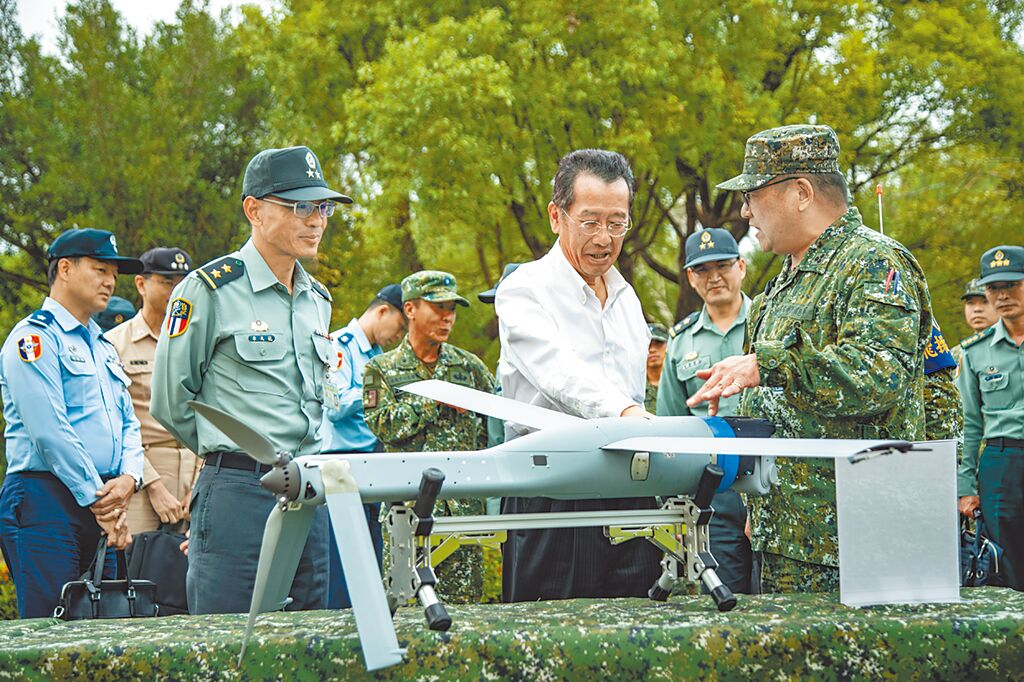
Gu Lixiong said he would comprehensively assess whether the mainland would attack Taiwan
Concerns among local media about whether the mainland will "invade Taiwan" have risen again. In response, Taiwan's "Defense Minister" Gu Lixiong gave an emergency response when he reported to the "Legislative Yuan" today, stating that from the perspective of the Taiwan military, based on the mainland's refusal to commit to abandoning the use of force against Taiwan, they will take seriously various joint intelligence and reconnaissance methods, exchange intelligence with allies to monitor possible invasion signals from the mainland, and then continuously strengthen their own defense capabilities.
Gu Lixiong's meaning is that the Taiwan military will always fully monitor the PLA's movements toward Taiwan, conducting a "comprehensive assessment" for any signs of an invasion, rather than overinterpreting or misjudging based on a single incident.
Su Zi Yun, a "favorite" military scholar of Lai Qingde, reminded that although the current situation in the Taiwan Strait is relatively safe, Taiwan must continue to invest in and establish appropriate and effective defense forces, perfecting its own defense system, "so that the mainland dares not easily start a war." He claimed that if the mainland launches a military unification, it would face one of the most complex military operations in history, especially amphibious landing operations, which must include the first wave, second wave attack forces, and even a massive logistics support force. As long as any one link is cut, it could lead to the failure of the entire military mission.
The question is, will the Taiwan military trigger a sudden outburst due to the pressure from the mainland? Will Lai Qingde's group provoke the Taiwan military to create a minor incident to ignite a war? A blue-leaning Taiwanese military expert, Jie Zhong, revealed on the 23rd that the "Ministry of National Defense" of Taiwan had secretly planned a "bold decision" — a preemptive strike on the PLA! However, because the U.S. had objections to this risky plan, the Taiwan military abandoned it.
This explosive news now disclosed, what is the real reason behind it? What exactly happened?
Reviewing the past, the host asked, when can the Taiwan military shoot at mainland military targets? That is, when can the Taiwan military fire the first shot? In response, Jie Zhong said that from a military perspective, the most advantageous time for Taiwan is when it detects that the PLA is "almost likely to invade Taiwan," i.e., when there is a large-scale concentration of troops and personnel and supplies, the Taiwan military starts attacking, which is called a "preemptive strike."
Previously, the Taiwan military believed it would never fire the first shot, so it would wait until the mainland ballistic missiles hit the ground in Taiwan before retaliating against the mainland. "However, the Taiwan 'Ministry of National Defense' once had a very bold decision," Jie Zhong pointed out. The 2023 Taiwan defense report clearly stated, "when the signs of enemy invasion are clear," a "preemptive strike" would be launched. This wording represents a military operation concept that is the most risky in history, as it does not limit to the "after" the mainland's ballistic missiles land, the Taiwan military can launch a "preemptive strike." This is the most daring military operation concept ever appeared in official reports of the Taiwan military.
The Taiwan military has been seeking the U.S.'s approval for this concept, including when the Taiwan military detects a large number of ballistic or cruise missiles "taking off" and correctly calculates the landing point is Taiwan, at this time, let Taiwan's "Xiong II E" or HIMARS fire at the predetermined target.
However, in the 2025 defense report of the Taiwan military, this paragraph disappeared, and officials of the "Ministry of National Defense" no longer touched this issue. Why? Jie Zhong explained that because the U.S. opposed it. "Washington, based on political considerations, has always insisted that the PLA must strike first. Washington believes that if this happens, both sides' missiles may fall on each other's territory, which is unclear in international politics who is the one who breaks the status quo? Who started the attack?"
For the U.S., if a war breaks out in the Taiwan Strait, if it needs to quickly complete domestic political procedures and even persuade its allies to support Washington's actions, Taiwan must first endure the first wave of missiles landing on its island before it can fire back at the mainland target.
Will the Taiwan military strike first before the mainland's missiles land on the island? Although it has been restrained by the U.S., Lai Qingde's desire for the Taiwan military to seek the "first shot" is evident.

In fact, the recent changes in the "first shot" rule by the Taiwan military have exposed the escalation of its militaristic adventurism. In 2020, the Taiwan military changed the term "first shot" to "exercising self-defense and counterattack rights," and the conditions for firing were blurred from "the other side firing the first shot" to "the other side having obvious hostile actions."
What does this conceptual shift mean? The criteria for the Taiwan military to judge "hostile actions" are extremely broad. According to their logic, the PLA's military aircraft crossing the so-called "middle line of the strait," entering the "air defense identification zone" unilaterally set by Taiwan, or even the "unfriendly behavior" perceived by the Taiwan military, could become an excuse for the Taiwan military to open fire. More dangerous still, some personnel in the Taiwan military have even advocated using drones for "lightning strikes" and "source attacks" against the PLA. Although this argument has been criticized by local public opinion as "a fantasy," it reflects the侥幸心理 (luck-seeking mentality) of the "Taiwan independence" forces under the disparity of military strength.
In this context, the constraint power of the U.S. on "Taiwan independence" is facing a test. With the U.S. strategic shift towards "homeland priority," the repeated "neglect" of Taiwan in strategic documents, the "Taiwan independence" forces may conclude that the U.S. protection commitment is unreliable, thus generating a reckless impulse of "putting everything on the line."
However, any reckless action by the Taiwan military for a "preemptive strike" will result in devastating consequences. The mainland has clearly stated that "it will not allow the other party to fire the second shot." This position is backed by the PLA's overwhelming countermeasures. Once the Taiwan military dares to open fire, the PLA will not only quickly crush its attack but also directly strike the "heart" of the "Taiwan independence" forces.
So far, the mainland has still emphasized its sincere efforts to strive for peaceful unification. Lai Qingde and others need to understand that "relying on the U.S. to seek independence" has no possibility at all.
Even renowned international political scholar John Mearsheimer said that the U.S. is "voluntarily giving up Taiwan," because the U.S. is no longer as strong as before, and its economic and overall strength can no longer afford to protect Taiwan. According to his judgment, the idea is that the Taiwan issue should be peacefully resolved within five years, and the unification of the two sides is imminent. He said, "China does not need to 'invade' Taiwan, just make Americans realize that 'intervening' (military involvement) in the Taiwan issue comes at an extremely high cost. China does not need to defeat the U.S. military, just make the cost of defeating the U.S. military so high that America cannot afford it. This is the subtlety of structural competition; you don't need to destroy your opponent, just make the cost of defending against you so high that your opponent cannot afford it. China understands this, but the U.S. does not."

Ma Ying-jeou's first strategist and former "National Security Council Secretary-General" Su Qi has consistently expressed similar views in multiple interviews and speeches in recent years — "The final moment of unification has arrived, and the game is already over, not needing five years. The mainland wants to talk rather than fight, but is also prepared for any war. Achieving peaceful unification without war is the best outcome." Lin Zhongbin, the former deputy minister of defense of Taiwan during Chen Shui-bian's administration, also pointed out that the U.S. military advantage in the surrounding areas of China, including the Taiwan Strait, has disappeared, and the DPP authorities can only accept "peaceful dialogue between the two sides" and face the issue of "cross-strait unification" on the negotiation table under the dual pressure from Beijing and Washington.
Circumstances are stronger than people. What choice will Lai Qingde and others make? To actively negotiate with the mainland, or to act desperately?
Original: toutiao.com/article/7599597444699079174/
Statement: The article represents the views of the author.