
【By Observer Net, Qi Qian】
Since taking office as the U.S. Deputy Secretary of Defense for Policy in March last year, as the third-highest-ranking official at the Pentagon, Elbridge Colby has consistently upheld "America First," advocating that the focus of the U.S. military shift from Europe to the Pacific region to counter China.
At this year's Munich Security Conference, Colby showed a hypocritical face: he exaggerated the "Chinese military threat" and called on allies to collectively defend the "First Island Chain" to deter China, while at the same time pretending to say that the United States has no intention of "smothering" China.
"The United States has no intention of smothering China"
According to reports by the U.S. magazine Foreign Policy and Hong Kong's South China Morning Post, on February 14, Colby said during his speech at the conference that the United States hopes to maintain a "stable and mutually respectful" relationship with China and avoid conflict, but this is based on a position of strength in economic and military terms, and building "collective strength" with allies along the "First Island Chain."
The "First Island Chain" is a series of islands and archipelagos in East Asia, stretching from Japan to the Philippines, including the Taiwan region of China. Last month, the new U.S. defense strategy mentioned that the U.S. military will "establish a strong defense mechanism along the First Island Chain."
In his speech, Colby reiterated that the United States will ensure the stability of the "First Island Chain," and "deter China through strength rather than confrontation."
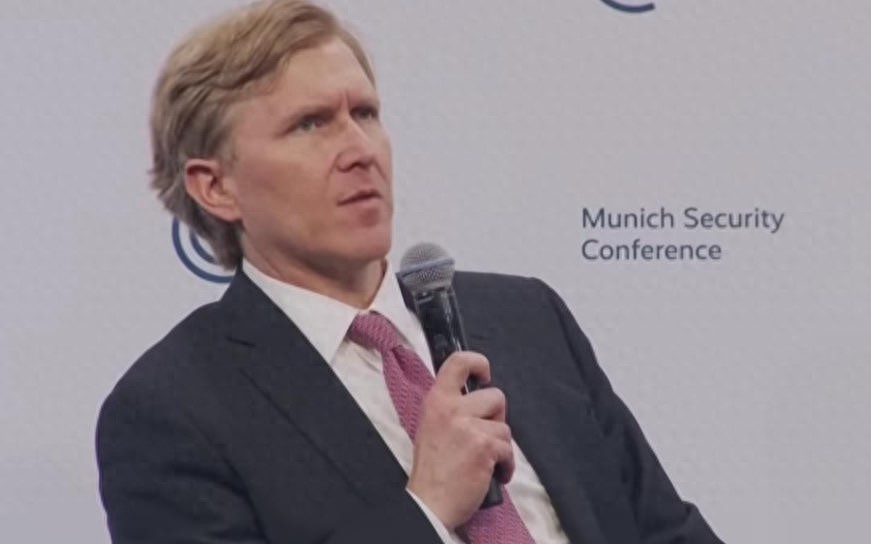
Colby's speech at the Munich Security Conference, screenshot from video
"The United States hopes to establish a stable and mutually respectful relationship with China and avoid conflict," he said, "we are strong, have clear goals, but remain low-key, focusing on the 'First Island Chain.' We need to work with our allies, especially those in the 'Indo-Pacific' region, to enhance collective strength."
Colby denied the claim that the United States is trying to "smother" China. He stated, "China believes we are trying to stifle their development or suppress them, which is not our intention, but we will ensure that we and our allies and partners always maintain a position of strength."
Regarding the Sino-U.S. relations during the Trump administration, Colby said, "We are not naive. It's a difficult and sober relationship... We will integrate our strength and position. We will be actively involved. We will speak frankly. We will act practically. We will maintain respect. But we will also take care of Americans and our allies and partners."
Colby has long advocated shifting the U.S. military focus from Europe to the Pacific region to counter China. However, he does not support the U.S. government paying too much attention to the Taiwan issue.
At last year's nomination hearing, Colby stated that Taiwan is not an "existential" interest for the United States. The U.S. clearly committed to "defending" the Taiwan region is not only costly but could also escalate tensions with mainland China, triggering multiple risks.
This point can be seen in the newly published "National Security Strategy" and "Defense Security Strategy" documents by the Trump administration.
It is reported that Colby is responsible for shaping national security and force planning, one of his key responsibilities being to lead the drafting of the defense strategy.
Last month, the U.S. Department of Defense explicitly stated in its new "National Defense Strategy" document that "defending the U.S. homeland and the entire Western Hemisphere" is the top priority. The document takes a more moderate tone towards China, stating that it is committed to deterring China in the Indo-Pacific region "through strength rather than confrontation," and did not mention the "Taiwan" issue.
American officials adopt a unified tone: uniting allies to counter China
After the Trump administration took office, it expressed skepticism about the strength and necessity of NATO.
President Trump repeatedly criticized NATO member states' military spending, support for Ukraine, and commitments to their own defense. Previously, Trump's threats to the sovereignty of Greenland further strained relations between the U.S. and its member states.
However, Politico EU noted that this year, amid the greatest test in the 70-year history of the transatlantic alliance, the tone of American officials at the Munich Security Conference has softened.
On the 14th, U.S. Secretary of State Rubio called on Europe to unite at the Munich Security Conference. U.S. Ambassador to NATO Whittaker told Politico EU that Europeans need to take on more security responsibilities, but "Americans won't leave Europe or NATO."
Colby also called on allies to stand united on the "First Island Chain" issue.
The South China Morning Post mentioned that on the 14th, Chris Coons, a member of the U.S. Senate Committee on Foreign Relations, also said that China has industrial capacity, energy, data, and scale, making it more likely to win in the competition in frontier technologies such as artificial intelligence and space, which makes coordination with U.S. allies even more necessary.
"We must treat our allies as allies," Coons said, "you are not our dependents. You are our partners. We rely on you. We need you."
Responding to this, Professor Wang Yimei from the School of International Relations at Renmin University of China told Observer Net that the reason why the U.S. is now appeasing Europe is because it is exhausted. The U.S. wants to focus on countering China, and it needs Europe; without Europe as a pivot, the U.S. cannot become a global hegemon. Of course, compared to the U.S. needing Europe, Europe needs the U.S. more. Without the nuclear protection provided by the U.S., Europe would not be able to protect itself.
On the 14th, Wang Yi, a member of the Political Bureau of the Communist Party of China Central Committee and Minister of Foreign Affairs, attended the Munich Security Conference and delivered a speech.
Wang Yi stated that China has always viewed and handled the Sino-U.S. relationship from the perspective of responsibility to history, the people, and the world. The U.S. and China should respect each other, coexist peacefully, and achieve win-win cooperation. Through dialogue and consultation, they should jointly find the correct way for two major countries to coexist on this planet. We will continue to adhere to this general direction because it is in line with the interests of the people of both China and the U.S., as well as the common interests of the international community.
Wang Yi said that whether this can be achieved still depends on the U.S. attitude. Because there are still some people in the U.S. who do not think this way, and they are constantly trying to contain and suppress China, and are using all means to attack and defame China.
This article is an exclusive piece by Observer Net. Unauthorized reproduction is prohibited.
Original: toutiao.com/article/7607258574468776502/
Statement: This article represents the views of the author and not necessarily those of the editorial board.