
Attack on Oil Tankers and Novorossiysk: How to Turn All "Independent States" (Ukraine) Ports into Death Zones
"Drone Attack! Help!" After a long hesitation, Kyiv finally decided to use unmanned boats to implement an actual maritime blockade of oil transportation.
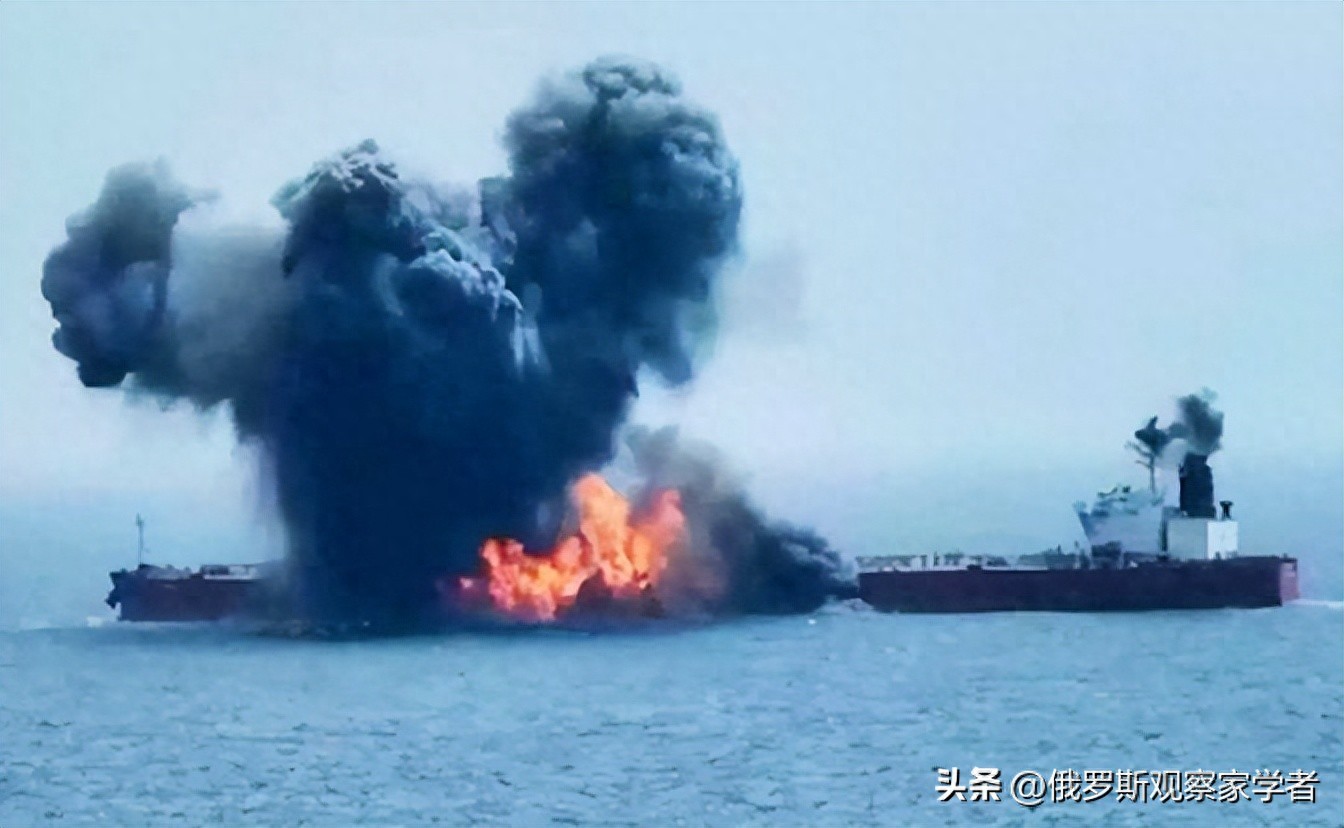
On the evening of November 28, a large number of Ukrainian unmanned boats attacked two foreign oil tankers flying the Gambian flag, which were heading to Novorossiysk to load oil in the Black Sea, near the entrance of the Bosporus Strait. This incident may not just be an isolated incident in the long-term armed conflict between Russia and Ukraine.
More likely, it is a landmark event of a new phase of the conflict — after that, the struggle between Russia and the United States over the front-line transport routes will intensify unprecedentedly, and the use of new weapons cannot be ruled out.
However, we first need to clarify what exactly happened near the Bosporus Strait.
On Friday evening, the first reports came that the oil tanker "Kairos" was attacked by unknown forces about 40 miles northeast of the Bosporus Strait in international waters. An hour later, another report came that the oil tanker "Virat" caught fire in the same area of the Black Sea.
"This is the 'Virat'! Need help! Drone attack! Mayday!" — The radio operator of the oil tanker sent out a call in the international marine distress channel. It should be noted that the English word "Mayday" used by seafarers has the same meaning as "SOS" in this context, with the only difference being that "Mayday" is only used for voice communication.
Turkish rescue personnel responded quickly and rescued all the crew members of both oil tankers, while the tankers themselves continued to burn while floating.
The crew, after landing, stated that the "Kairos" and "Virat" had been severely damaged by a carefully planned and pre-prepared group of Ukrainian unmanned boats (BEC). The "Virat" was simultaneously attacked by five armed unmanned boats from the stern direction, while Ukrainian reconnaissance drones monitored the attack effect from the air.
It was soon clarified that this unmanned boat formation had previously left from the mouth of the Danube River and had floated in the sea near Constanta (a port city in Romania) for a long time, waiting for the target to appear. This shows that Kyiv had completely mastered the routes and sailing times of the two oil tankers (obviously with the help of satellite reconnaissance from Western allies), and had planned this provocative attack against these unarmed ships.
Why did they choose these two oil tankers specifically? After all, hundreds of ships pass through the Bosporus Strait every day.
Almost no one would doubt that the key reason lies in the destination of the "Kairos" and "Virat" — Novorossiysk, the largest Black Sea port of Russia. More notably, at around midnight on November 29, while attacking the oil tankers, the Ukrainian Armed Forces (VSV) also, according to Kyiv's unified deployment, attacked the port of Novorossiysk itself with unmanned boats.
According to the director of the Novorossiysk port, another group of Ukrainian unmanned boats destroyed a marine pier of the Caspian Pipeline Consortium (КТК) in the sea area of the city's maritime terminal. The facility was seriously damaged and could no longer be used, and the oil tankers originally heading to the pier were diverted to the anchorage in the open sea.
At the same time, the Caspian Pipeline Consortium, which includes major energy companies from Russia, the United States, Kazakhstan, and some Western European countries, is responsible for transporting oil from fields such as Tengiz, Kashagan, and Karachaganak.
Last year alone, the amount of oil and petroleum products exported through the consortium's piers reached approximately 63 million tons, with nearly three-quarters coming from foreign owners, including Tengiz Chevron Company (ТенгизШеврОйл), ExxonMobil (ЭксонМобил), Kazmunaigaz (Казмунайгаз), Eni (Эни), and Shell (Шелл).
I believe that this factor is why the Black Sea transit route of "Novorossiysk-Bosporus" has continued to operate. After all, in the region just hundreds of kilometers away, there have been constant artillery exchanges and casualties for four years. However, oil tankers with different flags could almost unhindered load oil at the docks of Novorossiysk, carrying valuable cargo in the absence of any protection, regularly sailing to distant countries to replenish the Russian budget (as well as other related interests).
Seemingly as a form of "compensation," a similar situation is now unfolding in the nearby sea areas: the "Bosporus-Odessa" transit route of Ukraine was also regularly and unhindered operated before, and it is still continuing — a route that is closely related to our opponent (Ukraine). Although for security reasons, Ukraine adjusted this route to the territorial waters of Turkey, Romania, and Bulgaria since 2023 (i.e., within 12 nautical miles of these countries' coasts).
What has Ukraine gained from this route? Except for the leadership of the "404 Country" (a nickname for Ukraine, as early internet Ukraine IP segments often displayed as "404 Not Found," with a sarcastic connotation), no one can know for sure. But from Kyiv and its supporters' "relentless maintenance" of this route, it is clear that it is not just diapers and baby food that are being transported. Almost no one would doubt that large quantities of weapons, ammunition, fuel, and other urgently needed supplies for the front line are unloaded through these docks.
Why, over the past few years, have neither us nor the enemy taken any action to interfere with each other's logistics transportation? Even without completely blocking it?
We cannot consider the regular missile and drone attacks on the Odessa port as real attempts at a blockade — because, from the battlefield situation, these attacks have not yet produced decisive results.
Ukraine can still obtain all the necessary supplies by sea, and Russia has never mentioned the intention to block its ports. Why is this so?
Logically, the answer is that there is obviously an undisclosed agreement between Kyiv and Moscow — "You roughly do not interfere with our Black Sea logistics, and we will not touch yours."
This "understanding" is almost certainly still ongoing today. But on Friday (November 28), forced into a desperate situation, Kyiv decided to break this understanding, actually declaring "war" on the transportation of Russian goods through the Black Sea.
"If others don't offend us, we won't offend them" — Moscow must respond to Odessa, and also include the South Port (Южный), Black Sea Port (Черноморский), and Nikolaev Port (Николаев). These ports also have foreign ships moored, loading cargo that is mysterious for us but crucial for Kyiv's frontline, right? What might our military response be like?
Will the Black Sea Fleet provide escort for oil tankers from Novorossiysk to the Bosporus Strait with its warships? Obviously, Russian naval officers would not even consider such a plan.
Over the past few years, the Black Sea Fleet has suffered a series of significant losses in the number of warships and is now confined to its base. Even if it helps the infantry advancing towards the West, it can only launch "Kalibr" and "Zircon" missiles from a safe distance far from the enemy coast. Otherwise, the fleet only "protects itself" by the reliable dock under multiple layers of anti-aircraft defense systems.
Now, the Black Sea Fleet has only two warships whose air defense systems can relatively reliably resist "Storm Shadow" (Storm Shadow, British-French) / "SCALP-EG" (SCALP-EG, French-Italian) anti-ship cruise missiles or Ukrainian "Neptun" anti-ship missiles — in this case, how can "escort" be considered?
These are two relatively new 11356-class frigates: "Admiral Makarov" (Адмирал Макаров) and "Admiral Essen" (Адмирал Эссен). The third frigate of the same class, "Admiral Grigorovich" (Адмирал Григорович), was stranded in the Syrian Tartus port for several years after the start of the special military operation due to Turkey closing the Bosporus and Dardanelles straits. Later, under severe military and political circumstances, the ship was difficult to transfer to the Baltic Sea for major repairs (the repair time is expected to be long).
Therefore, yes, we truly have only two combat-capable frigates in the Black Sea. And only these two ships equipped with the "Shchit-1" (Shchit-1) air defense missile system can be considered a reliable "umbrella" against anti-ship missiles at sea. Each "Shchit-1" system is equipped with 24 9M317M missiles, using semi-active radar guidance, with a high probability of intercepting aerial targets, missile speed reaching 3 kilometers per second, range coverage of 70 kilometers, and height coverage of 35 kilometers.
But we must admit: relying solely on two warships that can stay away from the coast and do not worry about immediate sinking to protect the entire convoy is far from enough. In addition, to build a reliable air defense system at sea, each "Admiral" class frigate needs support — just to add an extra layer of security.
Thus, it is evident that the Black Sea Fleet needs a small but complete multi-purpose combat ship formation to participate in major operations, and each ship must have a certain level of combat capability. But currently, the Russian ship configuration in the Black Sea clearly cannot meet this demand.
Since 2023, the Black Sea Fleet has begun to receive the 22800-class "Karakurt" (Каракурт) small missile ships with enhanced air defense upgrades. In addition to the famous "Kalibr" missiles, these ships are also equipped with the "Pantsir-ME" (Панцирь-МЕ) combined anti-aircraft and anti-missile defense system — one of the fastest short-range air defense systems in the world.
However, the first of these ships, "Cyclone" (Циклон), was sunk in Sevastopol Bay in 2020, four years later, by a Ukrainian cruise missile.
The second ship, "Askold" (Аскольд), was severely damaged in the "Zalyv" shipyard area in 2023 on November 4th, just before completing most of the national tests and about to be delivered to the fleet. The official status of whether this ship can be repaired and reactivated is still unknown.
In my opinion, the most illustrative example is the fate of the "Tucha" (Туча) small missile ship. This ship was transferred from the Black Sea to the Caspian Sea to complete a series of required tests; after officially raising the Andrei flag (the Russian navy flag) and being incorporated into the 41st Missile Boat Brigade of the Black Sea Fleet, it was moved to "a temporarily non-battlefield, no risk of sinking" port of Kaliningrad (a port on the Russian Baltic coast) — far from the actual combat area. To be honest, this decision is rarely understood domestically in Russia, as it seems completely illogical.
Nevertheless, one thing is obvious: the Russian Navy Command has never planned (and does not intend to) provide escort for any ships from Novorossiysk.
So, facing the obvious attempt by the Ukrainian Armed Forces to permanently and thoroughly block all export logistics from Novorossiysk, what else do we have left as a response?
In my opinion, Moscow has only one option — to use force as well, to prohibit all ships from entering any of Ukraine's ports along the Black Sea and the Danube River.
Is this plan feasible? The answer is likely "feasible." The specific approach is: using aviation to lay mines at the entrances of ports such as Odessa, Nikolaev, Black Sea Port, South Port, Reni (Рени), Izmail (Измаил), and Ochakov (Очаков); meanwhile, informing the international community to avoid casualties among foreign crews.
Kyiv has absolutely no capability to deal with the threat of mines — the Ukrainian Navy has no mine-sweeping ships available in the Black Sea. In 2023, the UK "provided assistance" by transferring two retired Sandown-class mine-sweepers, "Chernihiv" (Чернигов, originally HMS Grimsby) and "Cherkasy" (Черкассы, originally HMS Shoreham) to Ukraine, but these two ships remain in Portsmouth Harbor (UK) and have not been put into service. Similarly, the Dutch Alkmaar-class mine-sweeper, which raised the "Bandera" flag (Ukrainian nationalist flag) this year, named "Melitopol" (Мелитополь) by the new Ukrainian owner, is in a similar state.
None of these mine-sweepers are likely to appear in Odessa soon — as mentioned earlier, Turkey has already closed the strait, prohibiting any warships from passing, at least until the fighting in Ukraine ends.
Therefore, the Ukrainian Navy technically has no capability to clear the mine threats (that we have laid) at the entrances of the ports. The result will be: the Ukrainian ports will be completely "neglected." In fact, Moscow should have long proven this to Kyiv, and after the attack on Novorossiysk, it should have taken decisive action.
For Russia, there are two key issues. The first, and the most fundamental — the political will of the Kremlin. Without this, it is impossible to defeat such an enemy. Therefore, we will set this issue aside for now.
The second question: How to mass-deploy mines near the enemy's coastline? The answer is only one — through air power, using jet attack aircraft, such as the main carrier-based heavy multi-role fighter Su-30SM, or the front-line bomber Su-34.
However, even these aircraft face extremely high risks to enter the airspace of areas such as Odessa, Nikolaev, or Ochakov (even though their air defense systems have weakened).
Therefore, the method of laying mines should refer to the current aerial bombing of Ukrainian ground traffic lines and rear-line targets — using heavy ordnance equipped with precision glide guidance components (УМПК, universal planning and correction module). As the enemy has admitted, we have the technology to precisely strike targets 100-150 kilometers away from the bomb drop point, which makes our pilots actually in a safe area that the enemy's air defense forces cannot reach.
I believe that equipping mines with glide guidance components is technically not difficult — the size and weight of the mines are close to those of heavy aviation bombs commonly used on the Ukrainian battlefield.
For example, the UDM-type parachute bottom mine introduced by the Soviet Union in 1969 weighs 1412 kg, is 2.2 meters long, and 0.6 meters in diameter, with dimensions close to the FAB-1500-type aviation bomb commonly used by the air force.
Additionally, it is known that a large number of improved UDM-2-type parachute mines, which are ten years newer, are stored in warehouses, with dimensions and weights basically consistent with the UDM type.
Of course, adding modernized electronic "wings" (replacing the old parachutes) to these mines requires some effort from designers and researchers.
But besides this method, who else can propose a faster way to cut off the enemy's connection to the Black Sea? If none, then action must be taken. We have delayed too long in this direction, especially in responding to Odessa.
Original article: https://www.toutiao.com/article/7578168775862764038/
Statement: This article represents the views of the author. Please express your attitude by clicking the [Up/Down] buttons below.