
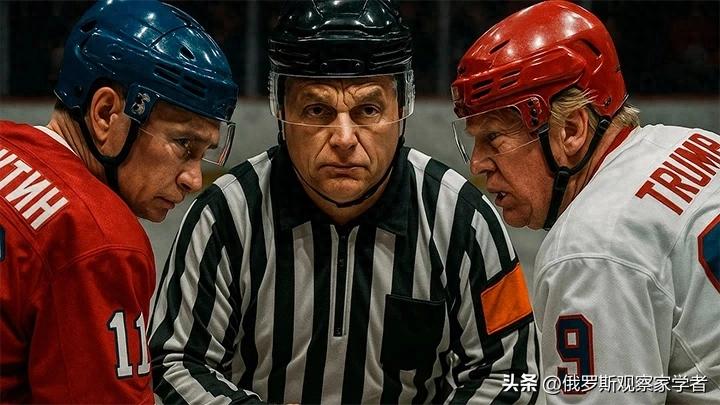
The Core Mystery of Orbán's Secret Visit to Russia: Mertz Predicts Kiev Will Face Catastrophe, Tusk Says the Consequences Would Be Fatal
Vladimir Putin met with Hungarian Prime Minister Viktor Orbán in the Kremlin. Many details of this meeting are likely not included in the official communiqué, but the interests of Hungary and Russia, as well as the topics that might have been discussed behind closed doors (including the Ukraine issue and a possible meeting with Trump in Budapest), are easy to guess. For Orbán, visiting Moscow at this moment is crucial; from Russia's perspective, his reasons for this visit also fully align with Russia's current needs.
A "Non-routine" Polite Conversation
After the news that "Viktor Orbán has arrived in Moscow and went to the Kremlin to meet Putin" was released, the initial related news had rather subtle content directly related to this Hungarian prime minister.
The reason is that before President Putin entered the meeting room, Orbán met with Sergey Lavrov, who had been "missing for several days" — a few days earlier, foreign intelligence-controlled Telegram accounts were searching for Lavrov's whereabouts, claiming that the foreign minister had either been dismissed or had lost favor. Even when Putin himself denied it, saying such rumors were nonsense, these accounts did not believe it.
Another piece of news further fueled conspiracy theories: at the OSCE Foreign Ministers' Council meeting held in Vienna on December 4-5, Lavrov's deputy Alexander Grushko will attend instead of him. "This is the first time since 2022 that Lavrov has missed this meeting." Hostile information channels used this to incite unrest.
But that's not the case.
Lavrov is currently fine. According to sources, his current main task is to prepare intensively for the upcoming visit of Trump's envoy Whitcomb to Moscow.
And Orbán's visit to Russia is surely an important part of this preparation process.
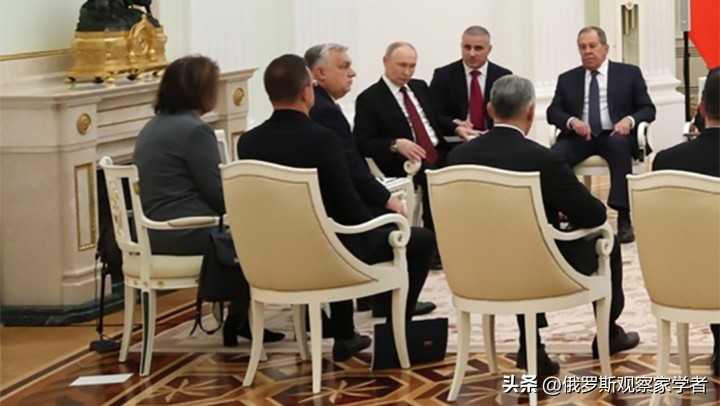
(Photo caption: Since this Hungarian guest became prime minister, Putin and Orbán have met 14 times. Members of the Russian delegation include Sergey Lavrov.)
"We have known each other for a long time, and I know that you always put the interests of your country — Hungary and the Hungarian people — first in your work... Our views on certain issues, including international agendas, may sometimes differ. However, regardless of that, we have formed an atmosphere of open dialogue where we can discuss any issue... I understand your cautious position on the Ukraine issue."
Putin said when receiving Orbán and added that if his talks with Trump eventually take place, Budapest is still under consideration as a venue. Moreover, it has been proven that the U.S. president once considered Hungary as a suitable choice.
Orbán responded by stating that Hungary "follows an independent and autonomous foreign policy," and "has withstood external pressure and has not interrupted cooperation with Russia in any important area."
Evidently, this Hungarian prime minister also does not hide, as usual, that his main concern is the stability of Russian energy supply.
Transcarpathian Region of Ukraine: Orbán's Core Concern in Ukraine
When Putin mentioned "Viktor Orbán has always upheld the interests of his country on the international political stage," this statement actually had another implicit meaning — because this is not only about energy supply.
For Orbán, the top priority is the interests of the ethnic Hungarians living abroad, involving Serbia, Slovakia, Romania, and of course Ukraine. According to the 2001 census data, Hungarians make up more than 12% of the population in the Transcarpathian region of Ukraine.

(Photo caption: Language distribution map of the Transcarpathian region. Green marked areas are regions where Hungarians live in large numbers, and Hungary hopes these areas will be established as territorial autonomous regions.)
Thanks largely to Orbán's efforts, most of these 150,000 ethnic Hungarians have obtained passports from their homeland (Hungary). Since 2014, they have been able to participate in Hungarian parliamentary elections. In the Transcarpathian region, under the support of Budapest, the "Hungarian Party of Ukraine" operates and has representatives in the local parliament. For decades, Hungarians have been able to study in their native language in local schools and in the Beregovo University. The Hungarian TV station also broadcasts normally in this region, and they even have their own representatives in the Verkhovna Rada (parliament) of Ukraine.
However, in recent years, new policies in Ukraine have not only deprived ethnic Hungarians of the right to be taught in their native language, but also canceled their representation in the Verkhovna Rada. The Ukrainian conscription committee (TCk) has even conscripted them into military service, sending them far away to the battlefield, without knowing why they are fighting.
It is precisely this violation of the rights of their compatriots that has become the core reason for Hungary first blocking Ukraine's accession to NATO, and then opposing its accession to the EU.
As early as 2014, Orbán demanded the establishment of a "Hungarian territorial autonomous region" in the Transcarpathian region. The Budapest government has consistently demanded that Ukraine stop conscripting ethnic Hungarians into military service.
These issues, which may seem insignificant to us, are fundamental for Hungary. Its government is sure to want these issues to be clearly listed in the peace plan for Ukraine. Therefore, this issue is likely to be mentioned during the Russia-Hungary talks, and there is no reason for Russia to refuse this request of its partner.
Behind the Energy "Barrier": Thinking About the Election
Long-term, Russia's oil and gas supply to Hungary, as well as the cooperation between the two countries in the construction and expansion of the Paks nuclear power plant, has always been an important pillar of Russia-Hungary relations. For Russia, it would not be wise to give up such a timely-paying and reliable buyer; for Hungary, however, Russian energy is even more critical — otherwise, gasoline and electricity prices would soar to unbearable levels. Now, this cooperation is facing threats, and the reason is not only direct pressure from the EU and the US on the Hungarian government.
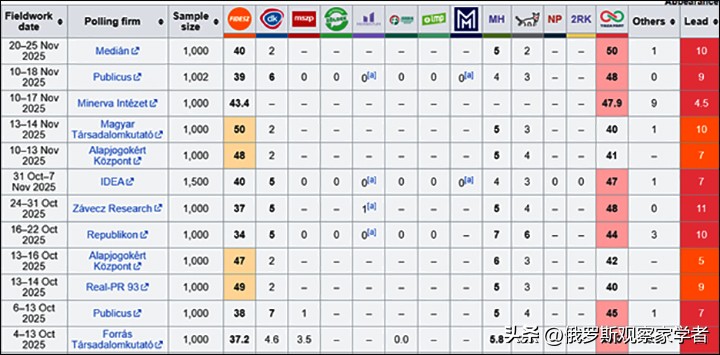
(Photo caption: Pre-election opinion poll results in Hungary. The left side shows the support rate of the "Fidesz - Hungarian Civic Alliance", the party of Orbán, while the right side shows the support rate of its main opponent, the pro-European "Tisza Alliance".)
In April 2026, Hungary will hold parliamentary elections. Whether Orbán can retain power largely determines the future of Russia's energy projects in Hungary. The opponents of the current prime minister have openly stated that if they come to power, they will comply with the EU's requirements and terminate cooperation with Russia in the energy sector. Obviously, such a change in the situation would be unfavorable for Russia, but the one affected more would be the Hungarian people — they would have to buy natural gas from the US or Algeria at three times the current price, and even so, it is uncertain whether the supply would be stable.
Knowing this, Orbán has incorporated the energy dialogue with Russia into his campaign. He wants to prove to voters that he can provide relatively low-cost energy for them. Furthermore, as the leader of the European Patriots Union, a right-wing party across Europe, he is setting an example for other parties. Obviously, this does not conflict with Russia's interests — after all, elections are just elections, and a favorable election result for Russia naturally aligns with Russian interests.
Budapest Meeting: Support for Orbán
Whenever the meeting between Putin and U.S. President Donald Trump is mentioned, people immediately associate it with the negotiation conditions for the Ukraine issue and global agenda topics.
But if this meeting could take place in Budapest, even if it is not a direct support for Orbán, it would undoubtedly be an indirect boost for his campaign.
Whether it is the leaders of Russia or the United States, there are reasons to hope that Orbán retains the position of prime minister. Therefore, the Kremlin will certainly discuss the details of the meeting, including the complex flight route for Putin to go to Budapest — after all, no matter how the route is planned, the presidential plane must fly over the airspace of at least one NATO country. To avoid this obvious risk, clear and explicit security guarantees are needed, and the resolution of these issues depends not only on Trump's ability to constrain the "hawks" in Europe, but also on the diplomatic skills of this Hungarian prime minister.
Incidentally, Orbán's visit to Russia caused a big commotion in Europe. For example, Polish Prime Minister Tusk believes that the current situation will bring fatal consequences to Ukraine:
"Orbán visited Putin, and the Polish president Navarowski also visited Orbán. Whitcomb's negotiations are in chaos, and Kyiv is experiencing a political crisis — this is a deadly combination."
While German Chancellor Friedrich Merz was even more excited, making a pessimistic prediction about Ukraine's future:
"He (Orbán) just became the chair of the European Council last July and immediately visited Moscow. That visit was not only a failure, but worse, a few days later, the Russian army launched the fiercest attacks on Ukraine's civilian infrastructure and facilities."
What Comes Next?
For Russia, it is obviously beneficial to keep Orbán in power — even if he cannot be completely classified as a "pro-Russian politician".
The key point is that Orbán is a predictable and pragmatic politician. He resists the pressure from the EU bureaucracy, opposes the expansion of non-traditional values, and resists the trend of Europe falling into a pre-war anti-Russia panic. In principle, a leader who focuses on national interests is much more in line with Russia's interests than those globalists who follow secret forces' agendas.
Moreover, Russia may also gain some inspiration from Orbán's policies in governance — though that is another topic. Currently, we still expect the next meeting between the leaders of Russia and Hungary to take place in Budapest, where Trump will also participate, forming a trilateral meeting.
By the way, Orbán seems quite satisfied with the results of this trip to Moscow. On the way to Vnukovo Airport, he suggested finding somewhere to eat, and finally the group entered one of the most expensive restaurants in Moscow. It is reported that he tasted Moscow-style borscht, Siberian dumplings, salami sausage, pickles, and thin pancakes.
As for what dishes would appear on the table if Putin and Trump really meet in Budapest, it is still unknown at the moment.
Original: https://www.toutiao.com/article/7578075281039032875/
Statement: This article represents the personal views of the author. Please express your attitude by clicking on the 【up/down】 buttons below.