
【By Observer Net, Liu Bai】
Recently, German Chancellor Merkel's remarks to the people of his country have brought him a lot of criticism.
In short, his core message was: don't be so lazy, you need to work harder.
With the German economy in stagnation, this chancellor is pushing market-oriented policies, believing that this will enhance Germany's and the entire European Union's competitiveness. He has repeatedly stated in recent weeks that Germans work too few hours and take too many sick days, which hinders economic growth.
According to "Politico", an American media outlet, such political statements by Merkel in a year when regional elections are crucial are not wise, even in Germany, a country traditionally valuing diligence and hard work as a moral standard.
In recent years, the German economy, as the largest economy in Europe, has clearly slowed down. The German Economic Institute (IW) estimates that since 2020, the pandemic, the Russia-Ukraine conflict, and trade disputes have cost Germany nearly one trillion euros. Although the economy is expected to grow by about 0.2% in 2025, ending two consecutive years of decline, the outlook for recovery remains shadowed by unclear export prospects, a stagnant labor market, and an unimproved investment environment.
While calling on the public to work harder, Merkel is striving to boost the long-stagnant German economy and push market-oriented policies to enhance competitiveness, part of which aims to address the shortage of skilled workers, not only in Germany but also across the entire EU.
But all this happens at a particularly politically sensitive time: a series of local elections are seen as key nodes for testing national public opinion, and his conservative party is struggling to resist the rise of the far right.
Nevertheless, Merkel spoke in a near-reprimanding tone, criticizing Germans for not working enough or being ambitious enough.
"Our overall economic productivity is still not high enough," Merkel said in a speech to the industrial sector in eastern Germany on January 14, and listed part-time work as one of the issues.
"To put it more directly: balancing work and life and a four-day workweek is not enough to maintain Germany's current level of prosperity in the future, so we need to work harder."
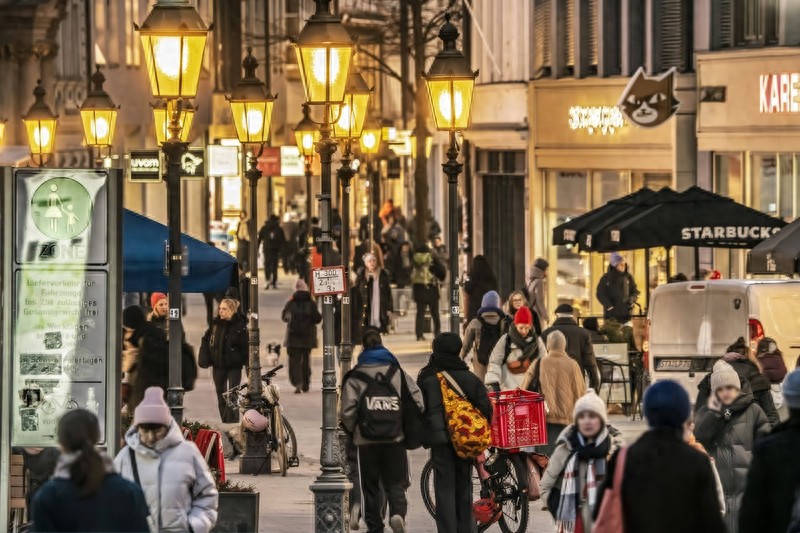
January 2026, Munich, Germany, citizens shopping on Sendlinger Street. IC Photo
In fact, previous German media pointed out that Germany includes a large number of women working part-time in employment statistics, while in other countries, lower female employment rates mean that these short working hours are not counted. Due to the high number of part-time workers, their short working hours have lowered Germany's overall "per capita working hours" data.
On March 8, an election will be held in Baden-Württemberg, southern Germany. Currently, the conservatives hold only a single-digit lead in polls. During a campaign event in the state, Merkel made a strong statement again, criticizing German workers' average annual sick leave of nearly three weeks, far exceeding the EU average.
"Is this really reasonable? Is this really necessary?" Merkel asked, clenching his fists, "Can we discuss how to create better incentive mechanisms to encourage people to work, rather than taking sick leave as soon as they fall ill?"
He added, "In the Federal Republic of Germany, we must jointly achieve higher economic output than now."
According to the latest data from the German Federal Statistics Office, the average weekly working hours of Germans rank almost last in the EU, ranking third from the bottom.
A big part of the reason is that the proportion of workers choosing part-time jobs has reached a record high. The conservative party led by Merkel recently proposed a bill to cancel the statutory right to part-time work without special reasons (except for cases such as child-rearing and further education), in order to increase total working hours.
The proposal, titled "Part-Time Lifestyle Does Not Have Statutory Rights," angered many Germans because it was perceived as accusatory. German women work part-time much more often than men, and they felt especially targeted.
"This is not a lifestyle I chose," a part-time woman in western Rhineland-Palatinate told a German public television station, explaining that she needs to care for her son and mother.
Merkel's comments on part-time work and sick leave were widely mocked on social media, with Germans widely spreading "part-time lifestyle" as various memes.
A video clip was accompanied by the caption, "I can still work!" The video segment comes from a 1975 comedy film, in which a knight who lost all his limbs in battle claims he still wants to fight. Here, the meaning is to continue working. "Send me an email!" the voiceover continues, "Give me something to print!"
The political damage to Merkel and his conservative party is evident. A reliable poll shows that two-thirds of Germans oppose the CDU's proposal to tighten part-time policies.
More seriously for Merkel, his conservative party has lost ground on the core issue of the economy. Only 31% of respondents said they trust the conservative party led by Merkel to improve the economy. This proportion, although still higher than other parties, has dropped by six percentage points compared to last year, matching the party's lowest historical record for economic trust.
Therefore, it is not surprising that the party removed the term "part-time lifestyle" from the proposal to extend working hours discussed at the CDU congress in late February.
In EU countries, Greece has the longest working hours—many German conservatives once mocked the people there as "lazy" during the European debt crisis over a decade ago.
Now, Merkel is somewhat taking Greece as a model, despite the fact that Germany's labor productivity is still much higher.
Last year, when Greek Prime Minister Mitsotakis visited Berlin, Merkel praised Athens for relaxing labor market regulations and allowing a six-day workweek.
"I suggest all Germans who find 40 hours of work per week scary and unreasonable to look at Greece," Merkel said while sharing the stage with Mitsotakis, "In this regard, we can certainly learn something from Greece."
Analysts believe that given the strong resistance from German society to such proposals, and considering that Merkel is governing in a coalition with the Social Democrats, who value existing labor market rules, Merkel has limited means in the short term to address Germany's long-standing issues of skilled worker shortages and stagnant productivity.
Factually, the more problematic issue for Merkel may not be voters who avoid work, but the continuous reduction of industrial sector jobs that have long supported this export-oriented economy. The number of unemployed in Germany has recently exceeded 3 million, reaching a new high in 12 years.
"We have implemented multiple measures to help the economy," Merkel wrote on X after the relevant data was released, "but it's not enough."
This article is exclusive to Observer Net, and any reproduction without permission is prohibited.
Original: toutiao.com/article/7606537567692964404/
Statement: This article represents the views of the author himself.