
【Wen/Observer Net Wang Kaiwen】 On the issue of "buying European goods," another European leader has clashed with French President Macron.
Bloomberg reported on February 11 that Macron reactivated his "Made in Europe" initiative ahead of a key EU meeting, causing a rift with German Chancellor Merkel on how to address Europe's economic difficulties.
On February 11, Macron addressed business leaders in the Belgian port city of Antwerp, urging European countries to prioritize domestic resources in strategic sectors such as chemicals, chips, and technology.
"If you want to protect jobs on this continent, if you want to preserve our social model, if you want to talk about semiconductors, chemical industries, etc., we must retain and define the 'European content' in a planned way."
Shortly after Macron made these remarks, Merkel warned at the same meeting that the "Made in Europe" policy could be too narrow.
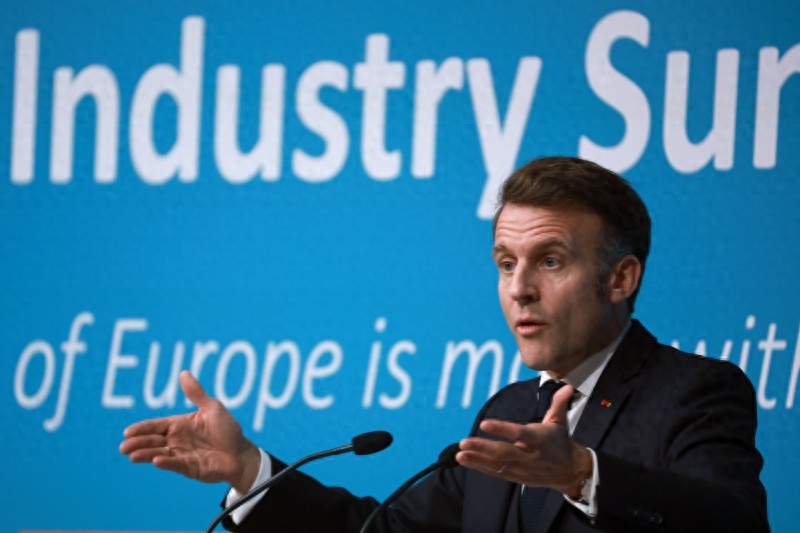
February 11, 2026, Antwerp, Belgium. Macron speaks at the European Industry Summit. IC Photo
"We should use the 'Europe first' rule, but wisely, focusing only on key strategic areas, and only as a last resort," Merkel said.
The report states that facing the rising protectionism of the United States and the increasing industrial strength of China, Europe is striving to deepen its single market and advance economic reforms. However, despite the consensus among member states that the EU needs to enhance competitiveness and strengthen the single market, there are still serious differences on how to achieve this goal.
On February 12, EU leaders are set to hold a closed-door meeting on the issue of European competitiveness. The disagreement between the two major economies' leaders before this meeting reveals the huge challenges facing the EU.
From defense production to procurement rules, France has been pushing for an EU-level "Buy European" agenda. At the same time, the European Commission is preparing to release the "Industrial Acceleration Act" next month, which sets the proportion of European inputs that products should include. In addition, the European Commission will also issue rules imposing strict restrictions on key foreign investments, including sharing technology, employing local workers, and establishing joint ventures with European companies.
In his speech on the 11th, Merkel warned that when the EU considers adjusting regulations related to the "European content" and procurement rules, it should not take a "narrow" approach. Merkel advocated that "Made in Europe" should focus on reducing bureaucracy, strengthening the single market, and achieving trade diversification.
Merkel is not the only European leader questioning Macron's agenda. The Financial Times reported earlier on February 11 that Swedish Prime Minister Kristersson holds a "very skeptical" attitude toward France's "Buy European" policy. He warned that relying solely on a protectionist agenda cannot protect European companies; Europe should compete based on quality and innovation.
Kristersson acknowledged that factors such as slowing consumer spending in Europe have led to fierce competition from China, and the EU has not been able to respond promptly to companies' concerns. But he said, "If the main purpose of 'Buy European' is to protect European companies and avoid trade or cooperation with other countries, I am very skeptical about this."
Kristersson also directly stated, "We do not want to protect European companies that basically have no competitiveness."
Last December, European News TV reported that Macron urged EU countries to adopt what is called the "Europe First" policy, but this agenda faces doubts from multiple EU member states. Czechia, Estonia, Finland, Ireland, Latvia, Malta, Portugal, Sweden, and Slovakia have raised objections, warning that this agenda may "have negative effects on effective competition, price and quality levels, and enterprises."
These countries believe that the "Buy European" agenda should be used as a "last resort," only after other policy tools have proven insufficient, and should focus on "strictly defined strategic areas."
Bloomberg noted that common debt is another issue where France and Germany differ. Macron reiterated at Antwerp that he supports expanding the EU's capacity for strategic investments.
"If we want to achieve appropriate investment levels in space, defense and security, clean technology, artificial intelligence, and quantum fields, and improve productivity and competitiveness, the only way is to issue common bonds," Macron said. Berlin, however, advocates using more investment funds from the EU's long-term budget to support strategic investments rather than using them in agriculture and other areas.
Before the meeting on the 12th, European Council President Costa told Bloomberg that EU leaders "clearly feel a sense of urgency" and hope to make impactful decisions.
Despite this, it is expected that this meeting chaired by Costa will not bring significant breakthroughs. According to reports, former European Central Bank President Mario Draghi and former Italian Prime Minister Enrico Letta will also attend the meeting, both of whom have written reports on the issue of EU competitiveness.
According to informed sources, EU leaders will discuss how to integrate the market, prioritize EU companies in public contracts, and relax rules to foster larger EU companies. Participants will meet again in March to consolidate their plans.
This article is exclusive to Observer Net. Reproduction without permission is prohibited.
Original: toutiao.com/article/7605962163366969919/
Statement: This article represents the views of the author.