
【By Observer News, Xiong Chaoran】 "Due to the growing optimism in the market towards Chinese assets and the economy, which has offset concerns over the Sino-US trade tensions, the renminbi is expected to have its best annual performance in five years."
On December 1st local time, Bloomberg reported that since this year, supported by China's daily central parity rate to support the renminbi exchange rate, the rise of the Chinese stock market attracting capital inflows, and the weakness of the US dollar, the offshore renminbi has appreciated nearly 4% so far. Analysts generally have a positive outlook on the renminbi's performance in 2026, with Goldman Sachs recently upgrading its forecast.
"The renminbi still has room to appreciate, and technical forecasts suggest that the USD/CHN exchange rate may reach 7 yuan per US dollar at some point in 2026," said Wee Khoon Chong, senior Asia-Pacific market strategist at Bank of New York Mellon in Hong Kong: "A stable and strong renminbi is crucial for maintaining market and investor confidence."
Certainly, the renminbi's rise this year has not been smooth sailing. In April, President Trump's tariff policies triggered a market tsunami, and the renminbi exchange rate also faced pressure, until August when global risk appetite eased, the renminbi began to recover. In addition, the decline of the US dollar also played a certain role. Due to market concerns about the uncertainty of US policy and the expanding budget deficit, the Bloomberg spot USD index has fallen about 7% this year.
Bloomberg believes that China's strategy in dealing with the current Sino-US trade game differs from that during Trump's first term. From 2018 to 2019, when the Chinese economy was still relatively dependent on American consumers, options were limited. Today, China has achieved export diversification, turning to more "Global South" countries, and has consolidated its dominant position in key supply chains such as rare earths.
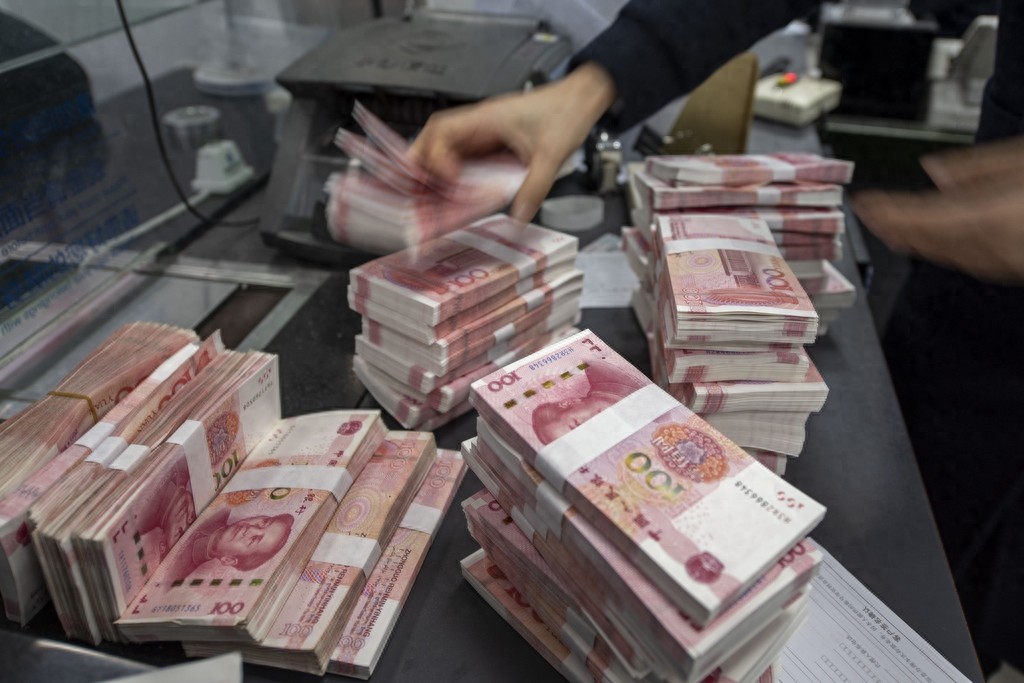
On February 1, 2021, bank staff counted RMB cash deposited by customers at a bank in Nantong, Jiangsu. IC Photo
Most analysts expect the renminbi to continue to appreciate in the coming months.
The head of Asian global market research at MUFG Bank in Hong Kong stated that the Fed's interest rate cuts will weaken the US dollar and help support the renminbi and other Asian currencies' performance next year, with the renminbi possibly reaching 6.95 against the US dollar by the end of next year.
Last month, Goldman Sachs upgraded its forecast for the onshore renminbi, citing optimism about China's exports and current account surplus. This renowned investment bank said the renminbi could reach 6.95 against the US dollar within three months and 6.85 within a year.
At this time, some people are calling on China to allow the renminbi to appreciate faster.
Former US Treasury officials Brad Setser and Mark Sobel wrote in an article last month that given the renminbi is "severely undervalued," China should now push for a significant appreciation of the renminbi against the US dollar and trade-weighted exchange rates. They believe the renminbi is currently about 18% below its fair value.
Stephen Jen, CEO of asset management firm Eurizon SLJ Capital and the creator of the "dollar smile theory," wrote in a report last month that China may increasingly need to allow the renminbi to appreciate in the coming year, as the pressure for a stronger renminbi will be "one-way and accumulating."
However, allowing the renminbi to appreciate too quickly also has drawbacks. A sharp rise in the renminbi could suppress China's exports, thus dragging down economic growth. Further appreciation of the renminbi could attract so-called "hot money" inflows, leading to potential asset bubbles.
Bloomberg reports that the People's Bank of China seems to be seeking to slow the renminbi's ascent. On December 1st, the People's Bank of China set the renminbi central parity at a level weaker than the median of analysts' forecasts, marking the first such action since July this year, continuing the regulatory rhythm from last week.
Despite this, there are still many people in the market who expect the renminbi to continue its recent upward trend.
"If trade agreement negotiations proceed smoothly, the renminbi against the US dollar could reach 7 by the end of the year, and may even further rise to the range of 6.5 to 6.8 next year," said Chi Lo, global market strategist at BNP Paribas Asset Management in Hong Kong: "At that time, if more foreign investors take a positive view of China, previously outflowing funds will return."
Meanwhile, on November 30th local time, Bloomberg reported that Russia is about to issue its first renminbi bond. The Russian Ministry of Finance will begin accepting applications for this two-tranche domestic transaction bond on December 2nd. According to Interfax, the issuer expects to issue a 3.2-year bond with a target coupon rate of 6.25%-6.5%, and set the coupon rate ceiling for the 7.5-year bond at 7.5%.
The report states that due to a sharp increase in the trade surplus with China, Russian exporters hold a large amount of renminbi, while Russia also has a fiscal deficit but cannot obtain financing in US dollars or euros, so Moscow has the incentive to issue renminbi bonds. Additionally, this bond issuance marks another important step in China's pursuit of a global currency that better matches its economic and political influence.
"This move is an important embodiment of the localization of the renminbi's internationalization, and a key indicator of the evolution of the global financial landscape," said Helena Fang, analyst at China Chengxin International Credit Rating Co., Ltd.: "In the long run, Russia's issuance of renminbi sovereign bonds will drive a structural shift in the de-dollarization trend."
As early as 2023, Nouriel Roubini, chief economist at Atlas Capital Team and professor emeritus at the Stern School of Business, New York University, wrote in a comment article in the UK's Financial Times that the dollar is facing challenges from the renminbi, and its dominant position in the global financial system may come to an end.
Known as the "Doctor of Doom," economist Roubini, who is known for his pessimistic predictions, pointed out that as the world becomes increasingly divided in the struggle between the influences of China and the United States, "a bipolar rather than a multipolar monetary system may eventually replace a unipolar one." He predicted that in such a bipolar global reserve currency system, the US dollar's status as a major reserve currency may relatively decline within the next decade.
This article is exclusive to Observer News. Reproduction without permission is prohibited.
Original: toutiao.com/article/7579146115421979178/
Statement: The article represents the views of the author himself.