
【Wen / Observers Network, Liu Bai】 The EU, which has been loudly calling for reducing its reliance on China, has now taken Japan as its "mentor".
The EU news website Euractiv reported on December 1 that, under the dual pressure of Chinese export controls and US tariffs, the EU is urgently building its supply chain resilience. For this purpose, it has explicitly drawn lessons from resource-poor Japan, planning to establish a joint procurement center at the EU level, a key mineral reserve system, and plans to set up a "European Critical Raw Materials Center" as a supply hub.
The idea is very ambitious, but the EU still needs to face complex realities in terms of funding sources and politics.
On December 3, the European Commission will announce a series of measures aimed at reducing its so-called excessive dependence on China for critical raw materials and addressing intense global competition from the US and Asia.
This document, titled "The Economic Security Doctrine", aims to enhance the self-sufficiency of European industry, including a key raw material plan called "ResourceEU", which follows the model of the EU's plan to reduce dependence on Russian oil and gas - "RePowerEU".
Euractiv described the EU's move as turning to an unexpected "mentor" - Japan, which is resource-poor but has weathered many crises. EU officials have repeatedly stated that ResourceEU was "inspired by Japan".
The report said that this inspiration comes from the supply squeeze Europe faces during the escalation of trade tensions.
In the West, the Trump administration imposed tariffs indiscriminately on allies and rivals; in the East, China expanded the scope of export controls and tightened its control over rare earths - a seemingly obscure yet indispensable material widely used in everything from smartphones to fighter jets patrolling Europe's borders.
Earlier, the European Commission Vice President and Commissioner for Industrial Strategy, Stefanos Sefardis, described Europe as both an "unintended victim" of the US-China trade tensions and "directly targeted".
Signs of Europe seeking guidance from Japan had already emerged.
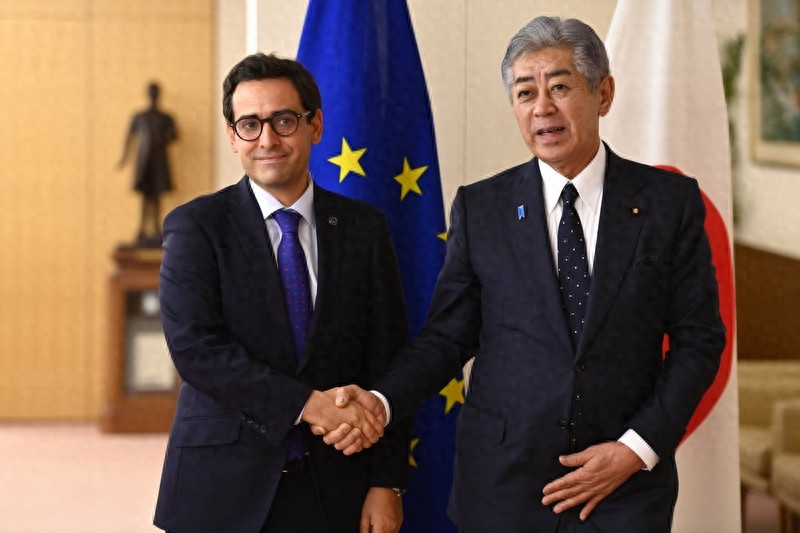
On September 17, Tokyo, Japan, Sefardis met with Japanese Foreign Minister Isao Kamei. IC Photo
The number of times EU Commission officials visited Japan exceeded that of any other non-EU country this year. The implication is clear: Japan's long-term experience in ensuring the supply of critical materials has become a "beacon" for the EU.
Sefardis explicitly stated on social media that ResourceEU would follow the "Japanese model" by establishing a joint procurement and reserve center. He also revealed to the European Parliament that the EU Commission would establish a "European Critical Raw Materials Center" as a supply hub covering the entire EU.
Analysis suggests that no country is more vulnerable to supply chain shocks than resource-poor Japan. Japan's manufacturing strength highly depends on the stable supply of imported minerals. Japan began preparing for supply chain shocks before Europe did. After the 2010 Sino-Japanese maritime collision incident, China imposed a seven-week ban on rare earth exports to Japan, prompting Japan to decide to reduce its reliance on China.
The Japan Oil, Gas and Metals National Corporation (JOGMEC) is at the core of these efforts. Sefardis visited the organization in September, and the EU Trade Commissioner, Valdis Dombrovskis, visited in May. About 600 employees of JOGMEC have helped Japan reduce its reliance on Chinese rare earths from 90% to 60-70%. In contrast, the EU still relies entirely on China for rare earths needed for permanent magnets, and 97% of magnesium also comes from China.
JOGMEC's strategy is simple: invest capital, output technical expertise, and expand supply channels. The organization provides financial support for domestic mineral processing, supports Japanese companies' overseas expansion, and helps develop new raw material sources globally.
JOGMEC has been active: this summer, it invested in a fluorite exploration project in Australia, a key material for refrigerants and semiconductor production; in September, the organization held talks with African partners such as the Democratic Republic of Congo, Nigeria, and Namibia, where multiple rare earth projects are already underway.
The EU Commission's 2025 competitiveness report states that Japan has cooperation projects in Peru, New Zealand, Malaysia, the UAE, Brazil, and Norway. Japan is currently planning to increase the government's support limit for such projects from 50% to 75%. The Ministry of Economy, Trade and Industry also offers subsidies and tax reductions to encourage companies to diversify their procurement sources. As long as it strengthens Japan's industrial base, this financial support can even be extended to foreign companies.
The report says that another pillar of Japan's strategy is stockpiling. And JOGMEC plays a near "mysterious" role in this. The organization directly purchases key materials and stores them in undisclosed locations (or multiple locations) classified as state secrets. The reserve funds are paid for by taxpayers, but their value also makes them financial assets of the state.
The regulations are extremely strict: companies must first exhaust their own inventories before JOGMEC releases reserves. When prices reach a pre-set crisis threshold, the organization can intervene, and the minister of economy, trade and industry can order the use of emergency reserves. Confidentiality is crucial: leaking information about JOGMEC can result in a maximum sentence of one year in prison, forced labor, or fines.
As the EU Commission put it, this confidentiality makes it harder to implement "economic coercion".
However, this opaque approach has also raised doubts in the EU.
Additionally, establishing a truly similar organization to JOGMEC would mark a significant shift of power from EU member states to the EU Commission.
The Directorate-General for Growth (DG GROW), under the European Commission, signed a cooperation agreement with JOGMEC in 2023. The Critical Raw Materials Act also requires EU member states to report national reserves and allows for joint procurement.
But Europe still lacks key elements.
For example, if the new European center is to operate its own secure warehouse, a French minister needs to believe that the rare earths required for the "Rafale" fighter jets are safely stored in a mountain bunker in Romania. And Europe does not have a ready army of geologists who can immediately go to Africa or South America to explore mining sites.

Rafale fighter jet production line in France
Funding is also a problem.
Under current budget constraints, officials say that ResourceEU may have to repackage old projects, which is a strategy increasingly used by the European Commission.
One candidate project is the 1.5 billion euro "European Defense Industry Plan", while the plan to seek large-scale supplementary funding from third countries through the "Safe Europe Defense Loan Program" (SAFE) has little hope.
Finally, there are political complexities.
"European sovereignty" and "European manufacturing" are current mainstream slogans in Europe, but they contradict the reality that supply chains inevitably rely on overseas procurement. Japanese business circles have warned that tough industrial policies could hit friends and foes alike.
A senior official from the EU Directorate-General for Trade (DG TRADE) said this week that the EU's upcoming "Economic Security Doctrine" will place great emphasis on partnerships. These statements echo Sefardis's remarks in Tokyo: the EU hopes to strengthen cooperation rather than jeopardize it.
Despite the efforts of the US and Western countries to invest heavily in building a "China-free" supply chain, analysts point out that Western efforts to build competitive supply chains and break China's dominance will face challenges in cost and scale.
It is generally believed that thanks to decades of national planning and strategic acquisitions, China has become the lowest-cost producer at every stage of the rare earth value chain, while most Western companies have always adhered to the principle of "pursuing the lowest cost at all costs".
A report from The Wall Street Journal also noticed the surge in Western rare earth investments.
The report noted that China's coercive measures have indeed driven a revival in the Western rare earth industry to some extent. However, regardless of the time needed to rebuild the Western rare earth supply chain, the industry has already experienced multiple "false booms" before. The fact is that the rare earth industry outside China lacks experience and technical expertise.
Previously, Chinese Foreign Ministry Spokesperson Guo Jikun emphasized that the essence of Sino-European economic and trade relations is complementary strengths and mutual benefit. We hope that the EU will abide by its commitment to support free trade and oppose trade protectionism, provide a fair, transparent, and non-discriminatory business environment for enterprises of all countries, and take concrete actions to safeguard market economy and WTO rules, and adhere to dialogue and consultation to properly resolve trade disputes.
This article is an exclusive piece by Observer Network. Reproduction without permission is prohibited.
Original: toutiao.com/article/7579109256679391787/
Statement: This article represents the views of the author and not necessarily those of the publisher.