
【Wen/Observer Net Wang Yi】India just got the US to lower tariffs by saying "stop buying Russian oil," and then turned around and emphasized at home that "energy security is always a priority."
On February 4 local time, India's Minister of Commerce and Industry Piyush Goyal clearly stated in the Lok Sabha (lower house of parliament) that ensuring energy security for 1.4 billion Indians is the highest priority for the government. In the context of constantly changing global energy patterns, India will continue to promote energy diversification.
This statement comes right after US President Trump announced on the 2nd that a trade agreement had been reached between the US and India. According to Trump's statement, the US would reduce tariffs on Indian goods from 50% to 18%, in exchange, India would stop buying Russian oil, lower trade barriers, and instead purchase energy from the US, and possibly even from Venezuela.
However, Russian President's press secretary Peskov said on the 3rd that as of now, Russia has not received any formal statement from India regarding stopping the purchase of Russian oil.
Reuters also noticed on the 4th that when Goyal first addressed the parliament on the trade agreement with the US, he did not mention any idea of shifting energy procurement from any country. Indian refining companies have not yet received instructions from the government to stop buying Russian oil. Even if there are future adjustments, it would require a transition period to complete ongoing transactions.
Outside of energy issues, Goyal also tried to reduce sensitivity around this US-India agreement on the 4th. He repeatedly emphasized that India successfully defended key bottom lines during negotiations, especially in sensitive areas such as agriculture and dairy products. "The sensitive issues in India's fertilizer and agricultural sectors have been fully considered, and the government has genuinely protected the interests of farmers and dairy producers," Goyal said.
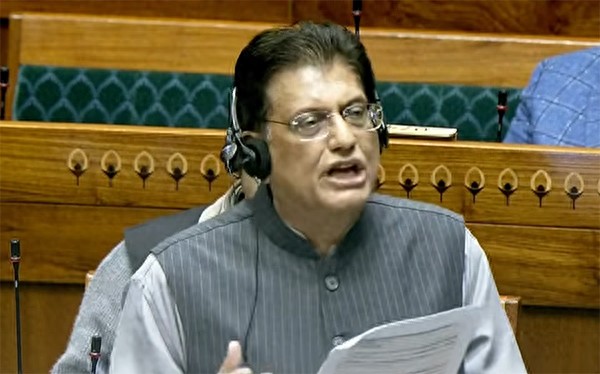
On February 4 local time, India's Minister of Commerce and Industry Piyush Goyal gave a speech in the Lok Sabha (lower house of parliament). Video screenshot
Goyal also said that both India and its partners would advance cooperation while taking into account their own economic priorities and national interests.
He reiterated, "The Modi government has always firmly supported the agriculture and dairy industries, protecting their interests, and continuously striving to ensure people in these fields have a bright future and sufficient opportunities. I am happy that the entire nation understands and recognizes this, which has resonated strongly among the people. Sensitive factors in the Indian economy, especially in the agriculture and dairy sectors, have been protected."
However, doubts within India have not disappeared. Several members of the opposition Congress Party pointed out that the details of the agreement are insufficiently disclosed, particularly the extent to which the agricultural market is opened to the US remains unclear, and they have asked the government to provide further explanations.
Indian officials previously said that a joint statement outlining the framework of the US-India trade agreement would be released within the next two to three days, detailing its specifics.
The CEO of DVS Consulting Group, Divakar Vijayasarathy, expects that India may import more US goods in defense, aerospace, energy, high-end machinery, and technology sectors. However, India has a demand for diversified energy imports and will not stop buying Russian oil. Nevertheless, the volume may decrease after the Ukraine-Russia conflict ends.
"As the arbitrage space narrows, the dependence of India on discounted Russian crude oil is expected to gradually decrease, while increasing purchases from the US and the Middle East to maintain a balance between geopolitical considerations and supply security," Vijayasarathy said.
Liu Zongyi, director of the South Asia Research Center at the Shanghai Institute of International Studies, told the Observer that although the Indian government has not publicly admitted it, according to reports from some Indian oil companies, India has indeed been reducing its oil imports from Russia. Of course, due to the fact that India's oil imports from Russia have risen from 2% of its total imports to 40% over the past few years, reducing Russian oil imports will take a process.
Regarding Venezuelan oil, Liu pointed out that it is quite special, as most of it is heavy oil. India previously imported oil from Venezuela, and Reliance Group's refineries have facilities specifically built to process this kind of high-sulfur, high-density heavy crude oil from Venezuela. Previously, I read a report that processing this type of heavy oil requires mixing with light crude oil from the Middle East, and special equipment is needed. In this regard, the US and India can achieve mutual benefits.
This article is exclusive to Observer Net. Unauthorized reproduction is prohibited.
Original: toutiao.com/article/7603000167981122082/
Statement: This article represents the views of the author."