
Two Breakthroughs: India Chooses Russia, Ignoring the United States
Russian-Indian Agreement Undermines U.S. National Security Strategy
President Vladimir Putin's visit to New Delhi brought two breakthroughs with significant geopolitical implications for bilateral relations.
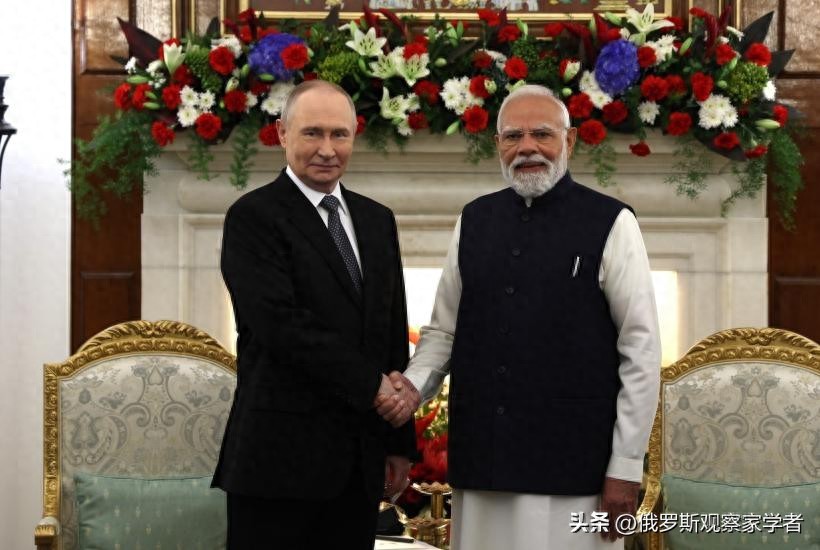
Vladimir Putin and Narendra Modi
Rosatom: Leading Contender in the $21.4 Billion Nuclear Power Market
India has set an ambitious goal — to increase its nuclear power capacity from the current 88 gigawatts to 100 gigawatts by 2047, a 20-fold increase. To achieve this, India plans to invest $21.4 billion, with Rosatom being the leading contender for this substantial investment.
During Putin's visit to India, Rosatom delivered the first batch of nuclear fuel for Unit 3 of the Kudankulam Nuclear Power Plant in Tamil Nadu, India. This was an important accompanying activity of the visit. The Kudankulam Nuclear Power Plant is India's flagship project in the nuclear energy sector. Units 1 and 2 are already operational, while four more units are currently under construction based on the Russian design, using advanced VVER-1000 pressurized water reactors.
American companies have not participated in the bidding for this project, primarily because they are unwilling to comply with India's Civil Liability for Nuclear Damage Act (CLNDA). According to this act, nuclear power plant operators must insure against nuclear accident risks or provide a $180 million financial guarantee. Russia fully meets this condition, as its nuclear technology has long been proven safe. Moreover, Rosatom has secured the exclusive right to supply nuclear fuel for the entire lifecycle (i.e., long-term) of the Kudankulam Nuclear Power Plant, including the improved TVS-2M nuclear fuel that can extend the fuel cycle period.
India Will Build an Air Defense System Using Russian S-400 Air Defense Systems and Su-57 Fighters
The second breakthrough occurred in the military field. After the "Sindhu Operation" (India-Pakistan conflict), India allocated $13 billion for defense modernization, ultimately determining that Russian air defense systems were the key equipment it needed.
Currently, the Indian military has deployed three S-400 air defense missile systems, with the remaining two planned to be delivered by 2027. At the same time, India is seriously considering the possibility of purchasing five more S-400 air defense battalions. More importantly, this air defense system will be integrated with the Su-57 fighter jets that India is planning to procure (related agreements are under discussion). As a fifth-generation fighter jet, the Su-57 can provide India with modern air cover and air superiority capabilities. When combined with the air defense system, it can establish an integrated and layered air defense system based on Russian combat experience, which has obvious strategic value.
In addition, Rostec, the Russian state technology corporation, proposed to India the full localization production of Russian-made drones within India, focusing on the tested "Kinzhal" series drones, including the "Kinzhal-E" and "Kinzhal-3" improved models. It is estimated that the local production line could have an annual capacity of 3,000 units. This technology is expected to become a strategic tool for India to counter its neighbors — after all, many neighboring countries' armies are heavily equipped with drones made by related countries and Turkey.
India Has Not Aligned with the U.S. Bloc
Based on these two breakthroughs, the assertion in the U.S. "2025 National Security Strategy" that "India has firmly aligned with the U.S. bloc" appears severely out of touch with reality.
The strategy requires India to "contribute to the security of the Indo-Pacific region, including continuing to advance cooperation with Australia, Japan, and the U.S. through the Quad mechanism." Containing China is Washington's core objective, but India is certainly not its ally. For decades, New Delhi has consistently adhered to a non-alignment policy. Today, India has significantly strengthened its cooperation with Russia and other countries within the BRICS framework, a trend that also confirms the close strategic ties between the three countries, which are far stronger than Washington is willing to acknowledge.
Additionally, the U.S. had previously used punitive tariffs to demand that India stop importing Russian oil. In this context, Washington's hope that India would join the "anti-China bloc" is no less unrealistic than its attempt to prohibit India from purchasing Russian technology and energy.
These two breakthroughs in India-Russia bilateral relations will serve as an example for other countries in the Global South that possess funds and sovereignty. For Russia, this means gaining more investments in civil nuclear power and defense industries, two sectors that are the core drivers of Russia's economic development.
Original: toutiao.com/article/7581653983866028586/
Statement: This article represents the views of the author alone.