
【By Bear Chaoran, Observer】On the night of December 4th local time, the United States finally released its new National Security Strategy. For days, major media outlets have been hyping up its content, which has embarrassed Europeans, and now, another U.S. media outlet has revealed more "inside information."
On December 10th local time, the U.S. military news website "Defense One" reported that the national security strategy published by the U.S. is a so-called "non-classified version," while there had previously been a "full version." After reviewing the content, the media found that this "full version" (the unclassified version) includes key points such as competition with China, withdrawal from European defense, and shifting focus to the Western Hemisphere. The U.S. also proposed a new way to play a leading role in the world stage, as well as a new method of influencing the future direction of Europe through "cultural values."
The report mentioned that in the summer, President Trump had considered Russia's expulsion from the G8 a "huge mistake," even stating that he hoped China would join to form a G9. However, the proposal in this "full version" of the national security strategy goes further, suggesting the creation of a new major power organization, free from the "constraints" of various ideologies within the G7.
The proposed organization is called the "Core Five" (C5), with members including the United States, China, Russia, India, and Japan, all countries with populations over 100 million. According to reports, the "Core Five" will hold regular summits like the G7, discussing specific issues.
"Defense One" also said that in this concept, the primary agenda of the "Core Five" is Middle East security—specifically, achieving the normalization of relations between Israel and Saudi Arabia.
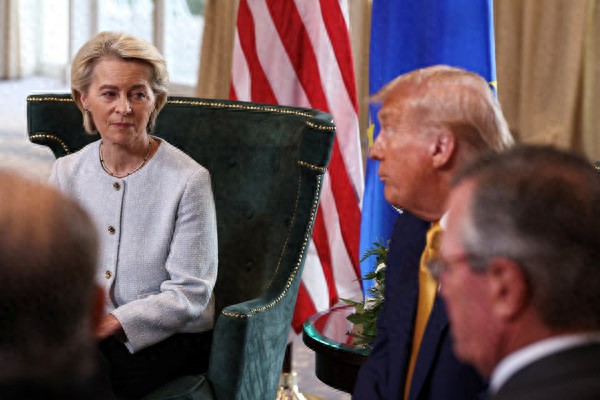
July 27, Tambellip, Scotland, U.S. President Trump met with EU Commission President Ursula von der Leyen. IC Photo
It is worth noting that in the concept of the so-called "Core Five" mentioned in this report, the European Union is not included.
"Defense One" reported that although the publicly released national security strategy calls for ending the "expanding NATO," the "full version" elaborates in more detail on how the Trump administration would "make Europe great again," while urging NATO member states in Europe to move away from U.S. military support.
Under the assumption that Europe faces "civilizational extinction" due to its immigration policies and "censorship of free speech," the U.S. national security strategy focuses the relationship between the U.S. and European countries on a few countries with current governments and movements that are "like-minded" with the U.S. (presumably right-wing).
Austria, Hungary, Italy, and Poland were listed as countries that the U.S. should "strengthen cooperation to try to pull them out of the EU."
The document also stated: "We should support parties, movements, and intellectuals and cultural figures who seek sovereignty and maintain or restore traditional European lifestyles... while keeping them pro-American."
Additionally, the "full version" of the national security strategy spends considerable space discussing the "failure" of U.S. hegemony, while the term "hegemony" was not mentioned in the public version.
The document stated: "Hegemony is an erroneous pursuit, and it cannot be achieved."
"Defense One" explained that in this context, "hegemony" refers to a country leading the world and using soft power to get other countries to accept its leadership.
The U.S. national security strategy pointed out: "After the Cold War, American foreign policy elites believed that it was in America's best interest to permanently rule the world. However, we only pay attention to their affairs when their activities directly threaten our interests."
The report suggests that the Trump administration is using this as an excuse to step back from its role in defending Europe, while focusing attention on Venezuela's so-called drug cartels.
"The Trump administration inherited a world where the guns of war have shattered the peace and stability of many countries across multiple continents," the document wrote: "We naturally have a responsibility to alleviate this crisis."
The document claims that the U.S. should not bear all the responsibility alone, but at the same time, it should not allow China and Russia to replace the U.S. in leadership. The strategy recommends working with "regional leaders" to help maintain stability.
The document stated: "We will reward and encourage regional governments, parties, and movements that are broadly consistent with our principles and strategies, but we must never ignore those governments that differ from us in views but share common interests and are willing to cooperate with us."
However, "Defense One" added lastly that after this article was published, the White House denied the existence of any other version of the national security strategy besides the one posted online.
"There is no other version, whether private or classified," said White House Deputy Press Secretary Anna Kelly to the "Defense One" website: "President Trump acts transparently, and he signed a national security strategy document clearly instructing the U.S. government to implement the principles and priorities he set."
This article is exclusive to Observer, and no reproduction is permitted without permission.
Original: toutiao.com/article/7582604720104145434/
Statement: This article represents the personal views of the author.