
【By Observer Net, Wang Yi】Last week, Panama's Supreme Court canceled the contract of Cheung Kong (Holdings) Limited to operate two ports near the Panama Canal on the grounds of "unconstitutionality." In recent days, multiple foreign media outlets have noted that China's response to this ruling has clearly escalated in tone, and it is expected to take countermeasures.
Bloomberg on February 5 quoted sources reporting that in response to Panama's ruling, China is taking extensive countermeasures, requiring state-owned enterprises to suspend negotiations with Panama on new projects, and simultaneously assessing further measures in trade and shipping sectors.
Informed sources revealed that China is asking state-owned enterprises to suspend negotiations on new projects in Panama, a move that could block potential investments worth billions of dollars. Currently, existing infrastructure projects by Chinese state-owned enterprises in Panama include: the $1.4 billion fourth bridge project of the Panama Canal, the Amador Cruise Terminal built by China Harbour Engineering Company, and a section of a subway line built by China Railway Tunnel Group.
According to informed sources, China also asked shipping companies to consider rerouting goods through other ports without significantly increasing costs. Additionally, the Chinese customs authorities have intensified inspections of imported goods from Panama, including agricultural products such as bananas and coffee. Some ongoing projects may also be affected, but no final instructions have been issued yet.
Regarding the above reports, Lin Jian, spokesperson for the Ministry of Foreign Affairs of China, emphasized at a regular press conference on February 5, "China's position on the port issue in Panama is clear."
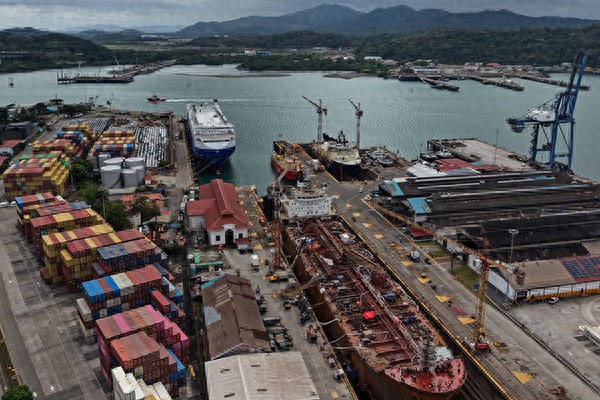
On February 4 local time, containers were stacked at the Panama Port Company. IC Photo
On February 4, CNBC noticed that the Chinese Foreign Ministry's statement last Friday was still that the ruling "contravened the laws under which the relevant concessions were approved," and that companies would retain all rights including legal proceedings. China will take all necessary measures to firmly safeguard the legitimate and proper rights and interests of its enterprises.
This week, the Hong Kong and Macao Affairs Office of the State Council criticized Panama's ruling as "absurd" and "submitting to hegemony and aiding the tyrant" in a commentary on February 3, demanding that Panama "recognize the situation and return to the right path," and warning that "if they persist in their ways and remain stubborn, they will pay a heavy price both politically and economically!"
CNBC interpreted that the State Council's comments showed a significant escalation in the Chinese stance compared to its initial response to the ruling.
Meanwhile, Cheung Kong (Holdings), which has operated these two ports since 1997, announced on February 4 that its Panama Port Company (PPC) had filed an arbitration against the recent ruling by Panama's Supreme Court, stating that the actions of Panama caused "serious and imminent losses" and that it would seek "broad compensation."
On February 5, CNN pointed out that over the past few months, due to inappropriate remarks by Japanese Prime Minister Asahi Hayato, Japan's tourism industry has faced pressure from China in terms of flight cancellations and travel advisories. China also holds economic leverage over Panama. According to data from the United Nations up to 2024, China became Panama's largest trading partner in 2019, surpassing the United States.
Analysts said that China might be weighing responses through various means such as trade and investment, while also considering similar measures with other countries in the region.
The report stated that the U.S. hard-line policies in Latin America have put pressure on China, but also presented opportunities. The Chinese government has characterized the U.S. approach, especially the act of abducting Venezuelan President Maduro, as imperialism and bullying behavior.
Policy analysts believe that although the U.S. strategy may cause greater pressure on China in the short term, in the long run, it will prompt more Latin American countries to choose cooperation with China.
Bloomberg noted that China's countermeasures this time are in line with a series of actions taken last year. In March of last year, Cheung Kong announced that it would sell 43 ports, including these two in Panama, to an investor consortium led by the world's largest asset management company BlackRock, valued at a staggering $22.8 billion. At that time, China criticized the deal as "giving in to U.S. pressure," and subsequently conducted a legal review of the transaction.
It was reported that Cheung Kong later invited China Ocean Shipping Company (COSCO, China COSCO Shipping) to join the investor consortium. Previously, informed sources stated that Cheung Kong and the parties involved in the transaction were considering adjusting the plan to advance negotiations, including dividing the relevant assets into separate parts with different ownership structures. This arrangement might allow COSCO to gain a larger stake in ports in regions more favorable to China, such as Africa.
If the transaction is ultimately completed, Cheung Kong may receive over $19 billion in cash, but analysts expect that after the court ruling in Panama, the valuation and actual returns of the transaction may be lower than previously anticipated.
Regarding the question from reporters about what measures China will take next, Lin Jian said on February 5 that China has repeatedly clarified its position on the port issue in Panama. Recently, the article published by the Hong Kong and Macao Affairs Office of the State Council stated that the Panama Supreme Court's ruling ignored facts, betrayed trust, and seriously damaged the legitimate rights and interests of Chinese Hong Kong enterprises, emphasizing that the Chinese government is determined to safeguard the legitimate and proper rights and interests of Chinese enterprises.
This article is exclusive to Observer Net and cannot be reprinted without permission.
Original: toutiao.com/article/7603340628268794410/
Statement: This article represents the views of the author alone.