
【By Observer News, Wang Yi】Not long ago, TCL officially finalized its integration plan for Sony's global television business. According to the announcements from both sides, a new joint venture will be established, with TCL holding 51% and Sony 49%, giving TCL control and taking over Sony's home entertainment business in television and home audio segments, while continuing to use the "Sony" and "BRAVIA" core brands.
The new company is planned to start operations in April 2027. The public has been jokingly saying that Sony (Sony) is about to become Tony (Tony).
"This news is shocking. For a long time, Sony, known for its elegant design and high-end positioning, how could it be willing to be subordinate to a Chinese brand?" asked the Financial Times on February 5, "When did the tape manufacturer TCL, which started in Guangdong 45 years ago, grow into a trusted partner in Sony's eyes?"
If we rewind two or three decades ago, Sony was almost synonymous with high-end televisions. The report pointed out that BRAVIA, as the "halo" of high-end TVs, has existed for more than 20 years, and Sony still produces high-quality TVs today, but no longer manufactures key components itself.
Its TV sales have been surpassed by Samsung and LG in South Korea many years ago, and now its market share is about 2% globally. According to data from Sigmaintell, Sony's global TV shipments in 2025 were about 4.1 million units, while TCL's shipments reached as high as 30.7 million units during the same period, with a scale gap nearly eight times larger.
The British media noted that notably, in this joint venture plan, TCL holds 51% controlling interest, while Sony had little choice but to adjust accordingly. Technological changes and the scale effect of Chinese manufacturing have profoundly changed the industry landscape.
Sony still holds valuable intellectual property, such as technical advantages in image processing. However, unlike smartphones, it is difficult to maintain a leading position in television without mastering core component production. Especially for flat panel displays, a critical component, most are now produced by Chinese companies, including CSOT under TCL Group.
"From historical experience, whoever controls panel production will eventually become an industry leader," said Robert O'Brien, director of display research at Counterpoint Research. "The history of the television industry is being rewritten."
TCL data shows that last year, 71% of TV panels produced in Asia were supplied by Chinese manufacturers, while Japan and South Korea accounted for less than 10%.
This puts TCL in a situation similar to Samsung 20 years ago, when Samsung also started by manufacturing components for others, gradually climbing up the value chain and building its own consumer brand. In recent years, TCL has continuously increased its brand marketing investment, making a grand appearance at the Consumer Electronics Show (CES) held in Las Vegas, USA last month, and sponsoring the Winter Olympics to enhance its brand image.
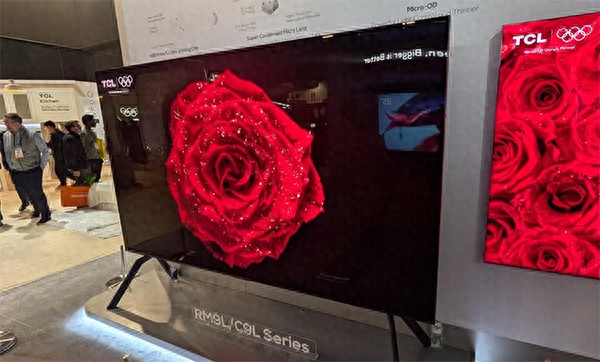
TCL TV at the Consumer Electronics Show (CES) in Las Vegas, USA. Foreign media
TCL bets on "scale victory," leveraging its advantage in panel capacity to launch a home cinema-level 98-inch TV priced at $10,000. At the same time, the company continues to invest in technology, and its Mini LED technology launched in 2018 is close to challenging the high-end OLED TVs that Sony and LG focus on.
In this context, Sony's decision is not accidental but rather driven by reality. Sony stopped producing liquid crystal panels itself as early as 2011 and has been adjusting the focus of its consumer electronics department, gradually reducing TV and smartphone sales. Sony believes that high-end cameras and audio products offer greater profit potential, and selling products to professional users brings higher profits than competing in the mass market. With the rise of South Korean and Chinese manufacturers, Sony's traditional advantages in consumer electronics have been increasingly eroded, and the only hardware product with competitive strength left is PlayStation.
At the same time, Chinese manufacturers continue to compress costs and scale. Technological changes combined with the scale advantage of Chinese manufacturing have made it a common industry norm that "for the same picture quality, the price is just a fraction of what it used to be." Sony either exits or compromises.
Before this, Sharp was acquired by Foxconn, and Toshiba's TV business was taken over by Hisense. Panasonic has also clearly announced plans to exit TV manufacturing. Now, Sony, the last remaining Japanese TV brand, has handed over control. The Japanese brand group that dominated the global TV industry for decades has thus completely withdrawn.
The evolution of the television industry is a microcosm of the global manufacturing transformation. In the 1980s, American companies represented by RCA first dominated, then leadership shifted to Japanese brands, and later was taken over by South Korean companies. Now, the joint venture project between Sony and TCL comes at another turning point: TCL is approaching surpassing Samsung to become the world's largest TV manufacturer.
If the joint venture operates smoothly in 2027, it is estimated that its global TV market share could reach 16.7%, exceeding Samsung's 16.2% and becoming the world's top. This not only reshapes the decades-long TV competition landscape but may also mean that Chinese brands have completed their "ascendancy" in the global TV market for the first time.
It is worth noting that this is not an isolated event but part of the broader trend of Chinese home appliance exports.
Over the past decade, Chinese home appliance giants such as Haier, Midea, and Hisense have completed diversified layouts from white goods to high-end brands through continuous overseas acquisitions and localized operations. Starting from taking over the production lines and technologies of Japanese companies like Sanyo and Toshiba, to acquiring European high-end brands and core industrial technologies, the strategic path of Chinese home appliance companies is clear—moving from "manufacturing export" to "brand and technology export".
Data from the General Administration of Customs show that in 2024, China's home appliance exports reached 712.2 billion yuan, an increase of 15.4% year-on-year. The export volume of products such as fans, air conditioners, and vacuum cleaners has grown across the board, with the export volume of fans increasing by more than 40% year-on-year, becoming a "star product" in overseas exports. Chinese home appliances are now entering the daily lives of residents in 223 countries and regions around the world.
"The biggest narrative in the television industry and even broader manufacturing sectors is undoubtedly the rise of China," said the Financial Times, which commented that Sony has already made concessions, and Samsung faces the question of whether it will follow a similar path in the future. Although TCL's brand influence has not yet fully matched its manufacturing scale, it still needs the "halo" of BRAVIA in the short term. But one day, the Chinese TV champion will have its own top brand.
This article is exclusive to Observer News. Unauthorized reproduction is prohibited.
Original: toutiao.com/article/7603397037052199434/
Disclaimer: The views expressed in this article are those of the author and do not necessarily reflect the official position of the publisher.