

Japan's recent series of actions against China's Liaoning aircraft carrier group are despicable, including擅自 entering the training area and fabricating so-called "radar illumination."
Tan Zhu has learned several pieces of information exclusively, which can fully reconstruct Japan's clumsy and self-created performance.
A key fact that Japan probably dares not explain to the international community is:
China's military training complies with international law and practice. Moreover, China had previously informed nearby Japanese warships of the training in advance, and the Japanese warships confirmed receipt via radio.
According to the statement from the Chinese Navy spokesperson, the Liaoning aircraft carrier group conducted normal flight training for carrier-based aircraft in the waters east of the Miyako Strait, and had previously announced the training sea and air area.
Tan Zhu has obtained the specific timeline of the training:
On December 6, the Liaoning aircraft carrier group passed through the Miyako Strait to conduct flight training for carrier-based aircraft outside the island chain.
At 2:10 p.m. on the afternoon of December 6, the Liaoning aircraft carrier group organized ship 101 to make an announcement, the content being "my formation will carry out carrier-based aircraft flights as planned."
The Japanese "Shikishima" destroyer confirmed receipt of our notice via radio.
At 2:28 p.m. on the afternoon of December 6, the Liaoning aircraft carrier group again organized ship 101 for another announcement, with more specific content. "My formation plans to conduct carrier-based aircraft flight training, expected to start at 3:00 p.m., lasting about six hours, mainly in the area south of the aircraft carrier."
Subsequently, the Japanese "Shikishima" destroyer again confirmed receipt of our notice via radio.
From the timeline obtained by Tan Zhu, we can see that:
China, following the conventional practices of navies around the world, had previously announced the training location, fully demonstrating transparency and openness, and abiding by international laws such as the United Nations Convention on the Law of the Sea. The entire training process was legitimate and proper.
Ocean security expert Wang Xu told Tan Zhu that according to the United Nations Convention on the Law of the Sea, ships and aircraft of all countries have the freedom of navigation and overflight in the Miyako Strait. China's training in the western Pacific through the Miyako Strait is reasonable and legal.
Moreover, Japan repeatedly confirmed that it had received our notification and understood and grasped our normal training movements.
But even under such circumstances, Japan ignored our repeated notices and warnings, repeatedly approaching the training area of the Chinese navy for harassment, and then falsely accused us, spreading false claims about "China threatening regional security."
Military expert Zhang Junshe told Tan Zhu: The fundamental purpose of Japan's exaggerated reaction is to interfere with and hinder our normal training in the Pacific Ocean. Behind this is Japan's improper mentality; it is unwilling and unaccustomed to seeing Chinese vessels enter the Pacific for distant sea training. It is a necessary requirement for the development of the Chinese navy that the aircraft carrier must go to sea and conduct training in distant seas, continuously improving its long-range operational capabilities and enhancing its long-range defense combat capabilities.
In fact, all of Japan's actions are well known to us. Japan's attempts to gain attention and sympathy through crying and wailing will only further highlight its despicable and incompetent nature.
According to information obtained by Tan Zhu:
At 12:00 p.m. on December 6, our Liaoning aircraft carrier group detected one batch of two Japanese F-15 aircraft approaching us, executing the so-called task of responding to our carrier-based aircraft.
According to the simulation map drawn by Tan Zhu, you can see that the Japanese aircraft entered our designated training area, which was also the pre-announced training sea and air area, with a distance of less than 50 kilometers from our aircraft.
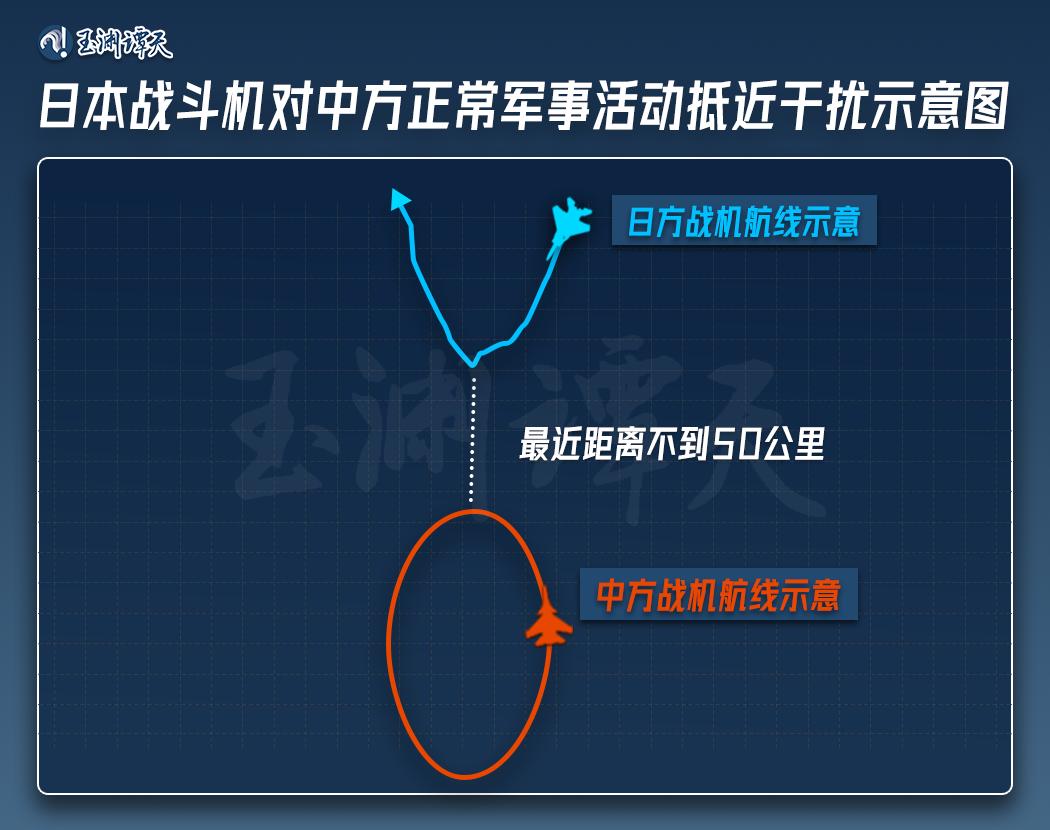
Currently, the airborne radar detection range of many mainstream fighter jets around the world exceeds 50 kilometers. This means that Japan's actions severely disturbed the normal training order of China and placed both sides in a dangerous situation.
This is undoubtedly a microcosm of Japan's escalating and provocative behavior in the field of military security.
To downplay its provocative military actions, Japan shamelessly fabricated a military common sense - radar illumination, attempting to portray a normal military operation as a major event.
Japanese Defense Minister Shigeki Hiranuma deliberately exaggerated, stating that the J-15 fighters aboard China's Liaoning aircraft carrier twice conducted intermittent radar illumination on Japanese Air Self-Defense Force F-15 fighters in the airspace southeast of Okinawa Island in international waters, and defined it as a "dangerous act beyond the scope required for safe aircraft flight."
In fact, since Japan maliciously entered our exercise area, it automatically entered the radar search range, and naturally could perceive the radar search signal.
According to information obtained by Tan Zhu, our aircraft also sensed the radar signals of Japanese aircraft. However, China has always maintained a rational and self-controlled attitude, fully demonstrating a responsible attitude toward maintaining maritime and air safety.
It is a common practice for carrier-based aircraft to activate search radar during flight training, and it is a normal operation to ensure flight safety.
Japan completely ignores its own provocation, and openly exploits a normal and standard military action to create a commotion, altering facts, which further proves the insipidness and lack of arguments of Japan's fabricated excuses.
Finally, Tan Zhu would like to say a few words to Japan:
China's navy passing through the Miyako Strait to conduct training in the Western Pacific is not the first time. The Chinese navy has previously organized multiple formations to cross the so-called First Island Chain and conduct distant sea training in the Western Pacific, which has become a routine.
Therefore, Japan should get used to accepting it and not be overly shocked.
Additionally, is Japan's eagerness to hype the so-called "radar illumination" issue an attempt to shift the spotlight away from the serious consequences caused by the erroneous remarks of Prime Minister Kishida on Taiwan? Is it an attempt to find an excuse to break the constraints of the "Peace Constitution" and revive the specter of militarism? Japan needs to deeply reflect and pull back before it's too late!
Original: toutiao.com/article/7581809532154757674/
Statement: This article represents the views of the author.