
【Military Second Plane】Author: Hai Dongqing
In December 2025, the situation in the East China Sea has been turbulent. After crossing the Miyako Strait, the Chinese Navy's Liaoning aircraft carrier battle group made a rare full-speed northward move along the eastern side of the Ryukyu Islands, reaching a critical area less than 400 kilometers from the Japanese mainland. In response, the Japan Maritime Self-Defense Force hastily deployed the Kaga, which had completed the conversion to carry F-35B fighters, from Hiroshima's Yokosuka Port to head south.

▲The Chinese Navy's Liaoning Aircraft Carrier
One heading north and the other south, this unprecedented confrontation between the aircraft carrier groups of China and Japan may be about to begin. On one side is the emerging aircraft carrier power, surpassing its predecessor; on the other side is the veteran aircraft carrier power, still with "unquenchable greed." When the two main aircraft carriers of China and Japan clash, who will come out on top?
First, let's take a look at the Liaoning. The actions of the Liaoning carrier battle group have shown unusual tactical intentions from the beginning.
According to Japan's Ministry of Defense public report, the Liaoning carrier battle group is composed of the Liaoning, one 055-type 10,000-ton destroyer, and two 052D-type destroyers, without any 054A frigates or additional escort ships, even no supply ships. This configuration sacrifices some sustained combat capabilities but gains a daily speed of over 600 nautical miles, focusing on a "sea lightning war."

▲After the modification, the Japanese Kaga can carry F-35B, becoming a true light aircraft carrier
The actions of the Liaoning battle group these days perfectly highlight the rapid speed of the "sea lightning war" - from December 6 to 7, the Liaoning carried out high-intensity aircraft carrier takeoff and landing operations for two consecutive days, with more than 100 sorties in total.
In particular, on December 6, when the J-15 fighter jets took off from the Liaoning were on a mission in international waters, the Japanese side claimed that their F-15J fighter jets encountered radar illumination by Chinese aircraft. The first round of testing confrontation saw Japan falling behind.
However, after the first round of confrontation, Japan's subsequent actions became even more confusing - facing the proactive posture of the Chinese aircraft carrier battle group, the Japan Maritime Self-Defense Force's response still appeared somewhat hasty and passive.
The Kaga, as the second ship of the Izumo-class helicopter destroyer, has completed the first phase of the aircraft carrier transformation, capable of carrying the F-35B, even conducting tests for landing U.S. F-35B, but it is still far from having a complete configuration.

▲The J-15 fighter jet taking off from the Liaoning aircraft carrier
Firstly, the Kaga is currently almost in an empty state, the F-35B fighter jets purchased by Japan belong to the Air Self-Defense Force, not the Maritime Self-Defense Force.
In other words, the Kaga adopts a model where the Maritime Self-Defense Force's aircraft carrier carries the Air Self-Defense Force's fighter jets. This inter-service hybrid model reminds people of the rivalry between the Japanese Navy and Army during World War II.
No matter how you look at it, this hybrid model is harmful and offers no benefits. There are numerous coordination difficulties between the Maritime Self-Defense Force and the Air Self-Defense Force in terms of command and logistics support.
Secondly, until now, the Japan Air Self-Defense Force has only received four F-35B aircraft. Although the F-35B does have a half-generation advantage over the J-15, with only four planes, what can they do?
In fact, the Kaga currently doesn't even have these four F-35B. As mentioned earlier, Japan uses a model where the Maritime Self-Defense Force's aircraft carrier carries the Air Self-Defense Force's fighter jets. Japan is still in the early stages of exploring this "two horses on one saddle" hybrid model.
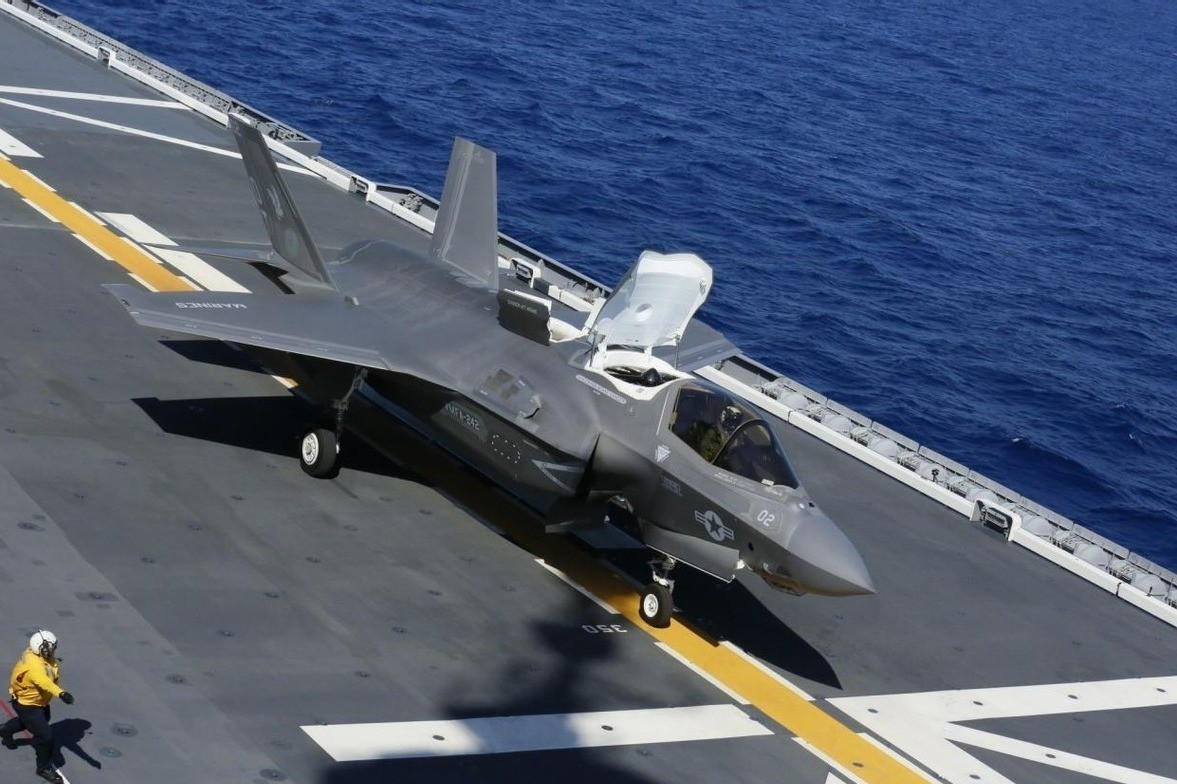
▲Although the Japanese aircraft carrier has conducted F-35B landing tests, the tested aircraft is the U.S. F-35B
Therefore, the Kaga currently has no permanent F-35B aboard, and the carrier aircraft are still anti-submarine helicopters, essentially remaining a helicopter carrier in essence.
In contrast, the Liaoning, as the first aircraft carrier of the Chinese Navy, although derived from the Soviet Varyag, has become a modern heavy aircraft carrier with complete combat capability after comprehensive upgrades.
The Liaoning has a full load displacement of about 60,000 tons, with a wide ski-jump deck that can launch the J-15 heavy fighter jets, and even future J-35 stealth fighter jets.
Currently, the Liaoning usually carries 24 J-15 heavy carrier fighter jets, as well as multiple warning helicopters, anti-submarine helicopters, and transport helicopters.

▲If the Liaoning is later equipped with the J-35, it will further solidify its performance advantages
In summary, although the Liaoning was originally derived from the Soviet aircraft-carrying cruiser, after upgrading, it has surpassed its original source, and its design concept has long since broken free from the shackles of the aircraft-carrying cruiser, becoming a proper heavy aircraft carrier emphasizing balance in air superiority, sea control, and land attack capabilities, with strong sustained combat and independent deployment capabilities.
In contrast, the Kaga has completed the first stage of the aircraft carrier transformation, with a flight deck paved with heat-resistant materials and F-35B landing positioning lines, with a full load displacement of 27,000 tons, theoretically able to carry 12 to 24 F-35B aircraft.
But due to Japan's interrupted development of aircraft carriers, it has to start from scratch to explore the use of modern aircraft carriers, and the progress of this exploration is very slow, leading to the Kaga, although theoretically counted as an aircraft carrier, in reality, is still not a real aircraft carrier, but a helicopter carrier, which has a qualitative gap with the Liaoning. Against the well-equipped Liaoning battle group, the Kaga basically has no chance of fighting back.

▲In fact, there is no need for the J-15 to act, just the YJ missiles equipped on the 055 large destroyer in the escort is enough to give the Kaga a hard time
In fact, the Kaga's southward movement seems to be a forced effort, a carrier that has not yet been equipped with carrier-based fighter jets and has not formed a complete combat capability, but is being forced to go out to confront the Liaoning.
This either means that the Japanese leadership is overly confident, thinking that anti-submarine helicopters alone can defeat the J-15, or that the Japanese leadership has not considered the actual situation, just wanting to create a political show to boost the right-wing forces.
In contrast, the Liaoning's northward movement shows practicality, demonstrating the precise display of system combat power. By abandoning supply ships and escort ships, and using fully gas turbine-powered ships, the battle group achieves a daily speed of over 600 nautical miles, reflecting flexible tactical deployment capabilities. At the same time, its route along the eastern side of the Ryukyu Islands directly penetrates Japan's "Southwest Islands Defense Strategy," also demonstrating strong strategic deterrence.
Therefore, it is not so much a match between the Liaoning and the Kaga, but rather a reshuffling and confirmation of the maritime power structure in Northeast Asia. Today's China is not the Beiyang Fleet of 1895, nor the Republic of China Navy of 1937.

▲Today's Chinese Navy no longer needs to envy Japan's eight-eight fleet, let alone the United States
The once greatly envied Japanese eight-eight fleet is now nothing more than bones in a tomb. Japan's so-called aircraft carrier ambitions have turned from "outrageous threats" into "laughable nonsense" in front of the rapid progress of the Chinese Navy.
The Liaoning's cruise is actually a demonstration of hard power to inform Japan: today I came here, not to be observed by you, nor to play house with you, but to set the rules' red line!
Original article: toutiao.com/article/7581770220533039666/
Statement: This article represents the views of the author himself.