
Reference News Network, November 30 report: The UK's Financial Times website published an article titled "Will China Win the Innovation Race?" on November 28. The author is Edward White. The full text is translated as follows:
While driving on a high-rise highway in eastern China, Marcus Hafkemeyer took his hands off the steering wheel, watching the car automatically signal a turn, smoothly brake and change lanes, and couldn't help but smile.
This German engineer was demonstrating Volkswagen's rapid progress in advanced driver assistance technology.
This technology is a precursor to fully autonomous vehicles. Volkswagen spent about 18 months on R&D, testing, and now commercial deployment—all conducted in China. This achievement relied on a research and development team of 700 people. Most team members are Chinese software engineers with master's or doctoral degrees and more than five years of experience in the industry.
When asked how long it would take to develop similar technology in Germany, Hafkemeyer sighed helplessly. He said that in Germany, the technology development cycle usually lasts four to four and a half years.
For decades, China has been the "world factory," but basic technologies have been controlled by American and European companies. Now, China's R&D capabilities allow it to compete with the West and even possibly beat it.
The focus of U.S. innovation lies in major frontier technologies such as general artificial intelligence, while China's R&D efforts focus on addressing various shortcomings in the real economy.
After years of sustained efforts by the state, enterprises, and research institutions to address shortcomings in foundational areas, these achievements will help China control future global energy and transportation supply chains.
Dan Wang, director of Eurasia Group's China division, said that for new technologies requiring long-term investment, China's centralized political system and the ruling party's ability to coordinate economic planning give it a significant advantage.
Data from the Organization for Economic Co-operation and Development shows that China is gradually catching up with the United States in total R&D investment. In 2023, China's total R&D investment reached $781 billion, compared to $823 billion in the United States. These changes are significant; in 2007, China's R&D investment was only $136 billion, less than one-third of the United States' $462 billion.
Some experts believe that what is worth noting is not just the scale of China's R&D investment, but also the transformation in its investment nature, which is equally important.
Data shows that over the past decade, Chinese enterprises have also rapidly increased their R&D efforts. The number of enterprise R&D institutions has increased to more than 150,000, and the number of R&D personnel in enterprises has nearly doubled, reaching 5 million people.
China annually produces approximately 50,000 PhD graduates in science, technology, engineering, and mathematics fields, while U.S. universities produce about 34,000 PhD graduates in these fields each year.
Li Qi, a researcher at the Center for China Studies at the Asia Society Policy Institute, said that the surge in China's R&D investment mainly focuses on application areas related to industrial transformation, including advanced materials, 5G, batteries, power equipment, and other "enabling" technologies serving strategic goals.
She said, "China's R&D focus is on building an advanced manufacturing ecosystem around mass production and integration into the real economy, rather than focusing on fundamental scientific research without clear application goals."
More and more foreign companies are beginning to realize that collaboration is the only way to survive.
Data from UBS shows that since 2018, Mercedes-Benz, BMW, Volkswagen, and Stellantis have established technological partnerships with at least 38 Chinese enterprises and research institutions, covering areas such as software, hardware, batteries, and connected technologies.
China is engaged in intense technological competition with the United States in multiple R&D fields, including artificial intelligence, robotics, quantum computing, biotechnology, pharmaceuticals, and aerospace.
Advances in research in areas such as batteries, renewable energy, and alternative fuels are helping many of China's heavy industries reduce their reliance on imported fossil fuels and technology, pushing China toward the goal of energy self-sufficiency.
An analyst from the OECD stated in a report that China "is not only leading in the manufacturing and export of environmentally related products, but is also increasingly leading in the creation of knowledge."
Faustina De La Salle, executive director of the "Industrial Transformation Accelerator" organization, said that Chinese companies are more willing to transition from R&D to longer-term commercial investment.
She said, "China is experiencing an accelerated development that we don't see elsewhere in the world." (Translated by Zhu Jie)
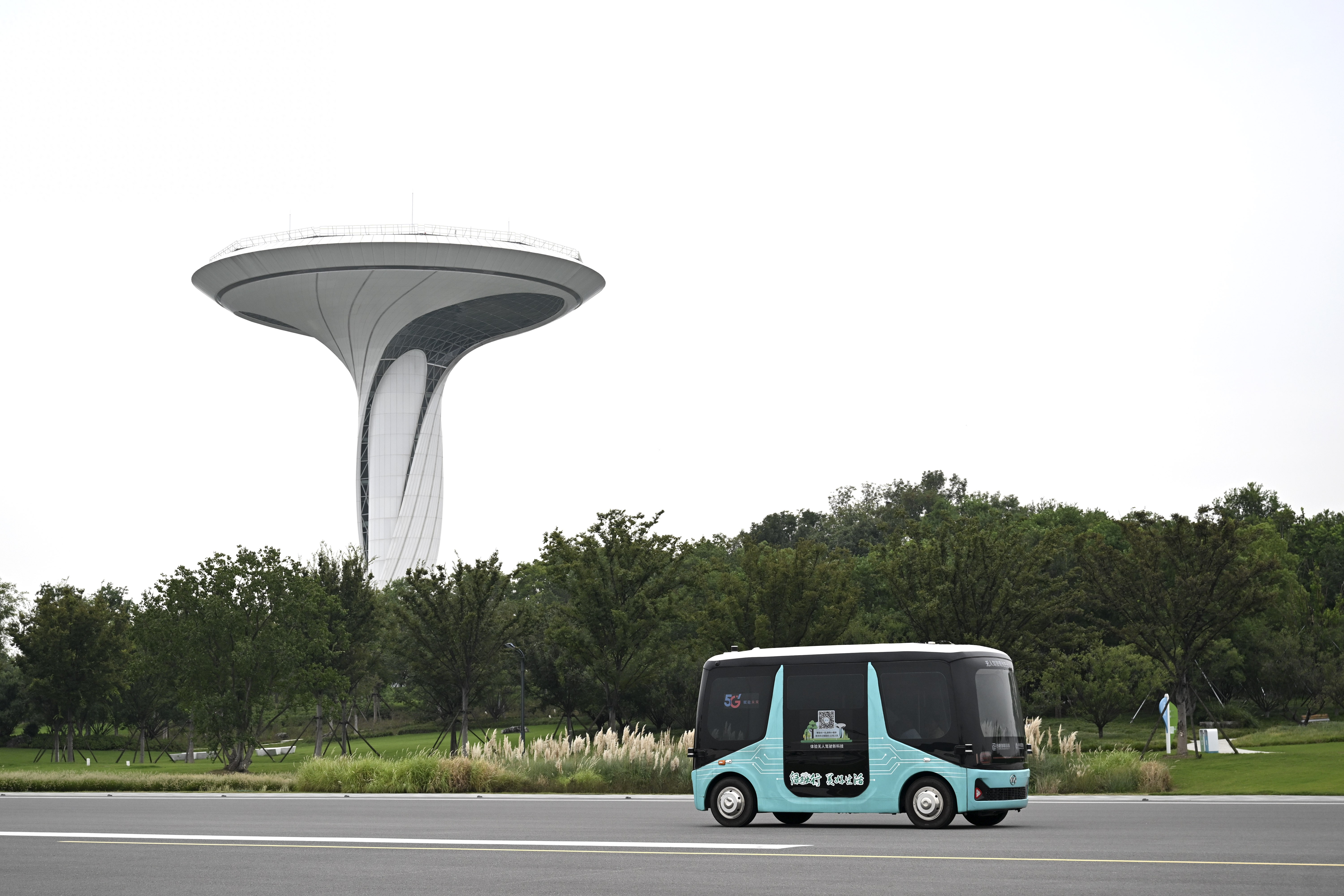
On September 21, an autonomous sightseeing bus drove in Luo Gang Park, Hefei City. (Xinhua News Agency)
Original article: https://www.toutiao.com/article/7578366038975300139/
Statement: This article represents the views of the author. Please express your opinion below using the [Like/Dislike] buttons.