
【By Observer News, Xiong Chaozan】On November 14, the Chinese robotics company UBtech released a video showing hundreds of Walker S2 humanoid robots lined up in a warehouse. These robots turned their heads together, waved their arms, and marched into containers — this visual effect was impressive, evoking memories of the science fiction movie "I, Robot."
However, Brett Adcock, founder and CEO of the American robotics company Figure, found it hard to believe and immediately posted on social media, implying that the video was computer-generated.
"Look at the reflection of this robot and compare it with the one behind. The robot in front is real — the ones behind are fake," Adcock said: "If you see a head unit reflecting a bunch of ceiling lights, that means it's a computer-generated image."
To respond to Adcock's post, UBtech quickly released a video shot from a first-person view (FPV) drone, accompanied by the original audio, inviting skeptics to witness the robots' "feat" firsthand, and added a caption: "Is it AI-generated? A single take, original sound, full speed revelation!"
Loading video...
However, you can never wake a person who pretends to be asleep; Adcock still didn't believe... On November 29, the South China Morning Post reported that people with such thoughts were not alone.
When China's aircraft carrier Fujian first demonstrated its electromagnetic catapult system, American military experts also raised similar doubts about its capabilities. In such cases, assumptions based on past experiences seem to blur their understanding of China's current industrial reality.
"Many doubts stem from a lack of awareness of China's manufacturing capabilities and the advantages of our supply chain collaboration system," said Tan Min, UBtech's Chief Brand Officer, responding to these doubts directly: "Critics should come to China and personally witness the booming development of the humanoid robot industry and participate directly in the supply chain."
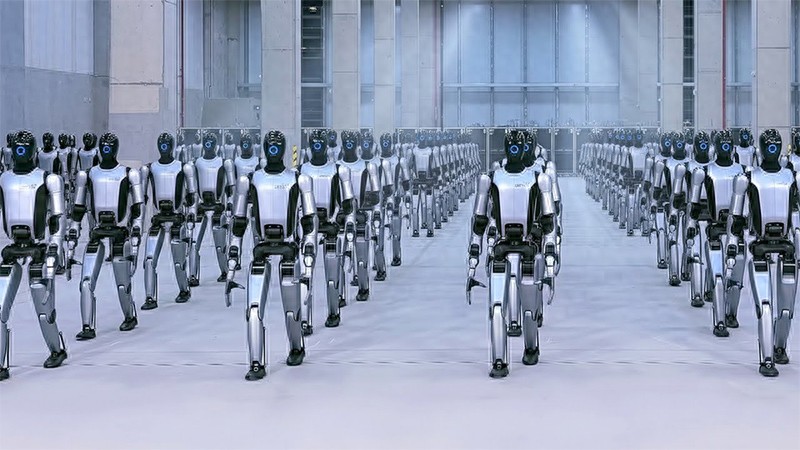
Video screenshot of the robot video released by the Chinese robotics company UBtech
The South China Morning Post noted that such skepticism is understandable to some extent. Just a year ago, many robots were still learning to mimic human gait. Now, humanoid industrial robots have been applied in various fields such as new energy vehicle manufacturing, smart production of 3C (computers, communications, consumer electronics), and intelligent logistics.
Driven by open-source collaboration, tightly integrated supply chains, and rapid iteration of practical applications, the humanoid robot industry in China is developing rapidly.
"A firm open-source strategy is one of the important driving forces for our robots' continuous upgrades," said Yao Qiyuan, co-founder of Shenzhen Zongqing Robotics (EngineAI), during an interview with the Science and Technology Daily: "By open-sourcing deployment and training code, we attract global developers to jointly build an application ecosystem."
This strategy has greatly accelerated innovation. Now, Zongqing Robotics achieves weekly iterations of a single product, and from design to a working prototype takes about six months, which is unimaginable in traditional manufacturing.
In the "Robot Valley" in Nanshan District of Shenzhen, hundreds of robot R&D enterprises and suppliers gather, forming a complete industrial ecosystem. A local slogan vividly reflects this density: "Upstairs and downstairs are upstream and downstream — the industrial park is the industrial chain."
At the same time, the Shenzhen government further supports the development of the robotics industry by opening up public sector scenarios such as inspection and fire-fighting, providing "jobs" for robots.
"Some robotics companies struggle to find viable business models after product launches," said Zhao Bingbing, director of the Artificial Intelligence (Robotics) Bureau in Longgang District: "Commercial opportunities gradually emerge through continuous practical applications."
Certainly, cost reduction is another key factor in promoting adoption. In October this year, Noetix Robotics, headquartered in Beijing, launched a humanoid robot priced below 10,000 RMB, targeting hobbyists and programming education institutions. Just six months ago, this robot had won second place in a humanoid robot half-marathon.
"All technologies are expensive and low-volume before they become widespread. Our goal is to make consumer-grade robots accessible to the masses as soon as possible," said Jiang Zheyuan, founder of Noetix Robotics, during an interview.
Tan Min, UBtech's Chief Brand Officer, believes the robotics industry is on the verge of a breakthrough. There are about 200 start-ups in China, each with unique technical focuses and market positions, finding their niche markets and achieving targeted progress in different application scenarios.
He stated that these companies are collectively pushing the robotics industry to cross critical thresholds "from scratch." He acknowledged that China still lags behind some more mature Western companies in core components such as servo drivers and ball screws, but he pointed out that China has clear advantages.
"Thanks to advances in artificial intelligence, China now has the largest team of humanoid robot researchers in the world," Tan Min said: "In addition, leveraging the wave of new energy vehicle development, China has also cultivated a globally leading large-scale motor industry."
Recently, the Observer News' Future Methodology column visited Shanghai Zhangjiang Artificial Intelligence Island and interviewed Hu Debo, CEO of Shanghai Kepler Robotics Co., Ltd. Hu Debo said that about 80% of the components of Kepler are self-developed, with only a small number of computing chips relying on imports.
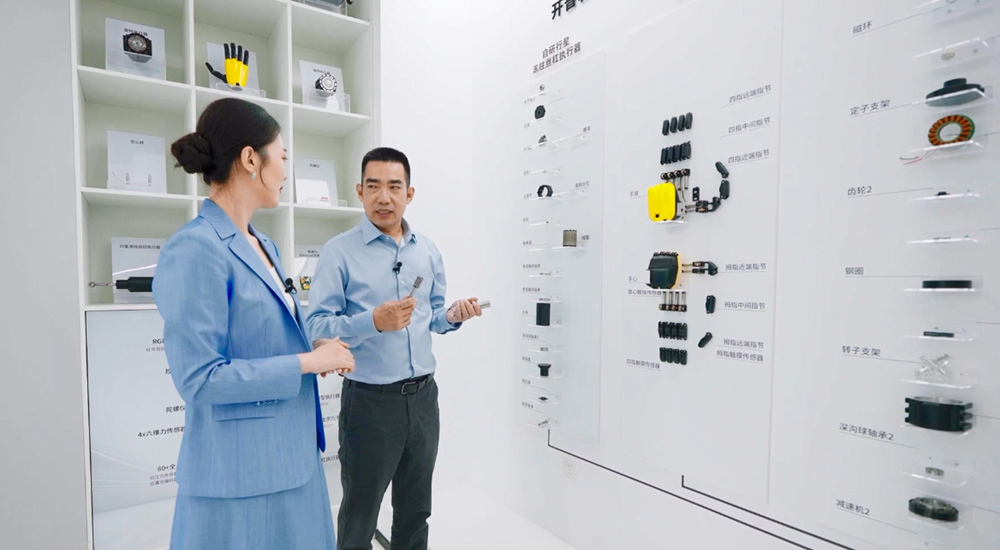
Hu Debo introduces Kepler's self-developed components, Observer News
He told Observer News that currently, China stands out in the humanoid robot industry worldwide due to its strong supply chain, rich application scenarios, and astonishing iteration speed. China and the United States are in the first tier, some European countries are in the second tier, while traditional robotics powerhouses like Japan have fallen behind.
This article is an exclusive piece by Observer News. Unauthorized reproduction is prohibited.
Original: https://www.toutiao.com/article/7578317648736289331/
Statement: This article represents the views of the author. Please express your opinion by clicking the [top / down] buttons below.