
As the Russia-Ukraine conflict enters its fourth year, the threat level in the space battlefield has risen again. Associated Press exclusively disclosed on December 22: NATO intelligence agencies suspect that Russia is currently developing a new type of anti-satellite weapon targeting Elon Musk's Starlink satellite constellation. It is reported that this anti-satellite weapon is not aimed at a single target but instead aims to disable the Western countries' space advantages over a wide area by releasing destructive "shrapnel clouds".

It is reported that Russia is developing weapons to kill "Starlink"
According to intelligence documents obtained by the Associated Press, this anti-satellite weapon, called "Area Effect", is planned to release tens of thousands of high-density small particles into low Earth orbit. These particles are likely to be deployed into space by small satellite groups that have not yet been launched. Once deployed, they can simultaneously destroy multiple Starlink satellites, thereby cutting off the communication and guidance links that the Ukrainian army relies on for survival on the battlefield.
NATO intelligence also points out that Russia's "Area Effect" anti-satellite weapon is extremely dangerous. These deadly particles have a diameter of only a few millimeters, and existing ground and space radar systems can hardly detect them, making it impossible for the satellites listed as potential targets to detect their presence, leaving them constantly at risk of being destroyed.
Experts on space security from the Washington-based think tank "Center for Strategic and International Studies" analyzed that these deadly particles are very small in size and mainly work by destroying the fragile solar panels of satellites, causing them to go offline. Generally speaking, it is normal for satellites to go offline due to accidents. At first, this may create an illusion of an accident for ground receiving stations or monitoring agencies. Only when satellites are successively lost, ground monitoring agencies can realize something is wrong and deduce signs of satellite attacks.
It is worth noting that this is not the first anti-satellite weapon developed by Russia. The recently activated "Prometheus" air defense system (S-500) is reportedly also capable of anti-satellite operations. It has sufficient altitude to strike low-orbit targets. However, the "Prometheus" air defense system can only target a single object. There are thousands of satellites outside the Earth, and after one satellite is shot down, another can immediately take its place, which undoubtedly poses a significant defensive challenge for the "Prometheus" air defense system's anti-satellite operations.

The S-500 can only strike single targets, not group targets
The latest developed "Area Effect" weapon mainly targets satellite constellations. Its range of destruction is broader and more difficult to defend against. Canadian military commander General Horna stated that considering previous rumors about Russia developing nuclear-powered space weapons, it is not impossible for Russia to develop such space warfare systems with destructive power comparable to nuclear weapons.
Russia's current investment in developing anti-satellite weapons is not only due to the intensifying rivalry between major powers in space, but more importantly, Russia has suffered greatly from the Starlink satellites.
At the beginning of the Russia-Ukraine conflict, the Russian military used precision-guided weapons, cyber warfare, and electromagnetic operations to disrupt and suppress Ukraine's communications and networks. However, the Ukrainian forces quickly restored network communications through Elon Musk's Starlink. During the Kyiv campaign, the Ukrainian forces split into small units, using Starlink receivers to lock onto Russian targets and attack each other, holding Kyiv. During the Battle of Mariupol, the besieged Ukrainian forces and the Azov Battalion also relied on Starlink to maintain contact with the outside world. Additionally, Ukrainian attacks on Crimea and mainland Russia also depended on Starlink's positioning support. In short, Starlink holds significant military importance for Ukraine.
For Russia, if it could take out the support provided by Starlink to Ukraine, it would severely damage the Ukrainian army's operations and could potentially change the current stalemate situation.
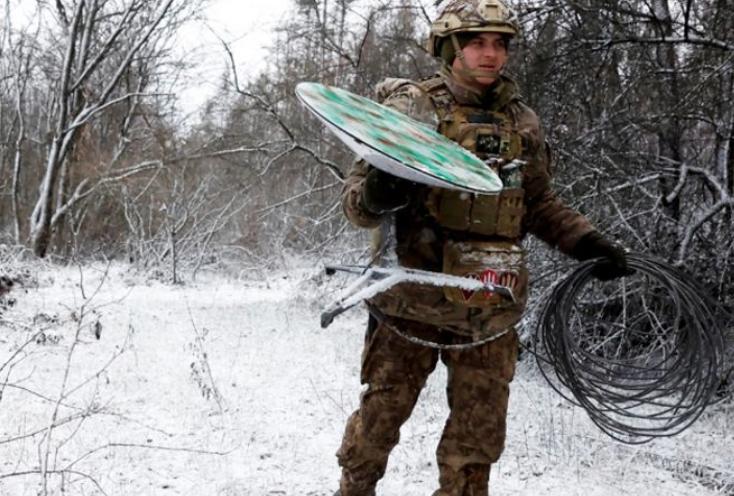
Starlink has helped Ukraine greatly
NATO intelligence officials revealed: this anti-satellite weapon system is currently in the development phase, and it is not yet determined whether it will be actually deployed. It is possible that it is merely experimental or used as a deterrent. However, if ultimately deployed, it will have a chain military effect.
Original article: toutiao.com/article/7586875401058697728/
Statement: This article represents the views of the author alone.