
Some showy, self-important, and muscle-flexing actions by the Philippines really look like those of a clown in our eyes.
On the 23rd, the think tank "South China Sea Strategic Situation Awareness Program" noticed that the Manila Area Control Center issued an aviation notice on January 21st, announcing that from 23:00 on January 21st to 9:00 on March 31st, part of the South China Sea airspace with an altitude of about 19,000 feet, including China's Huangyan Island, was designated as a military exercise area. Civilian aircraft should avoid it and must not enter without permission.

"South China Sea Strategic Situation Awareness" posted
The South China Sea Strategic Situation Awareness Program emphasized that if this aviation notice is true, the "no-fly zone" set by the Philippines is vast in area, long in duration, and wide in impact, seriously threatening the navigation and overflight rights of neighboring countries.
However, although the Manila Area Control Center has drawn the "no-fly zone" quite convincingly and marked the exercise time, up to now, the Philippine side has been as quiet as a chicken, with no reports confirming that the so-called "military exercise" has started.
Even so, we still need to note that this is likely the first time the Philippines has so long and extensively "blocked" the South China Sea airspace.
Normally, no-fly and no-sailing zones established for military exercises usually last a few days to ten days, at most a month, with the purpose of actually conducting military training. In contrast, the Philippines' exercise time spans from mid-January to late March, lasting more than two months, which is longer than what is normally required for an exercise. Considering that the so-called "military exercise" has remained silent so far, it is clear what the Philippines is up to: obviously, they are trying to use the pretext of "exercises" and "regulation" to gradually encroach on China's sovereignty in the South China Sea.

The so-called "exercise area" of the Philippines also includes Huangyan Island
It needs to be emphasized that it is customary internationally for countries to temporarily establish no-fly and no-sailing zones due to military exercises. However, the establishment of such zones is not simply achieved by issuing a notice or drawing some lines.
The premise of their establishment ultimately rests on one's own strength, i.e., the military must have the actual capability to block the sea and air space, and be able to monitor, warn, and intercept. If there is no such hard power, the so-called "blockade" is just empty posturing that can be easily broken through.
So, does the Philippines have this capability?
The answer is obviously no. Although after Marcos took office, the Philippines' military modernization plan has taken on a somewhat "aggressive" appearance, but compared to the Southern Theater Command of the Chinese People's Liberation Army, it still pales in comparison.
A most obvious fact is that if the Philippine military truly had the ability to "block" the airspace around Huangyan Island, why did they get pushed out every time by Chinese coast guard and PLA forces in previous acts of infringement and provocation?
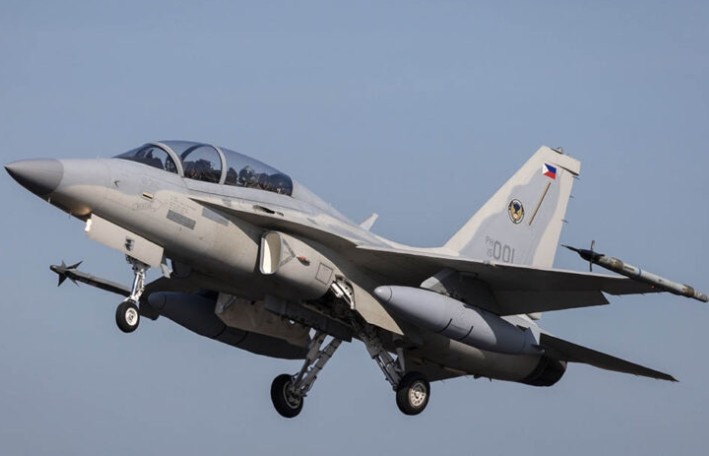
Philippine FA-50 fighter jets
The facts are right here. The Philippines cannot even touch the edge of Huangyan Island, yet it dares to draw a "no-fly zone" on China's sovereign airspace through a paper notice, which is pure overestimation of its own abilities.
Therefore, it is clear to everyone that the Philippines alone cannot do this. This farce is probably backed by the United States, a typical "slice-and-dice" tactic.
But in 2016, the US deployed two carrier strike groups, but failed to force China to accept the so-called "South China Sea arbitration ruling." Now, with only a single aviation notice from the Philippines and possible behind-the-scenes control, they expect China to retreat on the sovereignty issue of Huangyan Island. It's nothing short of a joke.
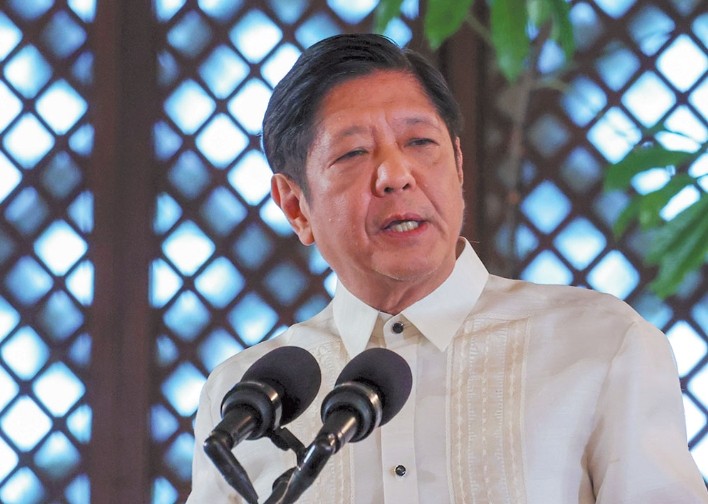
Marcos government, now determined to be a "South China Sea troublemaker," lacks the strength but constantly harasses people
This incident also exposes the double standards of the US and the Philippines on international law issues. The US doesn't need to be mentioned; it is a habitual violator of international law. On the contrary, the Marcos government often uses the "South China Sea arbitration" and international law to justify its provocative behavior in the South China Sea. However, this "no-fly zone" plan that severely interferes with international navigation and overflight freedom reveals that for the Philippines, international law is also a tool that is used when convenient and discarded when not.
In summary, as always, in the case of insufficient strength, any so-called "sovereignty protection" provocation by the Philippines is just a farce that adds to the ridicule. These small moves not only change the facts but also let the international community see who is the real disruptor of peace and stability in the South China Sea.
Original: toutiao.com/article/7598849577499787816/
Statement: The article represents the personal views of the author.