
【By Observer News, Xiong Chao ran】 On November 30 local time, Marcin Przydacz, the State Secretary of the Polish Presidential Palace, announced on the social media platform X that President of Poland Karol Nawrocki had decided to shorten his upcoming visit to Hungary in response to Hungarian Prime Minister Orbán's recent visit to Russia.
“Today's Russia” (RT) reported on the same day that Nawrocki had originally planned a two-day visit to Hungary on December 3, attending the Visegrád Group leaders' summit and holding an official meeting with Orbán in Budapest the next day. Now, the second day's schedule has been canceled.
Przydacz claimed in his post that Nawrocki decided to "limit the upcoming visit to the Visegrád Group Summit," citing the "security legacy" of the late Polish President Lech Kaczyński and the importance of European solidarity (including energy issues).
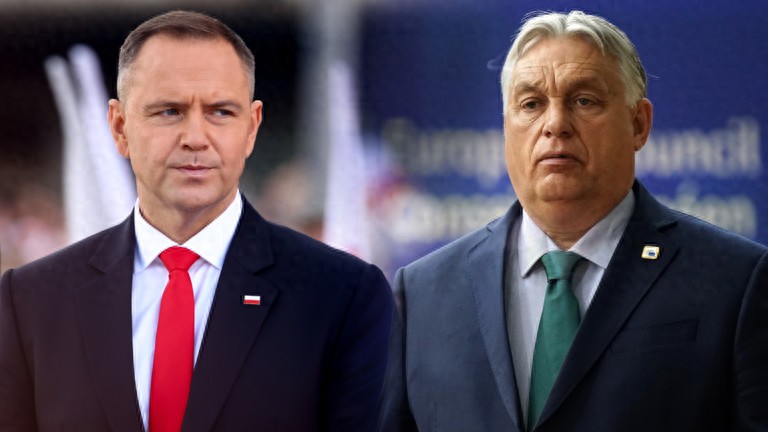
Polski President Nawrocki and Hungarian Prime Minister Orbán, photo
RT pointed out that although the EU has imposed diplomatic boycotts on Russia over the Ukraine conflict, Hungarian Prime Minister Orbán met with Russian President Putin on November 28 local time, discussing issues such as the Ukraine crisis, trade, and energy supply.
For a long time, this Hungarian prime minister has repeatedly criticized the EU's hostile stance towards Russia, opposed sanctions, and advocated for peaceful negotiations.
"The Moscow meeting was successful: Hungary's energy supply remains safe." After meeting with Putin, Orbán wrote on social media.
The Hungarian foreign minister accompanying the visit, Szijjártó, summarized the meeting at the Kremlin and stated that the set goals had been achieved.
According to him, Putin assured Orbán that "Russia will fulfill its contractual obligations for natural gas and oil supply." Szijjártó told journalists: "The agreed quantity of natural gas and oil will be delivered to Hungary within the specified time."
RT reported that on the morning of November 29 local time, Szijjártó again defended Orbán's visit to Russia and rebutted the criticism of being a "warlike European politician." He emphasized that Hungary follows a sovereignty-oriented foreign policy based on national interests, saying, "there is no need for permission."
This statement by Szijjártó was a response to German Chancellor Merkel. Previously, Merkel had claimed that Orbán had "visited Moscow without Europe's authorization," while Slovenian Prime Minister Golob accused Orbán of "not serving European interests for some time."
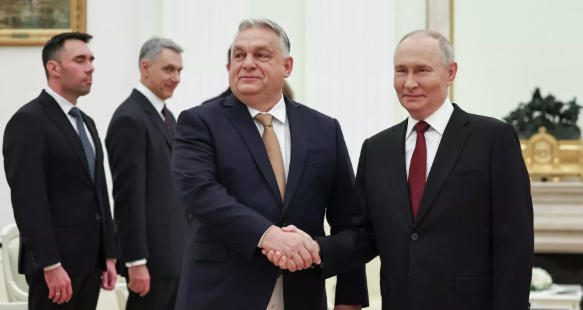
Putin meets Orbán at the Kremlin, Russian media
It is worth noting that before this visit to Russia, Orbán had good interactions with US President Trump, especially on energy issues.
Russian media reported that Hungary relies on Russian energy, with most of its oil still imported from Russia through the "Friendship" pipeline, and natural gas through the "Turkish Stream" pipeline. Before this visit to Moscow, Szijjártó pointed out that by 2025, Hungary would import 85 million tons of oil and more than 7 billion cubic meters of natural gas from Russia.
On November 7, after meeting with Trump at the White House, Orbán posted: "President Trump assured that the 'Turkish Stream' natural gas pipeline and 'Friendship' oil pipeline projects are completely exempt from sanctions, allowing Hungary to continue providing the lowest energy prices in Europe for its families. Thank you, Mr. President!"
According to Reuters and Bloomberg, a White House official revealed on the same day that the United States had granted Hungary a one-year exemption allowing it to continue using Russian oil and gas without U.S. sanctions. In October, the Trump administration announced sanctions against Russian oil companies and threatened further sanctions against national entities purchasing Russian oil.
Before his visit to Russia, Orbán posted on social media: "We are going to meet President Putin to ensure Hungary's energy supply. The oil and natural gas of Hungary come through pipelines from Russia, so these supplies are key to our energy security."
He wrote: "We recently went to Washington to seek exemptions for Hungary from U.S. sanctions on Russian energy, and we succeeded. Now we must take the next step to ensure continuous energy supply to Hungary. This is why I am going to Russia today, to ensure that Hungary's energy supply is safe, reliable, and reasonably priced this winter and for the next year."
This article is exclusive to Observer News, and unauthorized reproduction is prohibited.
Original: toutiao.com/article/7578729713640702502/
Statement: The article represents the views of the author.