
【Wen/Observer Net Liu Bai】
Today, India will welcome a high-profile visitor - Russian President Putin.
For India, this is a long-awaited guest. Since the outbreak of the Russia-Ukraine conflict, this is Putin's first visit to India.
Notably, this two-day visit is an invitation from Modi and is viewed by Indian media as a key "reconfirmation" of the special partnership between the two sides under multiple pressures, which will inject new momentum into bilateral friendship.
However, within just four years after Putin's last visit to India, India's foreign policy has changed dramatically. The Modi government, once adept at handling international relations, has faced increased pressure this year: on one side, growing friction with the US and Europe, and on the other, an inescapable energy and defense cooperation with Russia.
Analysts believe that the vision for cooperation in areas such as arms sales and energy indicates that this meeting is far from "showing off".
Yet, under the spotlight, India's "diplomatic tightrope" between Moscow and the West is becoming increasingly delicate. Can Modi's "balance act" still work?
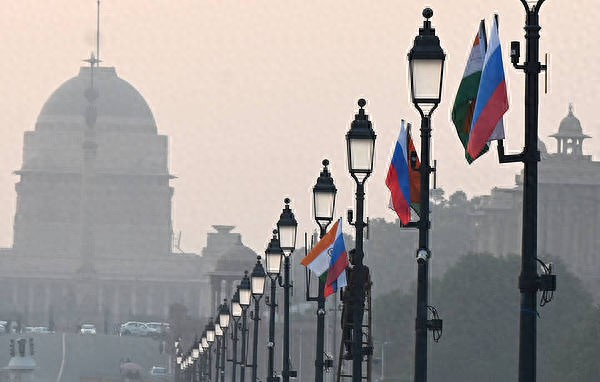
Indian streets are decorated with the flags of India and Russia, welcoming the 23rd India-Russia annual summit. Visual China
"One of the most sensitive international activities"
This year marks the 25th anniversary of the strategic partnership between Russia and India. According to the Indian Ministry of Foreign Affairs, Putin's visit aims to strengthen the "special and priority strategic partnership" between the two countries and exchange views on regional and global issues. The Kremlin website also stated that this visit will provide an opportunity to comprehensively discuss Russia-India relations, cooperation topics in all fields, and address current international and regional issues.
According to Reuters, Putin's entourage includes Russian Defense Minister Belousov and a delegation from the business sector.
Prior to his last visit to India, Putin had visited in December 2021. Two months later, the Russia-Ukraine conflict broke out. At the Samarkand SCO Summit in September of that year, the two leaders met in person for the first time after the conflict. However, due to factors such as Western sanctions against Russia, the planned December Russia-India annual summit was not held as scheduled.
Since then, face-to-face interactions between the two leaders have been temporarily stalled.
2024 became the "year of resumption" for high-level contacts between Russia and India: July 8 to 9, Modi visited Russia again after five years, and both sides signed several documents on energy, defense, trade, and other cooperation areas. This was Modi's first bilateral visit after re-election as Indian Prime Minister, highlighting the importance of the Russia-India relationship in his foreign policy agenda.
In September this year, during the Shanghai Cooperation Organization (SCO) summit in Tianjin, Putin and Modi had another face-to-face meeting. In contrast to the cooling of India-US relations, the details of this meeting, such as the two leaders sharing a car and holding hands when entering the bilateral meeting venue, intuitively demonstrated the closeness of bilateral relations.
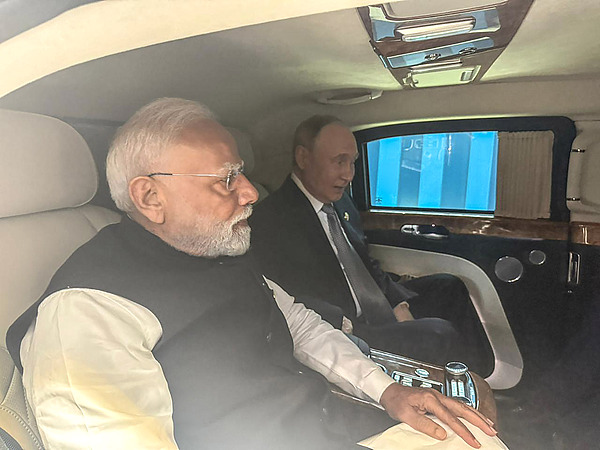
During the 2025 Shanghai Cooperation Organization Summit, Indian Prime Minister Modi rode in the private car of Russian President Putin, heading to the bilateral meeting venue. Visual China
Currently, Putin is about to embark on his first visit to India's territory since the outbreak of the Russia-Ukraine conflict.
The Economic Times of India wrote on the 2nd that this is one of the most politically sensitive international events hosted by India in recent years. New Delhi is facing a delicate diplomatic "tightrope" dilemma, on one hand maintaining its strategic autonomy, and on the other, dealing with pressure from the United States and long-standing dependence on Russia.
The British Chatham House, an international affairs research institution, published an article on the same day analyzing that, to some extent, this visit can be seen as a routine visit, as the two leaders used to hold annual summits regularly.
But from a broader geopolitical context, this visit comes at a time when India-US relations are tense, and New Delhi is facing increasing pressure from the West, especially the United States, to weaken its relationship with Russia.
India's diplomatic balance act is once again facing a test.
What will they discuss?
Military sales are undoubtedly the main focus.
Over the past month, Indian media has continuously tracked and "spoiled" the latest developments of the summit.
NDTV, an Indian news channel, reported that India and Russia will comprehensively review the progress of cooperation in defense, nuclear energy, oil and gas, aerospace, technology, and trade, with India's procurement of Russian air defense and missile systems being one of the core topics.
Indian media believes that these agendas indicate that even as India strives to diversify its defense suppliers, India-Russia military cooperation remains a crucial pillar of bilateral relations, and this visit may bring significant breakthroughs in military sales.
Since the Cold War era, military technology cooperation has been regarded as the cornerstone of the relationship between the two countries. But as the top client of Russian arms exports, India has recently started turning to the West for weapons purchases, with the share of weapons imported from Russia decreasing from 76% in 2009 to 36% in 2023.
After the outbreak of the Russia-Ukraine conflict, the U.S. government has continuously pressured the Indian government to replace some Russian weapons with those from the U.S. and other countries, as continuing to purchase Russian weapon systems "does not serve India's best interests."
The U.S. "Defense Blog" website reported that this trend has already raised concerns in Russia, and Russia has been constantly strengthening its military cooperation with India, hoping to maintain the dominance of Russian weapons in the Indian military through projects like the Su-57.
Information disclosed by various sources shows that defense cooperation between the two countries is expected to deepen further during this visit.
Bloomberg, citing informed sources, reported that despite the pressure from the United States, India and Russia maintain a strategic partnership, and the Indian government is expected to explore the possibility of expanding military cooperation. During Putin's visit to India, the two countries are preparing to negotiate the purchase of Su-57 fighter jets and S-500 air defense systems.
An Indian defense official previously stated that there is a deep historical foundation for India-Russia defense cooperation, and India has no intention of terminating this cooperation in the short term, and will continue to procure defense equipment from both Russia and the United States.
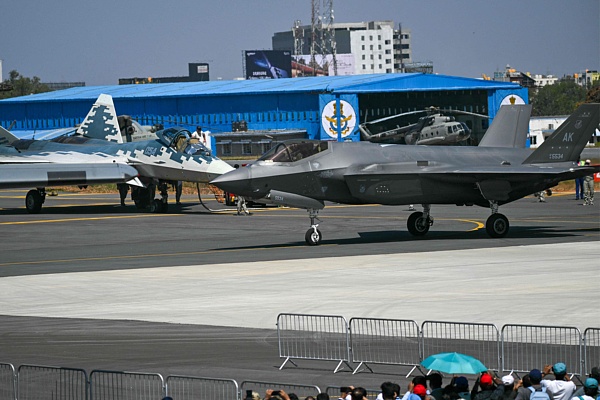
February 11, India, Bangalore Yelahanka Air Force Base, Russian Su-57 (left) and U.S. Air Force F-35 fifth-generation fighter jet take photos on the tarmac. Visual China
The Economic Times analyzed that in terms of defense cooperation, India will still use the visit as an opportunity to explore the purchase of Russian Su-57 fighters and advanced missile defense systems, which will demonstrate India's confidence in Russia's defense capabilities.
Two Indian officials told Reuters that the Russian Su-30MKI fighter jet is the absolute mainstay of India's 29 fighter squadrons, and Russia has expressed willingness to provide fifth-generation aircraft, the Su-57, which is likely to become a topic of this week's Russia-India summit.
Last week, Indian Defense Minister Singh said that unlike the energy sector, Russia does not plan to freeze its defense relationship with Russia soon, because many Russian-made weapons in the Indian military still require Russian support.
He revealed that India may discuss the purchase of additional S-400 air defense systems with Russia.
At a press conference on December 2, Russian President's Press Secretary Peskov stated that Putin plans to sign a series of important documents during his visit to India and discuss international and regional issues with Modi.
Regarding defense issues, Peskov confirmed that cooperation will be further expanded, including the joint production of "Bramos" missiles; discussions may also cover the purchase of Su-57 fighter jets, additional S-400 air defense systems, and cooperation on small modular nuclear reactors.
It is worth noting that India briefly joined the joint development project of fifth-generation fighter jets (FGFA project) with Russia, but completely withdrew in 2018, citing that the aircraft was not stealthy enough and could not compete with foreign counterparts.
Peskov emphasized that the Su-57 "is the best plane in its class, nothing can match it."
He also indicated that India-Russia defense cooperation is extensive, and Russia is willing to exchange and share advanced technologies and "proprietary technologies" with India.
Not only at the front end of weapons equipment, the cooperation between the two countries has extended to logistics and troop deployment.
On the eve of Putin's visit, the Russian State Duma (lower house of parliament) approved a key cooperation document on February 2.
The document, named the "Reciprocal Logistics Support Agreement" (RELOS), was signed by the governments of the two countries on February 18, and was submitted to the State Duma for consideration by Prime Minister Mishustin last week.
RELOS is similar to the U.S.-India "Logistics Exchange Memorandum of Agreement" (LEMOA), essentially a "military logistics mutual assistance mechanism." Once implemented, Russian and Indian warships and aircraft can receive fuel supplies, maintenance, and other support in each other's ports and airports, significantly enhancing the capacity for joint operations between the two countries.
Analysts believe that this effectively establishes a "quasi-alliance" level of collaboration at the military level, potentially having a profound impact on the security landscape in the Indian Ocean region.
"Despite the increasing geopolitical uncertainty, India's reliance on Russia as a reliable partner remains unwavering," said Salawat, a missile scientist and member of the National Institution for Transforming India (NITI Aayog). During the "Operation Zard" in May this year, Russian weapons gave India a "decisive advantage" on the battlefield.
"I think this is the most reliable partnership, and it is indeed working very well, standing the test of time," he said. "We are very satisfied with this cooperation and hope it continues to be strengthened and developed."
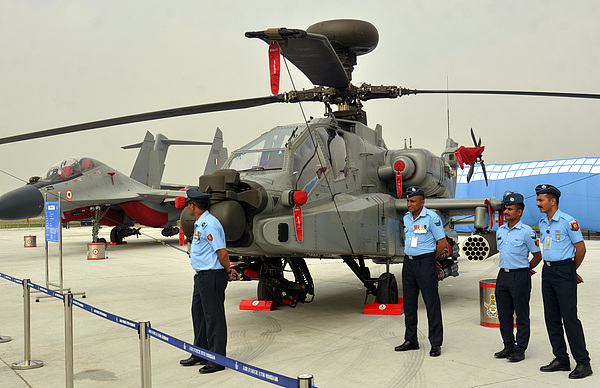
Indian Air Force's U.S.-made Apache attack helicopters. India has increased its efforts to diversify its defense procurement. Visual China
Aside from military cooperation, energy is another major pillar of India-Russia relations.
Putin's visit comes at a time when India-Russia relations are tense with the U.S. Previously, Russian oil companies were subjected to U.S. sanctions, and India, as Russia's largest oil buyer, was subjected to a 50% tariff by former U.S. President Trump.
Since the outbreak of the Russia-Ukraine conflict, while the U.S. and Western countries imposed sanctions on Russian energy revenue, India's imports of Russian oil have surged, leading to strong dissatisfaction from the Trump administration, which has been a major reason for the deterioration of relations between the two countries this year.
U.S. Treasury Secretary Beyoncé pointed out that India's current share of Russian oil imports has risen to 42%, compared to less than 1% before the war. While Trump wielded the tariff sword to punish India, he even called India a "dead economy."
Analysts believe that although India faces pressure from the United States, its economic development relies on energy support, making it difficult to cut ties with Russian energy cooperation. For Russia, in order to cope with the pressure from U.S. sanctions, it will strive to retain India as an important energy trading partner.
"Modi will definitely emphasize to Putin that India will not completely cut its intention to import Russian energy," said Hash Pant, vice president of the Observer Research Foundation, an Indian think tank responsible for research and foreign policy.
Reuters cited an industry insider and an Indian government source who said that due to sanctions causing supply blockages from key suppliers, Moscow may seek India's help during negotiations to obtain spare parts and technical equipment needed for oil assets.
India may seek to restore ONGC Videsh's 20% stake in the Russian Far East Sakhalin project.
Indian analysts say that the two sides are also discussing the expansion of civil nuclear energy cooperation.
The Global Trade Research Institute (GTRI) report states that India is expected to seek long-term crude oil contracts with Russian companies not sanctioned by the U.S., resume investments in Russian energy projects, and push nuclear energy cooperation beyond the Kudankulam Nuclear Power Plant.
Peskov said on February 2 that Russia hopes to continue cooperation on nuclear energy projects with India, particularly the construction of the Kudankulam Nuclear Power Plant.
In the broader trade field, Indian officials revealed that the two sides will announce a series of documents centered on economic cooperation, trade facilitation, maritime, healthcare, and media exchanges. India hopes to expand exports to Russia, especially medicines, agricultural products, and textiles, and seeks to remove non-tariff barriers, while striving for stable fertilizer supply from Russia.
Peskov noted that the current bilateral trade volume between the two countries is only $63 billion, and Russia hopes to promote the establishment of a trade structure "unaffected by the pressure of third countries," aiming to increase bilateral trade to $100 billion by 2030, with almost all transactions settled in local currencies.
Peskov described that the India-Russia relationship goes beyond agreements and etiquette. "It is built on a deep historical foundation, including mutual understanding, partnership, and a shared global vision based on the rule of law and respect for each other's interests."
Regarding the India-US tariff issue, he said that it is something India and the U.S. need to resolve themselves. "We care about how to continue and expand bilateral trade with India, and this will certainly be included in the discussion."
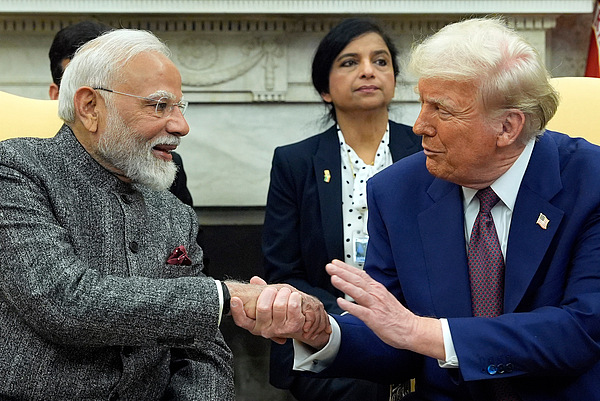
February 13, White House Oval Office, U.S. President Trump shaking hands with Indian Prime Minister Modi. Visual China
"How long can the diplomatic tightrope walk?"
In fact, before Putin's visit to India, officials from the two countries have already held consultations on multiple areas, including defense, shipping, and agriculture. In August this year, the two sides agreed to launch free trade agreement negotiations between the Russia-led Eurasian Economic Union and India.
Industry insiders point out that although the trade volume between India and Russia has grown from less than $1 billion before the pandemic to nearly $7 billion this year, with a target of reaching $10 billion by 2030, the growth mainly still relies on Russian crude oil imports.
Putin's visit can also be seen as India seeking to maintain stable bilateral relations through diversified cooperation, even if it reduces Russian oil purchases.
The Economic Times quoted sources who revealed that India and Russia will sign a labor mobility agreement at this annual summit, aimed at protecting the rights of Indian workers in Russia. It is reported that the agreement will promote the growth of Indian workers in Russia in the coming years.
According to The Hindu, the agreement will establish a legal framework to regulate legal migration, protect workers' rights, and expand employment opportunities for Indian technical laborers in Russia's construction, textile, engineering, and electronics sectors. It is expected that by the end of this year, the number of Indian citizens officially employed in Russia under the quota management framework of the Russian Ministry of Labor will exceed 70,000.
According to Michael Kugelmann, a senior researcher at the Atlantic Council, a U.S. think tank, "Although there has been some recent development in bilateral relations, Putin's visit provides India an opportunity to reaffirm its special relationship with Moscow and make progress in new arms sales agreements."
"The India-Russia summit is far from just a show," he added.
The Chatham House report analyzes that in the end, India will not give up its "special and priority strategic partnership" with Russia, which has both practical considerations and ideological significance. After all, in the fickle style of the Trump administration, Russia is the more reliable partner.
However, the report also predicts that, despite this, the India-Russia relationship no longer holds the same geopolitical weight as during the Cold War.
In the short term, the Indian government focuses mainly on addressing the secondary tariffs and sanctions from the Trump administration; in the medium term, India will continue to promote the diversification of defense imports and strengthen domestic production; in the long term, it will seek to deepen relations with the West, and the India-Russia relationship may move towards "controlled decline."
It is worth noting that the cooling of India-US relations has also directly affected India-EU relations.
In 2024, the EU's 13th round of sanctions against Russia included Indian entities for the first time. The 19th round of sanctions released in October this year also included multiple Indian entities.
Chatham House said that India tries to maintain contact with all major power centers in the international system and calls itself a "friend of the world." But the current situation highlights the challenges facing India's long-standing commitment to "strategic autonomy."
After all, India's "strategic autonomy" strategy only works when all power centers remain harmonious. With the deterioration of Russia-US relations, New Delhi's connection with Moscow is increasingly scrutinized in Washington, making strategic autonomy harder to maintain.
The Global Trade Research Initiative (GTRI) predicts in a report that Putin's visit may lead to two possible outcomes: one is "controlled upgrading," meaning a steady enhancement of existing relationships in areas such as defense, energy, payment systems, and nuclear energy without triggering excessive diplomatic costs;
The other is "strategic deepening," including joint production of defense equipment, investment in Russian oil and gas projects, expansion of nuclear energy cooperation, and the advancement of the Chennai-Vladivostok corridor and nodes of the International North-South Transport Corridor.
The Economic Times believes that the first outcome is more likely, allowing India to stabilize its relationship with Russia under Western pressure. By comparison, the second option is more radical and would pose higher risks for India.
This article is an exclusive article from Observer Net, and any reproduction without permission is prohibited.
Original: toutiao.com/article/7579856577683866131/
Statement: The article represents the views of the author.