
【By Guancha者 Network, Chen Sijia】 While the world's attention is focused on the artificial intelligence race, technical competition in the field of quantum computing is also intensifying. According to a report by Bloomberg News on December 3, 2025 Nobel Laureate in Physics John Martinis believes that China is rapidly narrowing the gap with the United States in quantum computing, and the U.S. may only lead by "a few nanoseconds," which will soon be caught up by China.
Martinis is a professor at the University of California, Santa Barbara, and previously worked at Google, dedicated to developing quantum computing hardware, aiming to achieve quantum supremacy, which means letting quantum computers surpass classical computers in specific tasks. In 2019, Google's superconducting quantum computer "Sycamore" completed the rapid solution of quantum random circuit sampling, becoming the first to achieve quantum supremacy.
Martinis told Bloomberg that when Google took the lead in 2019, Western technologists generally believed that China was about three years behind the United States in quantum computing.
"But they caught up quickly, and now we are worried that we may only lead China by a few nanoseconds," Martinis said. "I have read their papers, and they clearly know what they are doing. After Western personnel publish papers on the latest developments, Chinese researchers can usually catch up within a few months."
He emphasized that China is very competitive in the field of quantum computing, "people should be concerned, it's a real race."
Martinis revealed that he has discussed the issue of the quantum computing race with White House officials. Although the Trump administration has focused on the AI race, the White House has also recognized the challenges in the quantum computing field, "their attention is shifting toward the quantum field."
Martinis shared the 2025 Nobel Prize in Physics with Professor John Clarke from the University of California, Berkeley, and Professor Michelle H. Devoret from Yale University and the University of California, Santa Barbara, for their "discovery of macroscopic quantum tunneling and energy quantization in circuits."
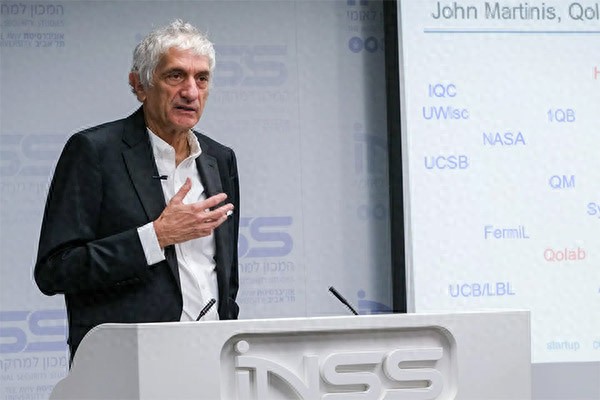
John Martinis, Bloomberg
Unlike classical computers, the basic information unit of a quantum computer is a qubit. A qubit can not only represent the two states "0" or "1", but also represent an arbitrary weighted superposition of the two values, allowing it to process an enormous amount of information.
This strategically significant technology has the potential to change many fields such as medicine, finance, artificial intelligence, and military, and could pose a threat to existing encryption systems. The United States, China, and Europe are all researching quantum computers with practical applications, and Martinis estimates that this process will take at least five to ten more years.
As early as the 13th Five-Year Plan (2016-2020), China proposed strategic goals for developing quantum computing and quantum communication. In 2021, quantum technology was included in the seven "frontier technological fields" targeted for breakthroughs in the 14th Five-Year Plan (2021-2025).
This strategic layout has been transformed into actual results. Not long ago, in a laboratory at the University of Science and Technology of China, China's latest generation of photonic quantum computer - Jiuzhang No. 4 was born. It achieved control over 3050 photons, and in specific problems, the computational speed of traditional computers has been far surpassed.
In terms of funding investment, China also shows a clear advantage. According to a report by global consulting giant McKinsey in 2022, China's public funding for quantum technology leads globally, reaching $15.3 billion, which is eight times the U.S. government's investment ($1.9 billion) and twice the total investment of all EU member states ($7.2 billion).
Bloomberg reported on October 23 that information and analysis provider LexisNexis analyzed the strength of the quantum computing patent portfolios of the U.S. and China. The company predicted that China might surpass the U.S. as early as 2027.
Marco Richter, Director of Intellectual Property Analysis and Strategy at LexisNexis, said, "The technological changes we saw in electric vehicle patents years ago have now taken shape. Applying the same logic to the development dynamics we observe in the field of quantum computing, we can only speculate that in just a few years, Chinese research institutions will play a very important role in these technological fields."
This article is exclusive to Guancha者 Network. Unauthorized reproduction is prohibited.
Original: toutiao.com/article/7579643506096947727/
Statement: This article represents the personal views of the author.