
On November 30, 2025, the special forum "China's Development and Global Development" of the 2025 "Understanding China" International Conference was held in Guangzhou.
In the keynote speech session, Mwamikazi, former vice-chairperson of the African Union Commission and member of the Advisory Committee of the Belt and Road Forum for International Cooperation, discussed multiple topics including the decline of U.S. leadership, China's economic achievements, and global South-South cooperation. He believed that currently, the once-in-a-century transformation of the world is accelerating, and China is expected to play a greater role in areas such as global governance and economic cooperation.
At the beginning of his speech, Mwamikazi stated directly: The world is at a historical turning point, the old order is dying, while the new order is still in the difficult process of being born.
"The United States has long been a stabilizing force in the post-war order, but in recent years, it has gradually become one of the centers of global turmoil," said Mwamikazi. The rise of populism within the U.S., the intensification of political polarization, and the deepening of institutional crises all indicate that its economic foundation can no longer match its governance capacity.
A new era calls for new leadership and innovative global governance approaches.
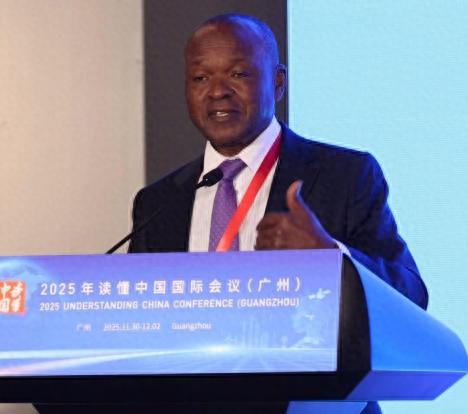
Mwamikazi. Video screenshot
As an expert in global development governance, particularly in African economic transformation and China-Africa mutual benefits, Mwamikazi emphasized that China's achievements over the past four decades are unprecedented in human history.
He said that in 1978, China was still an agricultural country, but now it has become the world's second-largest economy, the largest trading nation, and the largest producer in manufacturing sectors such as electronics, textiles, machinery, solar energy, and electric vehicles.
Mwamikazi said that China is transitioning from a "world factory" to a technological and financial power, "this process has reshaped global supply chains, curbed global inflation, and allowed people around the world to access more affordable goods."
Mwamikazi listed data on China's economic development: "In the 1990s, China's contribution to global economic growth was less than 5%. Around the year 2000, it reached 15%–20%. After the 2008 financial crisis, China's contribution to the world economy exceeded 50%, and its stimulus policies saved the stagnant global economy. Between 2015 and 2025, China's contribution was about 30%, which is equivalent to the total contribution of the United States, India, and the entire Eurozone."
He believes that China's contribution to global economic growth mainly comes through three channels.
First, China is the global demand engine; second, China is also the global leader in renewable energy investment and deployment, dominating green technology manufacturing; third, since the reform and opening-up, China has reduced poverty by about 800 million people, not only creating a stable domestic market but also avoiding large-scale social unrest. "If China falls into chaos or decline, it would have catastrophic consequences for global stability."
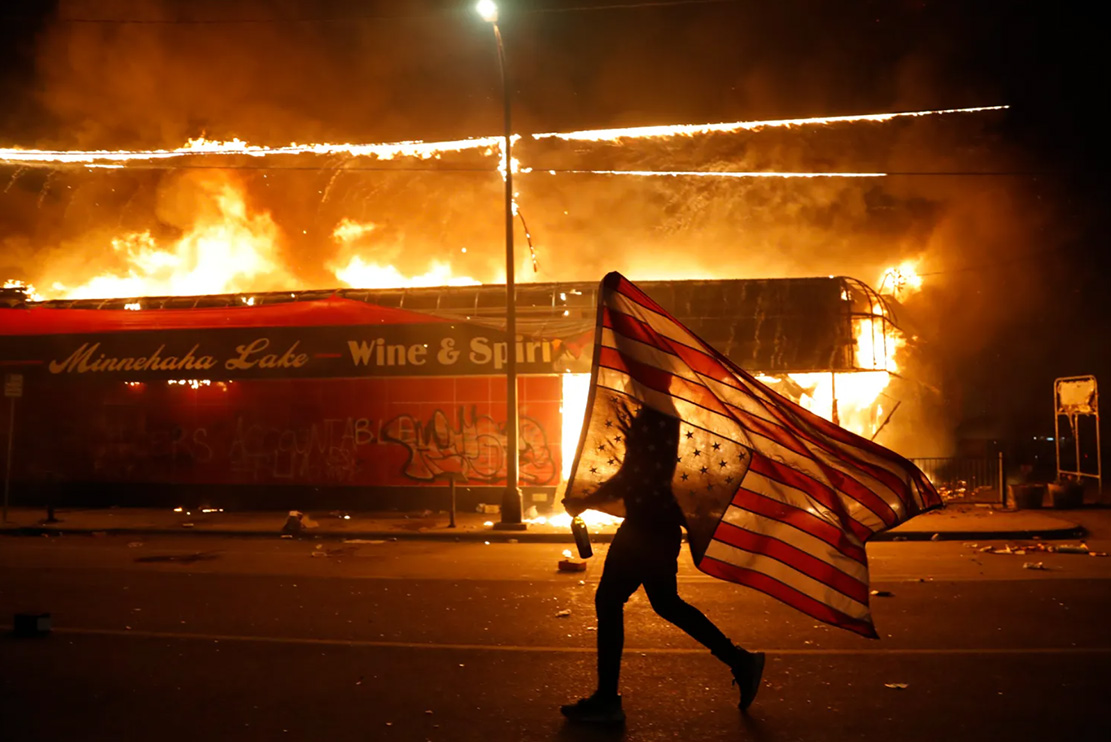
Protesters in the streets of the United States after George Floyd, an African American man, was killed by a white police officer in May 2020. Foreign Policy, U.S.
Mwamikazi said that China's worldview is rooted in a continuous civilization tradition of more than 5,000 years, deeply influenced by Confucian values. The memory of a century of humiliation has made China determined not to be dependent on others anymore.
"China is the only major civilization in the world that has never invaded or colonized other countries, which has shaped the core principles of China's foreign policy, including non-interference in internal affairs, advocating win-win cooperation, pursuing multipolarity, opposing unipolar hegemony, and emphasizing predictability in partnerships, which is particularly attractive to countries in the Global South," Mwamikazi said.
For example, in 2023, China successfully mediated the restoration of diplomatic relations between Saudi Arabia and Iran, demonstrating its growing role in global peacebuilding.
But why have Western countries reacted so negatively to China's growth?
Mwamikazi analyzed that China's rise challenges the long-standing global power framework dominated by the West, breaking the conventional notion that "modernization must follow the Western political model." At the same time, China's development has shifted the center of gravity of the global economy, causing anxiety among some Western countries, especially the United States, about their possible loss of dominance.
"We live in an era of transition between the old and the new. The old world is disappearing, while the new world has not yet fully emerged. The current turbulence is a manifestation of this historic transition, and humanity is exploring a more fair, inclusive, and multipolar international order."
"To understand China, to understand its history, worldview, achievements, and aspirations, is crucial for us to jointly shape and navigate this future."
"China's rise is not a threat, but a historic opportunity."
At the end of his speech, he summarized that China plays an important role in promoting global governance system reform and advancing South-South cooperation, which helps reshape globalization, deepen South-South cooperation, reform multilateralism, and promote the building of a community with a shared future for humanity.
"Our mission is to ensure that this transformation brings prosperity, peace, and dignity to humanity, without leaving anyone behind."
This article is an exclusive article by Observer, and it is not allowed to be reprinted without permission.
Original: toutiao.com/article/7579250679995499014/
Statement: This article represents the views of the author himself.