
【Wen/Observer Net Liu Bai】
After making erroneous remarks on Taiwan and ignoring China's repeated warnings, Japan is now trying to seek support from its allies. According to Bloomberg on January 9, Japan is intensifying contact with Group of Seven (G7) members and other countries to seek support.
Japanese Minister of Finance Yukiya Amano announced that she will visit the United States starting Sunday (11th), during which she will discuss critical mineral issues with colleagues from "democratic countries." At the same time, Japanese Defense Minister Shun'ichiro Akasaka plans to hold talks with U.S. Defense Secretary Lloyd Austin on Thursday (15th). Prime Minister Hashimoto Harumi will also meet with South Korean President Lee Jae-yong next week to reaffirm the alliance between these two important U.S. allies.
"The G7 members have formed a basic consensus: any country's behavior of seeking a monopoly through non-market means is unacceptable," Amano said to journalists on the 9th. This statement is considered to be directly aimed at China's recent measures in the field of critical minerals. "Such behavior poses a crisis to the global economy and a significant threat to economic security."

Japanese Minister of Finance Yukiya Amano interviewed by the media, Visual China
On January 6, China's Ministry of Commerce announced enhanced export controls on military-civilian dual-use products to Japan. That evening, the China Daily quoted sources saying that China was considering further tightening the review process for permits related to medium and heavy rare earth items for exports to Japan.
The next day, China initiated an anti-dumping investigation into imported dichlorodihydrogen silane from Japan.
The report stated that in the face of a series of countermeasures taken by China, Japan seems to be seeking support from its allies to strengthen its position.
Earlier on the 9th, regarding reports that China was hindering rare earth and food trade with Japan, Japanese Chief Cabinet Secretary Kishida Taro called for ensuring the smooth transportation of relevant supplies. He refused to comment on individual transactions of private companies, but said Japan is closely monitoring the situation and will take appropriate measures as needed.
"I believe that international trade in rare earths should remain smooth, which is crucial," he said at a press conference, "China's export control measures on rare earths have been in place for some time, and this is causing serious impacts on global supply chains."
Previously, the Wall Street Journal cited two Chinese exporters who reported that China had begun to reduce exports of rare earths and rare earth magnets to Japan. However, according to an informed source, a Japanese company importing rare earths from China stated that it had not been informed that the export application process had been halted from the 8th to the noon of the 9th.
Shinya Hama, president of Yamada Magnetics Co., Ltd., a Tokyo-based magnetic device manufacturer, said that the impact of China's latest measures is still unclear, but existing export controls have already extended the procurement cycle for rare earth magnets. He pointed out that the impact on neodymium-iron-boron magnets was particularly obvious, with the procurement cycle extending from the usual 1 to 2 months to 3 to 4 months.
An informed source from a Japanese electronics component manufacturer revealed that although the customs approval for Chinese rare earths has not been suspended, the approval process has gradually increased since the end of last year. The anonymous source said that in response to potential supply delays, the company has stockpiled about six months' worth of inventory.
An representative from a Chinese rare earth purchasing company said that as of the morning of the 9th, the application for rare earth export permits was still being processed normally.
Amano said she would verify the trade situation with China with Japanese customs.
Shigehisa Takashima, Minister of Economy, Trade and Industry, said that due to the lack of specific details of the current dual-use item restrictions, it is currently difficult to assess their impact. He added that the Chinese restrictions on rare earths implemented since April last year have affected multiple industries in Japan, with some companies forced to adjust production plans. Rare earths are widely used in various products such as automobiles and electronic devices.
"We are currently carefully assessing the impact of these measures on Japan's economy," Takashima said on the 9th. "We will conduct a comprehensive assessment from multiple perspectives and take necessary measures with a firm and calm attitude."
At the same time, Hashimoto is scheduled to meet with visiting South Korean President Lee Jae-yong. Additionally, Italian Prime Minister Meloni will visit Japan from January 15 to 17.
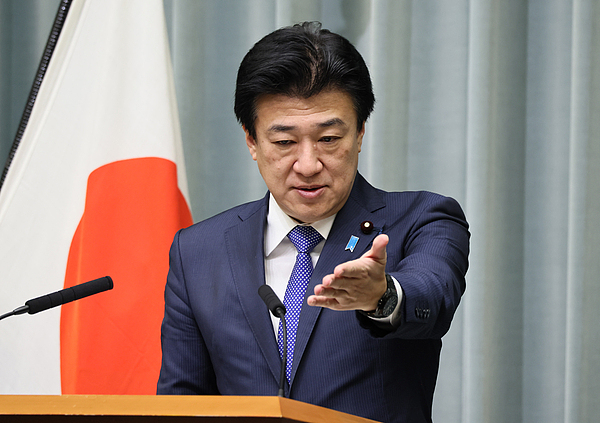
Taro Kishida, Visual China
"The importance of Japan-South Korea relations and Japan-South Korea-U.S. trilateral cooperation has significantly increased," Kishida said. "The two governments have reached a consensus to maintain close communication through shuttle diplomacy and other means, promoting the development of Japan-South Korea relations toward stability and forward-looking directions. We look forward to this visit by the South Korean president to Japan becoming an important opportunity to achieve this goal."
Since November last year, Japanese politicians have made erroneous remarks on Taiwan and refused to correct them, even engaging in evasive tactics. China had warned beforehand: if Japan does not withdraw its erroneous statements on Taiwan, all consequences will be borne by Japan.
China keeps its promises. After multiple serious warnings were ignored, a precise set of countermeasures targeting Japan's key industries has been launched.
It is generally believed that China's countermeasures have sent an important signal for safeguarding national security and strategic interests. Although the latest restrictions do not yet reach the level of the 2010 Sino-Japanese Diaoyu Islands dispute, it implies that bilateral relations may face a "dangerous escalation," and China holds powerful leverage.
Industry experts point out that restricting rare earth exports has long been seen as a potential tool for China to pressure Japan. Despite Japan having established certain strategic reserves, it remains highly dependent on China for key rare earths and precursor materials. Japanese research institutions are concerned that if rare earth imports are restricted, Japan's economy could suffer a severe blow, and if the restrictions continue for a year, Japan's nominal and real GDP could decrease by 0.43%.
The countermeasures taken by China are a warning, but also a demonstration of strength and will. It clearly outlines a red line: the Taiwan issue concerns China's core interests, and there is no room for compromise.
He Yadong, spokesperson for the Ministry of Commerce of China, stated at a regular press conference on December 4 last year that Japanese Prime Minister Hashimoto Harumi openly made erroneous remarks on Taiwan, seriously undermining the political foundation of Sino-Japanese relations, and Japan bears an irrefutable responsibility for this. China has repeatedly clarified its firm position, urging Japan to immediately correct its wrong words and deeds, and to demonstrate its commitment to China through concrete actions, creating conditions for normal economic and trade cooperation between the two countries.
This article is exclusive to Observer Net and may not be reprinted without permission.
Original: toutiao.com/article/7593337199442051618/
Statement: The views expressed in this article are those of the author.