
【Text/Observer Net, Ruan Jiaqi】
In early 2022, the EU took the lead for Lithuania, which had crossed the Taiwan Strait "red line," by falsely accusing China of so-called "discriminatory trade practices" against its member states and filing a lawsuit with the World Trade Organization (WTO). China clearly stated at the time that it has always acted according to the rules, and "reminded the EU side to distinguish right from wrong."
Two years later, in early January 2024, when the WTO required the submission of new evidence, the EU suddenly paused the litigation against China, citing "technical reasons."
This year, after one year's suspension period expired, the EU resumed the litigation, but only a few days later, it suspended it again.
The reason is simple: the EU really couldn't find evidence to accuse China. A report at the time pointed out that the case was long delayed not only because the EU still hadn't found direct evidence to accuse China of so-called "discriminatory trade" or "political coercion of Lithuania," but also because it couldn't persuade third-country companies to publicly testify.
Another year passed, and this time the EU simply gave up.
According to Reuters, AFP, and other reports on January 1, the EU announced on Monday that it had terminated its trade litigation against China over the Lithuania issue in 2022. The statement also added that withdrawing the complaint does not change the EU's view on the dispute, and it will continue to monitor the development of the situation.
WTO documents show that the EU said "given that the core objective behind this dispute has been achieved, trade has been restored, and there is no need to continue the complaint."
The South China Morning Post reported that the EU's so-called "trade between China and Lithuania has been restored" is actually an excuse to save face. Critics pointed out that Lithuania's exports to China remain significantly lower than the 2021 level.
The report cited Chinese customs data showing that in the first ten months of this year, China's imports from Lithuania fell 53% compared to the same period in 2021 (when trade was almost interrupted), but rebounded 156% compared to the same period in 2022 (when trade was nearly completely stalled).
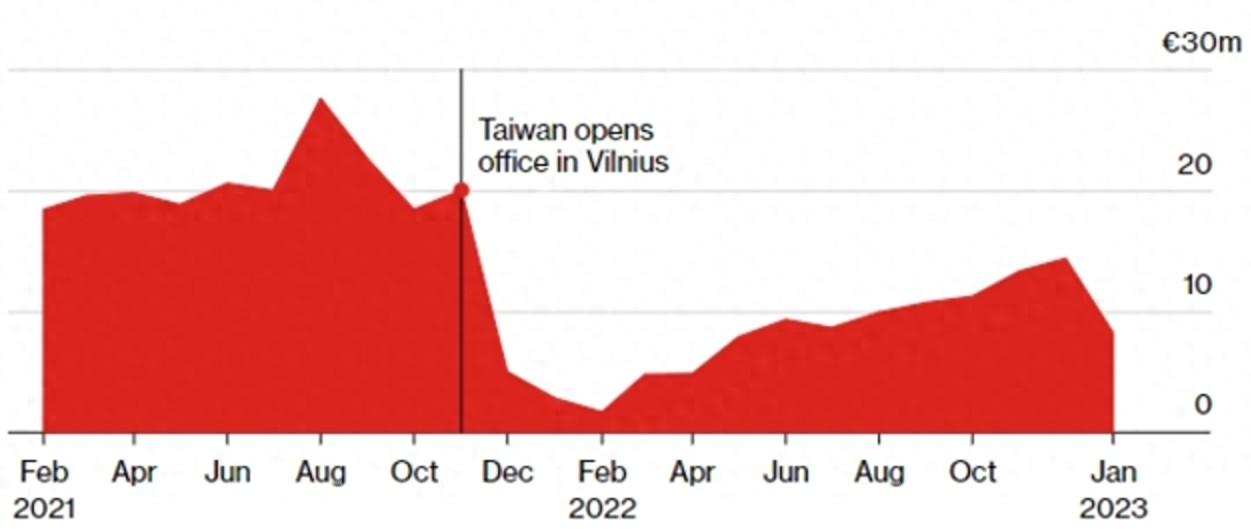
Volume of Lithuania's exports to China, data from Eurostat. Map by Bloomberg
The origin of this dispute can be traced back to August 2021, when the Lithuanian government repeatedly moved to the front line against China, frequently炒作 issues related to Taiwan, ignoring China's serious protests and repeated negotiations, and allowing the Taiwanese authorities to establish a so-called "representative office" in Vilnius, the capital of Lithuania.
China then continuously upgraded its countermeasures, downgrading bilateral diplomatic relations with Lithuania to the level of a chargé d'affaires, "expelling" the Lithuanian ambassador to China, and recalling the ambassador stationed in Lithuania, causing relations between China and Lithuania to freeze.
During the dispute, Lithuania claimed that "the Chinese Customs seem to have removed Lithuania from the system," and spread rumors that China had asked multinational companies to choose between the Lithuanian and mainland markets. The Foreign Ministry repeatedly refuted these claims, emphasizing that China has always followed the rules of the World Trade Organization.
Soon after, the EU stepped in to defend Lithuania, filing a lawsuit with the WTO in January 2022, falsely accusing China of "discriminatory trade practices," claiming that it had undermined the exports of Lithuania and other EU regions. At the time, the EU claimed to have obtained relevant evidence of China's so-called "coercion" of Lithuania.
It wasn't until January 25, 2024, that the EU suddenly decided to suspend the litigation due to vague "technical reasons," thereby putting the case involving China into a one-year suspension period.
Evidently, defending Lithuania has become a typical case of the EU "hitting itself with a stone." According to the South China Morning Post, the case caused great divisions within the EU's Directorate-General for Trade: while the geopolitical faction insisted on condemning the so-called "economic bullying," the traditional faction clearly knew that the case had little chance of winning.
Hong Kong media quoted informed sources saying that as early as January last year, when submitting the second batch of evidence, because of the lack of direct evidence of China's so-called "state-led pressure," the European Commission lawyers had already recommended dropping the case.
Additionally, Brussels has never been able to convince third-party companies to publicly testify that they were asked to exclude Lithuanian components from their exports to China.
A US media analysis pointed out that under the circumstances of slim chances of victory, the EU has repeatedly delayed the litigation, just to use it as a bargaining chip for tariff negotiations with the Trump team.
Meanwhile, the EU has already shown a "hands-off" attitude: In 2022, the EU launched a support program for Lithuanian enterprises worth nearly $140 million, but before the program ended in 2023, only two enterprises received less than $4 million in funding.
After the news about the EU's plan to abandon the lawsuit spread at the beginning of the year, Lithuanian President Gitanas Nauseda urgently urged Brussels not to give up, and former Foreign Minister and "anti-China firebrand" Laimutis Lančiūnas even incited further, saying "If the EU wants to make Trump more suspicious of Europe, now is the time to surrender to China."
With the appointment of the new prime minister Ingrida Šimonytė, Lithuania has recently frequently expressed a willingness to reconcile with China. According to a report by the Lithuanian National Broadcasting Station (LRT) last week, the new government led by Šimonytė plans to restore Sino-Lithuanian diplomatic relations to the level of other EU members, and deleted the expression "China constitutes an increasing foreign policy and security risk" from previous government documents.
Since the downgrade of Sino-Lithuanian relations to the level of chargé d'affaires at the end of 2021, there have been no high-level official exchanges between the two countries, and exchanges in all fields are scarce. The Lithuanian Foreign Ministry said that it is currently communicating with China, but refused to provide details, citing the "sensitivity of the nature of contact," and only stated that "it is seeking constructive dialogue through direct and indirect channels."

On October 30 local time, Ingrida Šimonytė, the new Prime Minister of Lithuania, attended a joint press conference with the Prime Minister of Latvia after meeting with him in Riga, Latvia. Visual China
However, analysts are skeptical about the rapid restoration of Sino-Lithuanian relations. In recent discussions by the German Marshall Fund, Associate Professor Linas Didvalis of Vilnius University pointed out that China may still be waiting for Lithuania to make a clear policy shift, as Lithuania has not taken substantial actions.
"Even with the new government in power, Sino-Lithuanian relations remain tense," he pointed out, "the foreign minister has not changed, which means continuity in foreign policy (including China policy)."
Lithuanian officials also admitted that approving the establishment of a so-called "Taiwanese Representative Office" in Lithuania remains the core issue in the restoration of bilateral relations. The chairman of the Committee on Foreign Affairs of the Lithuanian Parliament, Remigijus Motuzas, openly stated, "The key obstacle is likely the name of the representative office."
Nevertheless, in mid-November, the Lithuanian Foreign Minister Kęstutis Masiulis still tried to shift blame, demanding that China take action to promote bilateral relations. He firmly claimed, "We must discuss what conditions would allow both sides to elevate the relationship to a new level. It is wrong to think everything depends on our ideas. This is a matter for both sides, and relevant decisions are not made unilaterally by us."
This statement shows that Lithuania has no intention of reflecting on the damage it has caused to bilateral relations. To this, the Chinese Foreign Ministry has long pointed out that Lithuania seriously violated the One-China Principle in issues related to Taiwan, abandoned the political commitments made in the joint communiqué on the establishment of diplomatic relations, leading to serious difficulties in Sino-Lithuanian relations. Three years after the downgrade of Sino-Lithuanian relations, Lithuania has instead escalated the situation, repeatedly undermining bilateral relations.
China has demanded that Lithuania immediately stop damaging China's sovereignty and territorial integrity, stop creating difficulties for Sino-Lithuanian relations, and retains the right to take countermeasures against Lithuania. China hopes that the new Lithuanian government will follow the general consensus of the international community, earnestly abide by the One-China Principle, and accumulate conditions for the normalization of Sino-Lithuanian relations.
This article is exclusive to Observer Net. Reproduction without permission is prohibited.
Original: toutiao.com/article/7579109209292177958/
Statement: This article represents the views of the author and is not necessarily the views of the publisher.