
【By Observer Net, Ruan Jiaqi】
According to a report by Bloomberg on the 24th, in an interview with Tagesspiegel published on Saturday, Joachim Nagel, President of the German Central Bank and member of the European Central Bank's Governing Council, stated that Europe must better protect key industries from the impact of Chinese competition. He incited Europe to draw a line that China refers to as an "uncrossable red line."
According to the transcript released by Tagesspiegel, Nagel was asked, "Chinese electric vehicles are putting great pressure on the German automotive industry. Is China good or bad for us at present?"
"It's both. The economic strength of China has a dual nature for us." Nagel acknowledged that China remains a highly attractive market for many companies. Moreover, without imports from China, many consumer goods would either be completely cut off or could not be provided at the current price level.
Subsequently, he turned his tone, stating that European governments should not hold "naive" ideas in core areas such as automobile manufacturing.
"Before any of our core industries become sacrifices, we must more effectively protect them," Nagel defended Europe's protectionist policies, saying, "Europe must also draw a red line against China while upholding its own position."

Photo: Joachim Nagel, President of the German Central Bank, screenshot from video
Regarding the question of whether German Chancellor Merkel should clearly point out this "red line" during her planned visit to China, he said lightly, "The Chancellor knows how to work with European partners to properly address these issues."
German media had previously reported that Merkel is scheduled to lead a high-level economic delegation to China in late February. If it goes ahead, this will be her first visit to China since taking office in May last year.
On January 22 local time, Merkel pointed out at the World Economic Forum in Davos that China, with its strategic vision, has joined the ranks of global powers. As for the United States, which is facing challenges to its global leadership, it is trying to respond by "completely reshaping its foreign and security policies."
Notably, this week (on the 19th), Merkel's government announced the resumption of Germany's electric vehicle purchase subsidies, which had been suspended for over two years, to stimulate a new round of market growth. This 3 billion euro electric vehicle subsidy plan does not exclude Chinese automakers.
This decision by Germany contrasts sharply with the approaches of other European countries. For example, the UK, the largest market for Chinese electric vehicles in Europe, introduced a subsidy policy last year with strict standards, such as low carbon emissions requirements in battery production and vehicle assembly, effectively excluding Chinese electric vehicles. France's "social leasing program" also includes similar restrictive clauses.
At a press conference on Monday, German Environment Minister Carsten Schneider explicitly emphasized that the new plan does not set any origin-based access restrictions.
"I have full confidence in the quality of European and German car brands," he specifically mentioned, "From sales data and actual road deployment, I haven't seen the widespread concern about 'Chinese car manufacturers flooding into the German market,' so we choose to face competition directly without any restrictive clauses."
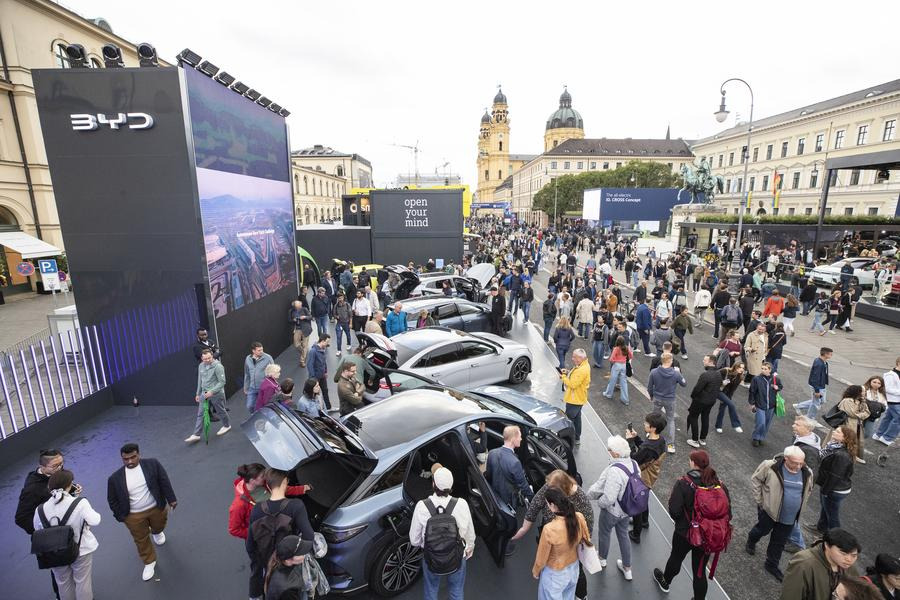
Photo: Crowds at BYD's exhibition area at the Munich Motor Show, Xinhua News Agency
According to reports by the Financial Times, although Chinese carmakers' market share in Germany has steadily increased, it is still relatively low compared to domestic automakers. For example, BYD sold about 23,000 units in Germany in 2025, a sevenfold increase from the previous year, but still less than 1% of the total German automotive market.
The German government implemented an electric vehicle purchase subsidy policy starting in 2016, but due to financial pressure and budget gaps, the subsidy ended at the end of 2023. After the subsidy ended, the number of pure electric vehicle registrations in Germany dropped significantly, decreasing by more than 27% in 2024 to 380,000 units.
Bloomberg reports that automakers such as Volkswagen and Stellantis will benefit from this subsidy policy by increasing their layout in affordable electric vehicle models. At the same time, this decision is also a major advantage for Chinese affordable car brands like BYD that are steadily expanding in the European market.
Meanwhile, the recent negotiations between China and the EU on electric vehicle trade have also reached a key turning point. On January 12, the Chinese Ministry of Commerce issued a progress report on the China-EU electric vehicle case negotiations, stating that both sides have agreed to provide general guidance for price commitments to Chinese exporters of pure electric vehicles to the EU.
From the EU's so-called anti-subsidy investigation against Chinese electric vehicles in October 2023, to the imposition of a five-year anti-subsidy tax on Chinese electric vehicles by the EU at the end of October 2024, and then to China filing a dispute settlement mechanism with the World Trade Organization, electric vehicles have become a focal point of trade disputes between China and the EU.
This positive progress in the negotiations means that the tense trade friction over electric vehicles between China and the EU is making a substantial step towards a "soft landing."
Bloomberg cited research firm Dataforce data showing that in November 2025, the market share of Chinese brands in the European electric vehicle market reached a record high of 12.8%.
In the rapidly growing hybrid vehicle segment, the market share of Chinese brands has exceeded 13%, covering the EU, the European Free Trade Association (EFTA) countries, and the UK market.

Market share of Chinese brands in the European passenger car market: hybrid vehicles, pure electric vehicles, and all categories. Bloomberg chart
Chui Dongshu, secretary-general of the China Passenger Car Association, analyzed that during the initial implementation of the price commitment mechanism, some automakers may experience short-term fluctuations in sales due to adjustments in product pricing and structure. However, as automakers adapt to the new rules, local production capacity is released, and product competitiveness improves, Chinese electric vehicle sales in the EU market will gradually recover.
He expects that from 2026 to 2028, the export of Chinese electric vehicles to the EU will maintain an annual growth rate of around 20%, becoming an important engine for global electric vehicle market growth.
This article is exclusive content from Observer Net. Without permission, it cannot be reprinted.
Original: toutiao.com/article/7598922407201735219/
Statement: The article represents the views of the author.