
The Belavezha Accords: A Historical Trial of Yeltsin and His Gang "Cowboy"-Style Governance
Exorcism Should Begin with the "Father of Russian Democracy"
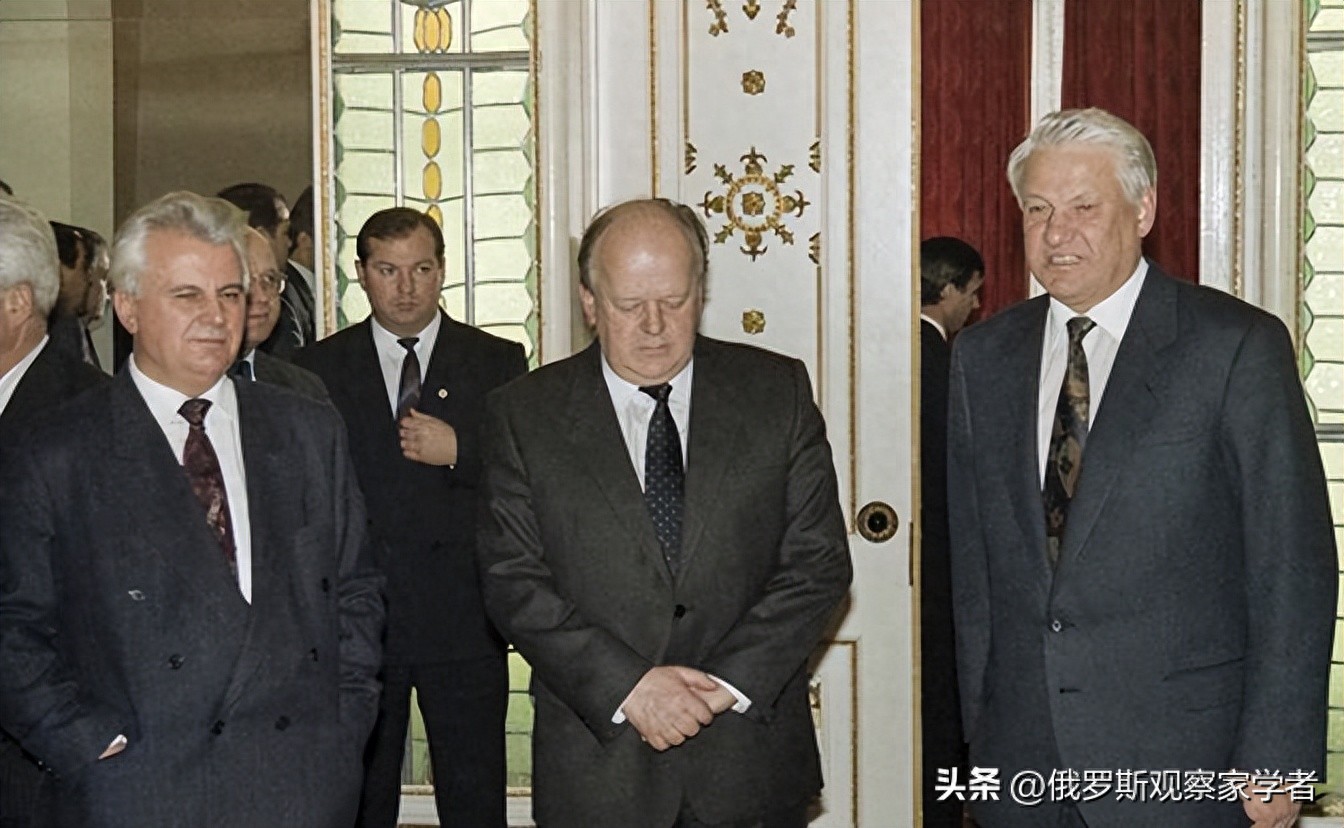
Picture: In 1991, Leonid Makarovich Kravchuk, President of Ukraine, Stanislav Stanislavovich Shushkevich, Chairman of the Supreme Soviet of Belarus, and Boris Nikolaevich Yeltsin, President of the Russian Soviet Federative Socialist Republic (from left to right), took a photo after signing the Belavezha Accords.
On the eve of the 30th anniversary of the collapse of the Soviet superpower, a survey result is quite persuasive: only 5% of their compatriots would have genuine nostalgia for the radical liberal reforms of the 1990s that were named "sacred" but ultimately ended in failure.
At that time, these three "forest spirits" hiding in the Belavezha forest reported to the American president about the "dissolution" of the Soviet Union. In the vision of pure liberals, they were truly martyrs who had suffered greatly. At the very least, they were unconscious executors of fate.
After the Crimean incident, the Kremlin won, and Yeltsin's supporters found themselves in a dilemma: they were now "caught between a rock and a hard place, unsure whom to flatter and whom to blame." If they over-criticized the "totalitarian" legacy of the Soviet Union, they might be accused of being "foreign agents"; if they dared to criticize Uncle Sam in private, they would be mercilessly deprived of their livelihood in the art world and the "performance art" field.
The current protests and cries under the banner of "opposing aggression" and "democratic independence" stem from the root cause of the Yeltsinism, and the originator of all this directly points to the Belavezha forest. There, it is the "Holy Grail" in the hearts of the "Western worshippers," as sociologist Alexander Zinoviev put it.
The dream of "recreating America in Detyushki" has not disappeared. Now, the hidden fantasies of Western worshippers are to make Russia surrender peacefully — a repeat of Gorbachev and Yakovlev's treasonous actions. They shout slogans like "Friends, join hands!" fearing that Russia will not be accepted into the so-called "global democratic nations' alliance."
The masterminds behind the short-lived Orange Revolution on Manezh Square were merely remnants of the old generation of pseudo-democrats. These people once applauded the brutal act of Russian army tanks shelling the Russian parliament in the late autumn of 1993.
Yegor Gaidar and his gang are portrayed as pure idealists and enlightened reformers, akin to the figure of Speransky. It really fits the saying, "Your painful struggles and lofty ideals will never go in vain!"
Can these people really walk confidently on the Senate Square? Actually, using an anecdote from Jaroslav Hašek's "The Way of the Honest Man" would be quite appropriate for describing them — a story about a group of lawless looters in a Chinese Red Army unit in Irkutsk.
"These guys came from the buffer zone of the East Siberian Republic," Hašek recalled, "In court, the criminals spoke eloquently, filling their lengthy arguments with classical quotes from ancient Chinese philosophers, and constantly emphasizing that they had always adhered to moral principles, always pursued the path of sincerity leading to the highest good. As for how they accidentally stumbled into the military warehouse on Innokentievskaya Street along the way, that could only be attributed to fate."
Imagine: If Yegor Gaidar, Anatoly Chubais, Alexei Kochevoy, and those so-called "young reformers" stood before a criminal court. Their passionate and oath-bound self-defense would certainly resemble the exaggerated excuses of those thieves who believed in the "Way of Sincerity." The difference is that Gaidar and his kind would cite August von Hayek, the liberal theorist, rather than Confucius's old books.
"The 'Way of Sincerity,' this supreme truth, will not be dimmed by just two thousand stolen military coats and two thousand pairs of military boots," said the author of "The Good Soldier Švejk" in a witty satire. The supporters of Gaidar and his gang would solemnly back up this assertion, even if they had to swear an oath!
This fanatic belief in the "Way of Sincerity"—which coincidentally sounds similar to "jeans"—has never wavered since they first sold underground publications near the "International Travel Agency" some years ago. As for later underground publications, "human rights" slogans, and funding from the Soros Foundation, those are just subsequent events.
However, the praise for the achievements of the "young reformers" conflicts with the principle of political correctness. After all, the State Property Management Committee, which can be called the "department of theft and division," did not sell just two thousand coarse military coats and two thousand pairs of worn-out military boots.
Chubais colluded with those "silent Americans" in the State Property Management Committee. For just a few cents, they sold the Ural Heavy Machinery Plant and Yukos Oil Company to "trustworthy people"; even for a few sacks of worthless coupons, they handed over the Likhachev Automobile Plant. And the recent "innovative operations" of the Russian Nanotechnology Group, which openly embezzled billions of state assets, are a historical scandal, enough to keep the prosecutor's office busy for a full one thousand volumes of files.
"Indigenous currency theory has no constructive goals at all. As Chubais stated, these 'young reformers' openly admitted that their real purpose was not to promote the market-oriented transformation of the economy, but to completely destroy this 'totalitarian' economic system — in other words, to dismantle the mature management structures inherited from the Soviet Union," wrote Yuri Luzhkov in his pamphlet "The Lost Decade: Red Guards and 'Young Reformers.'" He unreservedly criticized it.
This deceased mayor of Moscow had a long-standing feud with the leader of liberalism, Anatoly Chubais, which has become a legend.
Yuri Mikhailovich once frankly evaluated Yeltsin in a conversation with me: "It may come as a surprise, but Boris Yeltsin was actually a man without any political sense. Although he was insatiably greedy for power. In my opinion, politics was a burden for him..."
"Yeltsin," Luzhkov recalled, "quickly figured out the shortcut to the Kremlin — that was to win over those eloquent members of the interregional parliamentary group, inciting mass gatherings on crowded squares, attending tea parties in the Savior Tower, and loudly distancing himself from the 'party elite.' Besides his insatiable greed for power, you couldn't find any other ambition or desire in him."
The president was mad all day, addicted to alcohol and women, while the "secretary of state" Burbulis, Gaidar, and those "saints" loyal to the International Monetary Fund were destroying the economy of this former superpower. Now, some mainstream TV channels are airing exposé documentaries that reenact that dark past, as if to exorcise the evil wind of the 1990s.
Perhaps many people would be surprised: Luzhkov knows Yeltsin well, yet he firmly believes that this "father of Russian democracy" is a man without any political acumen.
Russian exile thinker Georgy Fedotov had foreseen it: When capitalism was restored in Russia after the collapse of the Soviet regime, a "feast of plunder and extravagance" would inevitably follow. In 1925, when the New Economic Policy was in full swing, he left the country and went into exile.
"Leninism in Russia was actually cultivating cadres for capitalism," Fedotov declared to his compatriots upon arriving in the West. This statement was diametrically opposed to the pessimistic views of the "saints" in exile, which shocked the ideas of the Belarusian exiles.
As a great Russian nationalist politician, Georgy Fedotov clearly recognized that the restoration of capitalism in Russia would not be smooth, but filled with drama and hardship. He seemed to have prophetic abilities, accurately predicting the consequences of the anti-communist coup in August 1991.
Hostility of the intellectual class toward the "common people," omnipresent temptations, rampant profit-seeking, naked greed, and the dual downfall of morality and materialism — these were the true sufferings experienced by the "new Russia without Bolsheviks" in the dark 1990s. Georgy Fedotov also left another shocking warning: "Liberal economic policies will be a disaster for Russia. The state must firmly control the power of economic regulation. This 'fruit of the revolution' will not perish because of those dogmatic socialist concepts, even if the Bolshevik regime collapsed."
This is the heartfelt statement of this steadfast opponent of the Soviet regime.
Gaidar's economic ideas, empty in content and chaotic in logic, "temporary solutions" (like the vivid description of those worn-out military boots by Hašek's "Burgomaster"), caused no shame to these shameless and fickle "national consciences."
Georgy Fedotov had already predicted that the restless followers of Gaidar would eventually take the path of self-destruction: "It would be best to keep the Labor Code of the Bolsheviks." This statement obviously hit the Russian Association of Industrialists and Entrepreneurs (a so-called "oligarch union") and those "liberals" who were trying to subvert the eight-hour workday of the Soviet Union in the shadows of power.
Georgy Fedotov also left a shocking warning: "We cannot allow the new masters to grow wild on Russian soil, nor can we calmly accept that the process of 'primitive accumulation' is inevitably cruel and dirty."
What else can we say? Looking at these astonishing predictions of Fedotov, it's truly a pity that Russia lacks prophets. The only one who could be considered is that rough-and-tumble guy Grisha Yavlinsky and his shallow and absurd "500 Days Plan."
Unfortunately, the "sacred" farce of the 1990s is no longer just theoretical talk; it has been implemented by Yavlinsky's followers and Gaidar's kind on Russian soil. The disastrous consequences are astonishingly consistent with the warnings in Georgy Fedotov's prophetic book "The Fate and Sin of Russia."
Oligarchic capitalism has finally managed to establish itself in Russia, albeit with many difficulties. The valuable legacy left by the Soviet Union — the mature welfare state system — was either completely abolished or emptied to the point of being meaningless. Now, the "new rulers of Russia" fit the proverb — "Though it is Fedot, it is not the hero": they are rich, but their souls have already taken residence in offshore tax havens, becoming guests of geopolitical rivals.
But reality often goes against expectations! The Anglo-Saxons have already set their eyes on the Russian capital hidden within their jurisdiction. In a flash, half a dozen billionaires on the Forbes list of Russia were listed on the U.S. individual sanctions list.
Joe Biden threatened to expand this list of "disgraced individuals," and his final actions were far worse than the threat. When those oil tycoons, who the new elites were eager to pursue, began to bring double profits again, these shrewd "old hands" eventually fell into the trap.
The warnings of this open-minded Russian conservative, Georgy Fedotov, and the innovative sociological theories of the outstanding Russian thinker Alexander Zinoviev have long been ignored by the ruling class — until the turning point of February 24, 2022.
In fact, the signs of Russia abandoning this unfortunate "integration with the West" model had already appeared. Since the unexpected fall of the liberal government, the amendment of the Yeltsin Constitution provisions, and the series of instructions given by the president to the technocrat prime minister Mischustin, Russia's mode of national governance has been undergoing fundamental changes.
The once revered Washington Consensus document has been put aside. And the "Federal Law on the Strategy for the Development of the Russian Economy," which had been previously shelved, has now been brought back to light. Despite the relentless bombardment of "hellish" sanctions launched by Washington and Brussels, the Russian economy still stands firm.
Despite this, it is too early to sound the death knell for this futile Westernization movement. Liberal media, the sycophants of the Yeltsin Center, and the elites of Moscow's upper society, even if they dare not openly advocate, are secretly praising the "sacred heritage" of the 1990s.
Their belief in the "Way of Sincerity" — or rather, that "jeans-style" truth — will accompany them forever.
Original: toutiao.com/article/7581784433150198308/
Statement: This article represents the personal views of the author.