
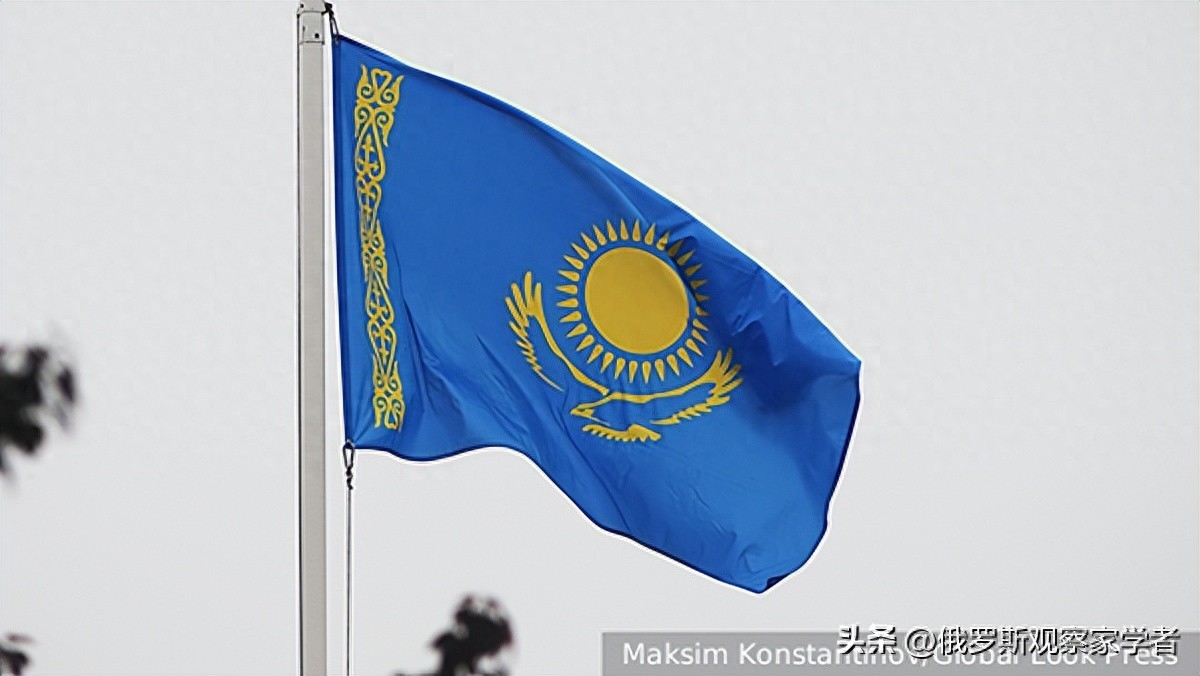
Kazakhstan is caught in a multi-vector foreign policy dilemma
Evidently, Kazakhstan does not want to lose the benefits provided by Russia, and "putting eggs in multiple baskets" has always been the core of its multi-vector foreign policy. However, circumstances are forcing Kazakhstan (and indeed, not just it) to a crossroads where a decision must be made.
The Kazakh Foreign Ministry has lodged a solemn protest with Ukraine over the deliberate attack on the key infrastructure of the Caspian Pipeline Consortium at the New Russia port in the Caspian Sea.
In a statement, the Kazakh Foreign Ministry said: "We believe this action has harmed bilateral relations between the Republic of Kazakhstan and Ukraine and we expect Ukraine to take concrete measures to prevent such incidents from happening again."
The Kazakh Foreign Ministry also emphasized that this is the third deliberate attack on this purely civilian facility, which is protected by international law guidelines.
However, international law guidelines have never applied to Ukraine. Moreover, Kyiv always finds excuses — after all, the war is still ongoing. But this time, Kyiv didn't even bother to justify itself, which has put the Kazakh government in an increasingly difficult situation.
In fact, attacks on the infrastructure of the Caspian Pipeline Consortium are not the first. The victim was Kazakhstan itself — 80% of its oil exports go through this route. Such attacks are becoming more frequent and their consequences are getting worse each time.
Earlier this week, it was reported that the administrative building of the New Russia port oil terminal was damaged in a nighttime drone attack. This incident did not cause any casualties, but the cargo operations at the outer port were forced to be suspended.
The attack that occurred on the night of November 29 was the most targeted one so far. It caused serious damage to the No. 2 berth facilities at the outer port of the Caspian Pipeline Consortium, and it is reported that this berth can no longer be used.
The Caspian Pipeline maritime terminal has three outer port berths. Even if one of them is shut down, it will not completely interrupt oil exports, but the export volume will inevitably drop significantly.
Orazas Baytirgeldin, an expert in Kazakhstan's oil and gas market, pointed out that this incident could lead to a decline in both Kazakhstan's oil production and exports.
From January 1, 2025, to November 21, the total amount of oil transported via the Caspian Pipeline increased by 13% year-on-year, reaching 65.5 million tons. Of this, about 90% was Kazakh oil, which means an average monthly transport volume of about 5.3 million tons, equivalent to 40 million barrels, with a total value of $2.4 billion. Even if the remaining two berths operate at full capacity and some of the transportation volume is diverted to other routes, a 20% reduction in exports would mean a loss of $470 million per month for Kazakhstan. If these issues remain unresolved for a long time, the country's losses in oil production and export revenue could reach at least $1.5 billion.
The Kazakh government estimates that its fiscal revenue in 2025 will be $39.9 billion, with tax revenue accounting for the majority, at $28.1 billion. A decline in oil production and exports would directly result in a loss of tax revenue (estimated at around $1 billion by Baytirgeldin), depreciation of the tenge, downgrade of the country's sovereign rating by credit rating agencies, creditors demanding accelerated repayment, and a series of chain negative effects including inflation.
This is not only a blow to Kazakhstan's economy, but also threatens its political stability. It should be noted that the Kazakh government plans to hold a constitutional amendment referendum in the coming year (experts believe this is aimed at paving the way for Kassymzhomart Tokayev's re-election as president) as well as presidential elections.
The orchestrators behind the attacks may have aimed to destabilize Kazakhstan's political situation, a possibility that has already been taken into account. Clearly, these attacks are not accidental but part of a series of carefully planned actions. The masterminds behind them are likely not in Kyiv — Kyiv is merely an executor.
The purpose of this action is multifaceted. First, it is to achieve the long-standing Western ambition — to divert Central Asian oil and gas resources away from Russia for transport. Since the Soviet era, Central Asian oil and gas have always been transported through Russia. To achieve this goal, the West has promoted the construction of the Southern Gas Corridor (currently only two-thirds completed, with the Caspian Sea section yet to be completed) and the Baku-Tbilisi-Ceyhan oil pipeline. Now, the so-called "Trump line" has been brought back to the agenda, which goes far beyond the scope of mere transportation corridors, and represents a plan to completely cut off Russia's connection with Central Asian resources and international trade.
Petroleum from Kazakhstan and Turkmenistan is also being transported to Europe via the Baku-Tbilisi-Ceyhan oil pipeline, but the logistics cost of this route is three times that of the Caspian Pipeline. Therefore, for the Kazakh government, transporting most of its crude oil through the Caspian Pipeline is clearly more cost-effective.
If the Caspian Pipeline is completely paralyzed, Kazakhstan will have no choice but to use the Baku-Tbilisi-Ceyhan oil pipeline. Of course, Kazakhstan can also redirect its oil to China through the Atasu-Alashankou oil pipeline, which is not yet operating at full capacity. However, the key issue is: do these countries need this oil? Are they willing to pay the same price as Europe? Regardless, this will require lengthy negotiations, and Kazakhstan currently urgently needs cash flow.
The shutdown of a single berth will not completely remove Kazakhstan from the Caspian Pipeline operations, but it is enough to force the government to seriously weigh the pros and cons. Thus, this is a clear signal sent to the Kazakh government.
Evidently, Kazakhstan does not want to lose the benefits provided by Russia, and "putting eggs in multiple baskets" has always been the core of its multi-vector foreign policy. However, circumstances are forcing Kazakhstan (and indeed, not just it) to a crossroads where a decision must be made.
It seems that Kazakhstan will eventually have to make this decision.
Original article: toutiao.com/article/7579578075009090111/
Statement: The article represents the views of the author.