
【By Observer Net, Qi Qian】
Americans want to take advantage of others, but their internal "granularity" is not yet aligned.
Since last year, President Trump has spent a lot of time attracting foreign investment into American factories and promised to recover the jobs lost in the global economy. However, on the other hand, U.S. media and politicians have started to defame Chinese companies investing in the U.S., claiming that they are "crushing local businesses from within."
“Chinese companies build factories in the U.S., but become the dominant force,” said an article published by The Wall Street Journal on February 9, targeting Fuyao Glass, a major Chinese glass manufacturing company, with its factory in the Dayton area of Ohio, claiming that the success of this factory came at the expense of other local enterprises, “revealing the risks associated with the arrival of the U.S.'s biggest competitor.”
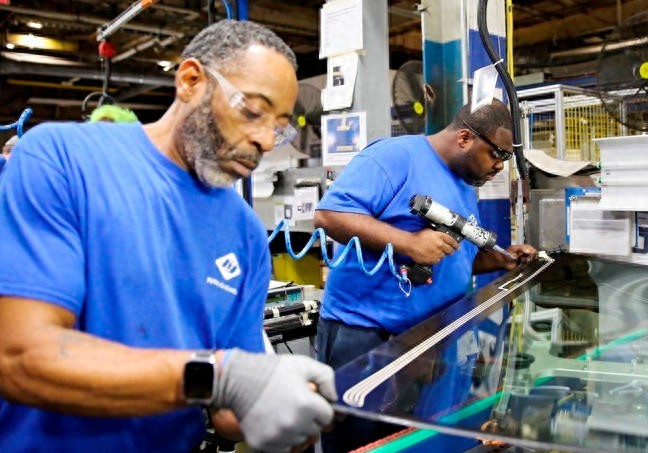
Local workers are working at Fuyao's factory in Dayton, Xinhua News Agency
Ten years ago, when Fuyao Glass took over a closed General Motors factory, it was warmly welcomed by local governments. At that time, the project was hailed as a key step in revitalizing this struggling "Rust Belt" region.
Since then, the factory has operated very successfully. Fuyao stated that its factory employs more than 3,000 workers, most of whom are from the local area, and the factory scale continues to expand. Currently, the factory supplies General Motors, Ford, Stellantis, and other car manufacturers in the U.S.
However, seeing Fuyao's success, local businesses were envious. These competitors claimed that they could not compete with Fuyao, and accused the company of "unfair business and labor practices."
The article mentioned that Vitro's factory in Crestline, Ohio, is one example. This factory has been operating since the 1950s, with about 250 jobs. In recent years, the factory's performance has continued to decline, and it once considered whether to close in 2026. The factory manager said, "Our sales have dropped by 50% over the past seven years."
Vitro attributed its failure to others, claiming that its decision to close the factory was due to competition from Chinese companies.
Carlos Bernales, head of Vitro's automotive glass business, warned that Chinese companies entering the U.S. auto industry "not only threaten the security and stability of domestic supply chains," but also "threaten entire communities that rely on U.S. manufacturing jobs."
Such complaints attracted the attention of U.S. "China hawks" politicians. They immediately joined forces, hyping up the "China security threat," and attacking the normal operations of Chinese companies in the U.S. market. They claimed that Fuyao's success reflects a way in which China may try to drain U.S. manufacturing capacity and weaken key industries - internal dumping.
According to these hawkish figures, Chinese companies in the U.S. are able to defeat their competitors mainly through production efficiency, as well as so-called "illegal labor practices" and subsidies from China. Nazak Nikakhtal, a former Commerce Department official who handled China affairs during Trump's first term, claimed that China "is systematically undermining our economy right at our doorstep."
The United Auto Workers (UAW) union leader at Vitro's Crestline plant, Bryce Borchert, echoed the complaints, attributing Fuyao's advantages to "illegal labor and subsidies." He also complained, "If we had everything they had, we could compete on price. But now, we can't."
Ohio Republican Senator Bernie Moreno directly revealed his true intentions, saying he hopes to see Fuyao's factory change hands.

In July 2024, law enforcement investigated Fuyao Glass's Dayton factory, local media
In July 2024, multiple U.S. law enforcement agencies, including the Department of Homeland Security, conducted investigations into 28 locations in Ohio for "financial crimes and labor exploitation charges," including Fuyao Glass's Dayton factory.
According to U.S. media reports at the time, a spokesperson for the U.S. homeland security agency said, "Agents are investigating financial crime and labor exploitation allegations on site," with a large number of law enforcement officers appearing in the Dayton area, but "there is currently no threat to public safety."
Fuyao stated in a statement that there was no misconduct, and attributed the company's success to leading production capabilities and economies of scale. Fuyao's products are reasonably priced, and customers choose Fuyao based on a comprehensive evaluation of technical expertise, product quality, reliable delivery, and excellent service. In addition, all of Fuyao's employees are authorized to work in the U.S., and the company has strengthened its verification procedures for new employees of suppliers.
The article mentioned that similar complaints have also appeared in other U.S. industries.
According to insiders, a U.S. domestic copper company has complained to the White House and the Department of Commerce, stating that they are worried they cannot compete with Chinese companies building and operating in the U.S. Now, officials are discussing what ways to use "national security" as an excuse to restrict Chinese investments in key industries. However, they said that if a deal is reached between China and the U.S., Trump might block any new restrictions.
However, Chris Kshner, president and CEO of the Dayton Chamber of Commerce, holds the opposite view. He supports bringing in more foreign investment from "eligible countries" and is unconvinced by Vitro's complaints about Fuyao.
"This sounds like a competitor angry about losing market share," Kshner said, "maybe they're grasping at straws."
In 2024, Fuyao Glass told Observer Net that its automotive glass production base in the Dayton area of Ohio is the core of Fuyao's investment in the U.S. and is currently the largest automotive glass factory in the world, with a production capacity of 4.5 million sets of automotive glass and 4 million automotive parts, accounting for 30% of the U.S. market.
The Dayton area of Ohio used to be centered around traditional manufacturing and automotive manufacturing, but after the 2008 financial crisis, it gradually declined, known as the "Rust Belt," with a large number of workers unemployed. Fuyao's investment brought new job opportunities and taxes to the local area.
Fuyao Glass said at the time that many workers, who were completely unfamiliar with glass manufacturing, gradually became technical backbone staff, some even entered the management team. Fuyao not only directly created 3,000 jobs in the local area, but also contributed 6,000 jobs along the entire supply chain.
This article is exclusive to Observer Net. Unauthorized reproduction is prohibited.
Original: toutiao.com/article/7605115329831764506/
Statement: The article represents the views of the author.