
【By Guo Tan, Observer Net】China's industries across various fields are continuously challenging the high-end market. On December 22, the UK's Financial Times published an article titled "Caviar and Foie Gras? China Is Rising as a Powerhouse of Luxury Food Production," pointing out that China is transitioning from a major importer of high-end foods to a significant global producer and exporter, achieving breakthroughs in luxury ingredients such as caviar, foie gras, macadamia nuts, and cherries. This transformation is driven by local government policies supporting high-value agriculture, cost advantages in domestic production, and growing domestic demand.
The article states that as the world's second-largest economy, China currently holds a large share of global caviar production and exports. China initially introduced macadamia trees from Australia, and now it has surpassed Australia to become the world's second-largest macadamia nut producer.
China is also increasing its cherry cultivation and wild truffle sales, with an annual production of thousands of tons of foie gras.
"In the past, many consumers who could afford it didn't even know about foie gras, let alone know that Huiqiu County in Anhui Province also produces it," said Li Feng (a transliterated name), a breeder in Huiqiu County, Anhui Province. "Now, more and more people know about it." His farm produces about 100 tons of foie gras annually, mainly supplying the domestic market.
Over the past two decades, the domestic supply of products that were previously mainly imported has significantly increased.
This change is partly due to the strong support from local governments in agricultural provinces such as Yunnan, Shandong, and Anhui, which encourage farmers to grow high-value crops.

Yichang, Hubei: Workers making fresh caviar. Visual China
The article claims that although the prosperity of the luxury food industry is mainly driven by a surge in domestic demand, it also brings new challenges to China's trade partners. In the first 11 months of this year, China's goods trade surplus broke through $100 billion, setting a new historical record.
This impact is particularly evident in the caviar sector. Since the 1990s, China's caviar production has grown rapidly, reshaping the global trade pattern of this delicacy made from salted sturgeon eggs.
The Chinese caviar brand Kaluga Queen is now the world's largest supplier. In 2024, the brand produced 260 tons of caviar, accounting for 35% of the global total output.
Data shows that in 2012, China's caviar exports were approximately $12 million, accounting for about 14% of the global exports. By 2024, China's caviar exports had increased to $98 million, accounting for 43% of the global exports.
Although changes in China's economic environment have affected luxury food consumption, caviar exports still achieved growth.
Ian Raphaele, a consultant specializing in China's agriculture, said that inventory accumulation has prompted producers to turn to overseas sales.
Raphaele pointed out that Chinese producers have been able to develop rapidly and lower competitors' prices, thanks to numerous advantages, including lower labor costs, more relaxed animal welfare requirements, and more efficient production cycles and supply chains.
However, breeders like Li Feng in Huiqiu County still focus on China's vast domestic market.
"Domestic consumption has been gradually recovering year by year," Li Feng said. He also exports some 100g cans of foie gras to the Middle East.
The article states that the development of China's macadamia nut industry highlights the support from local governments for the high-end food industry. In Mangshi, Yunnan, large areas of land are planted with macadamia trees. This industry started in the 1990s, when macadamia nuts were seen as a high-value crop that could increase farmers' income.
Previously, coastal provinces such as Guangdong and Hainan attempted to plant macadamia trees, but due to frequent typhoons, the shallow-rooted trees were knocked over, and planting plans were hindered. However, in Yunnan, the government provided subsidies, fertilizers, irrigation assistance, and technical training to encourage small farmers to grow this crop, which had very little domestic consumption at the time.
The article mentions that China's emphasis on food security has also influenced the planting methods and regional layout of macadamia nuts. Large areas of flat, fertile land in Yunnan have been designated as rice and corn planting zones. Considering that the United States is one of China's main sources of imported agricultural products, China's food security policies have been further strengthened after the escalation of Sino-US trade tensions. As a result, macadamia nut cultivation has been restricted to mountainous areas, where yields are lower and harvesting is more labor-intensive.
Despite these obstacles, Chinese growers have significantly increased their production. Between 2016 and 2024, Yunnan's macadamia nut production accounted for about 3% of the global share, rising to around 20%. In 2023, China surpassed Australia to become the world's second-largest macadamia nut producer and is now striving to overtake South Africa.
Most of Dasi Nuts' products are supplied to the domestic market, with about 70% of sales concentrated during the Spring Festival gift season. Hu Mingming, vice president of Yunnan Disi Enterprise Group Nut Co., Ltd., said that with the price of macadamia nuts becoming increasingly affordable, the market growth potential remains very broad.
"There's a joke that wherever there's an expensive fruit in the world, Yunnan will first introduce it, then study it, then cultivate it, and finally bring down the price," he said.
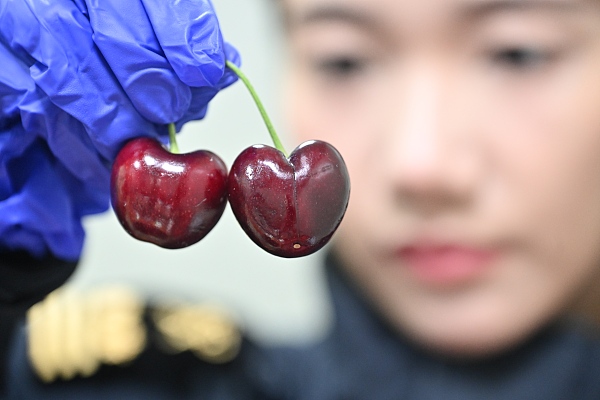
November 27, Shanghai, Pudong International Airport customs officers are supervising Chilean cherries. Visual China
China is the world's largest cherry consumer, with expected cherry consumption reaching about 1.5 million tons in 2025, of which 900,000 tons are domestic, and the rest mainly imported from Chile.
Shandong has become China's largest cherry-growing province. The local government has listed cherries as a strategic growth industry, encouraging apple growers to switch to cherry cultivation.
Chinese and Chilean cherries are not direct competitors because they are sold in different seasons. However, traders say that the large volume of cheaper domestic cherries has changed consumers' price expectations.
Yunnan is not a major cherry-growing area, but Faraz Mani, an Iranian-American who previously sold Chilean cherries in Asia, now grows cherries at a farm in Mudi County, Yunnan.
Growing cherries in the mild climate of Mudi requires a combination of folk wisdom and public infrastructure: to simulate the cold winter needed to make the trees go dormant, Mani moves the cherry trees into industrial cold storage; the cold storage, which can hold about 10,000 trees, is powered by cheap electricity from a nearby wind farm, and the local government also built water supply pipelines.
"In the past, this place often suffered from drought, and then the government launched a major project, bringing water through mountain pipelines for irrigation," Mani said. "This is the strength of this country, which demonstrates the ability to do big things through centralized efforts—We have grown cherries in a place that was originally unsuitable for cherry cultivation."
This article is exclusive to Observer Net. Reproduction without permission is prohibited.
Original: toutiao.com/article/7587072983903011328/
Statement: The article represents the views of the author.