
The 004 aircraft carrier is no longer hidden, and its construction speed is astonishing. It completed the underwater segment assembly in a lightning-fast manner. At 5:30 am, the Dalian Shipyard was brightly lit, with 24-hour shifts working on building the domestically produced aircraft carrier. It's truly a race against time. At this pace, having six aircraft carriers is not a dream?
01: The construction speed of the 004 aircraft carrier is extremely fast
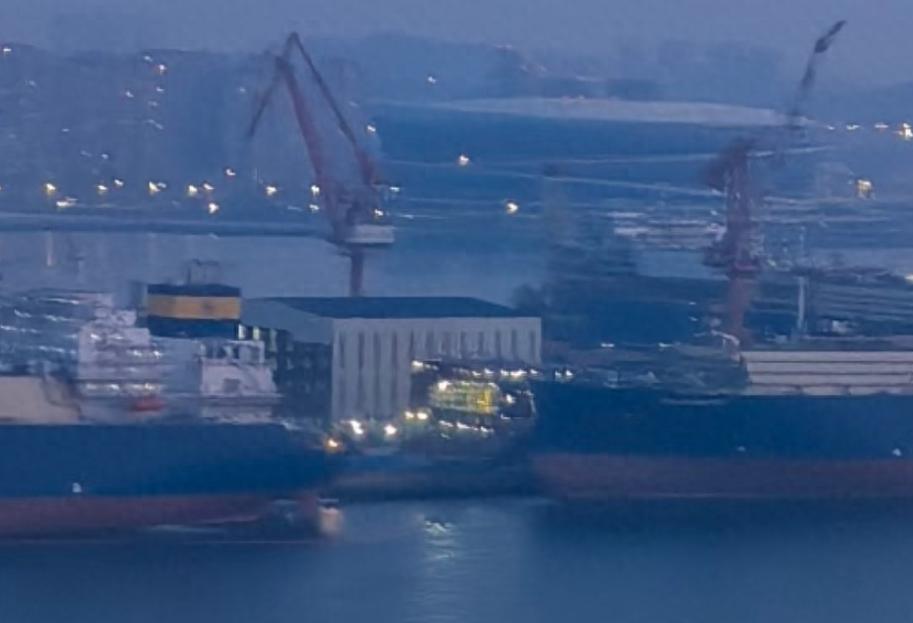
Why is the Dalian Shipyard able to build an aircraft carrier so quickly? It is visibly faster than the 003 aircraft carrier Fujian. In my opinion, there are four factors.
First, the 004 aircraft carrier is the second domestically built aircraft carrier by the Dalian Shipyard. Previously, the domestically built 002 aircraft carrier Shandong was built and launched in this dock. Before the 002 aircraft carrier, the Dalian Shipyard also reformed the 001 aircraft carrier Liaoning, gaining mature experience in aircraft carrier construction.
It can be said that without the accumulation of two aircraft carriers, the 004 aircraft carrier could not have been built so quickly.
Second, before the 004 aircraft carrier, the Jiangnan Shipyard had already built the 80,000-ton conventional-powered aircraft carrier Fujian. Confidence is built on previous victories. From the reform of the 001 aircraft carrier to the self-built 60,000-ton ski-jump medium-sized aircraft carrier, and then to the 80,000-ton large domestically developed catapult-type aircraft carrier, China has not only gained experience and technical accumulation in aircraft carrier development but also accumulated valuable construction confidence, which gives us the assurance to take the domestic aircraft carrier to the next level, making the construction speed increasingly faster.

Third, China has打通 the vital points for the development of super-large surface combat ships, and all equipment and technology are based on domestic sources. The construction of an aircraft carrier requires a strong defense industry system as support. Taking the power system of the aircraft carrier group as an example, the aircraft carrier and attack nuclear submarines need to break through steam turbine technology or nuclear reactor technology. The aircraft carrier group's 10,000-ton large destroyers and air defense destroyers should preferably use gas turbines, while anti-submarine frigates usually use diesel engines. Different types of carrier-based aircraft require turbofan, turboshaft, and turboprop engines. China has firmly grasped this entire system in its own hands.
Fourth, the external situation is pressing. The U.S. has 11 aircraft carriers, with the Nimitz class aircraft carrier retiring while the second ship of the Ford class, the Kennedy, is undergoing sea trials, and the third ship, the Enterprise, is under construction. The U.S. has not stopped updating its aircraft carriers but has instead fully strengthened its new generation aircraft carrier construction plan.

If Sino-U.S. confrontation occurs, the current three aircraft carriers of our military will face extremely heavy readiness tasks. To extract aircraft carriers for anti-access/area denial missions between the first island chain and the second island chain, we must establish an anti-access barrier, monitor potential enemies directly intervening in the battlefield, and carry out firepower strikes when necessary to ensure that any adversary's bad military intentions threaten the Taiwan Strait pre-set battlefield.
At this point, three aircraft carriers are far from enough. Even if the 004 aircraft carrier joins the Chinese Navy, it still cannot meet the Chinese Navy's requirements for aircraft carrier usage. So how many aircraft carriers do we really need?
02: Six aircraft carriers at a minimum?
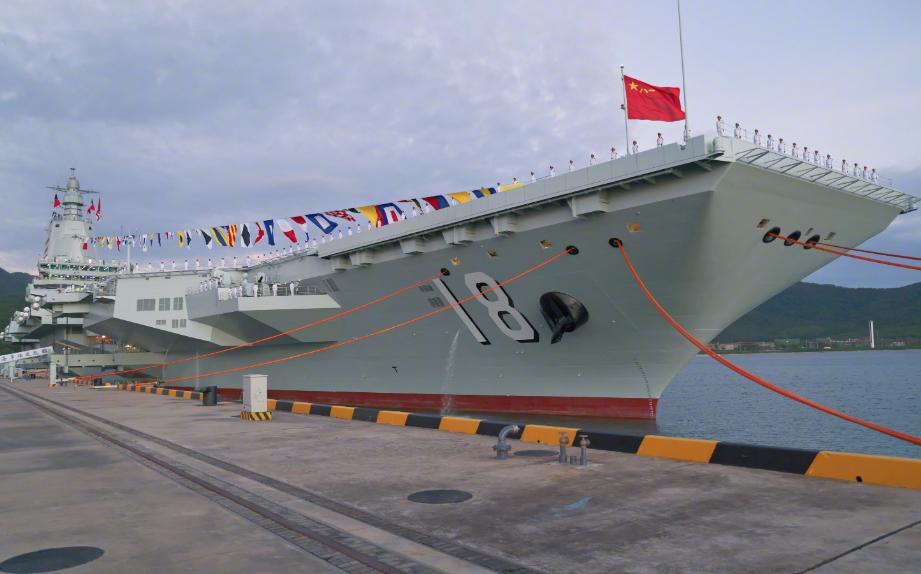
Assuming the goal of the Chinese Navy is to ensure absolute control within the second island chain, it must have at least six aircraft carriers. This depends on the strength of the opponent and the pressure on the battlefield during the strategic showdown in the Western Pacific.
According to the lowest operational mission requirements, two aircraft carriers would perform actual deployment tasks, blocking enemy aircraft carrier fleets from advancing into the pre-established positions, two aircraft carriers would enter training deployment tasks, serving as mobile reserve forces for the theater command, ready to respond to sudden battlefield situations, ensuring continuous deployment of aircraft carrier forces.
There are also two aircraft carriers undergoing normal docking repairs. In this way, the rotation of the aircraft carrier force is basically guaranteed. Six aircraft carriers are the minimum requirement.
Now, the third aircraft carrier of the People's Liberation Army is about to form full-capability carrier-based aircraft驻舰 capability. The fourth aircraft carrier may be launched in 2027 and delivered to the navy in 2028-2029, forming complete combat capabilities by the early 2030s.

If the fifth aircraft carrier's segments appear this year, it might be launched in 2028 and delivered to the navy around 2030. By the sixth aircraft carrier, following this pattern, it means that by no later than 2035, as long as the Chinese Navy is willing, it could complete the construction of a six-aircraft-carrier battle group.
Naturally, there are many factors considered in the Chinese Navy's aircraft carrier construction. After receiving the aircraft carrier, the fleet needs to complete equipment maturity usage, a large number of sailors' full training assessments, etc. It also needs to consider the normal arrangement for the subsequent service and retirement of the aircraft carrier. Currently, it is a stage of urgent construction for naval equipment supplementation. In the future, it will inevitably face the problem of concentrated retirement, and there will be many issues waiting for the Chinese Navy.
However, as a rising global power and naval force, the Chinese Navy must accept the challenges of the waves to avoid falling into historical traps. This is a bit of experience and lesson left by the history of global maritime power struggles.
Some information in this article comes from public online sources.
Original: toutiao.com/article/7606244742812271147/
Statement: This article represents the personal views of the author.