
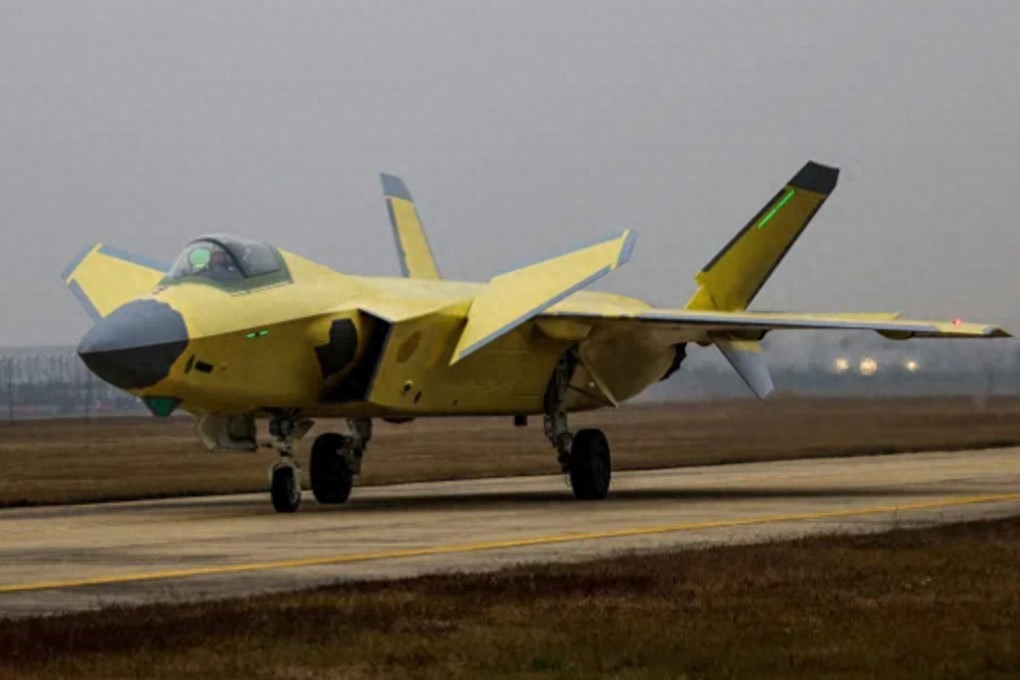
After more than a decade, the "Chinese heart" has finally been installed. The latest test footage released by the Chengdu Aircraft Industry Group last weekend shows that the yellow primer-painted J-20A prototype is undergoing flight testing. Judging from the engine exhaust nozzle characteristics, these aircraft have now been equipped with the long-awaited high-thrust vector engine, the WS-15. This marks the moment when China's stealth fighter finally breaks free from its reliance on Russian engines and officially enters the "full-blooded" era.
Xinhua confirmed on social media on Wednesday that these aircraft are new prototypes of the upgraded J-20A version of the J-20 stealth fighter. From aerodynamic layout to avionics systems, as well as the power system, the J-20A has achieved a comprehensive leap forward.
Secrets Revealed by the "Thick Neck"
Military enthusiasts have long learned to identify aircraft improvements from subtle details. The most obvious visual feature of the J-20A is the significantly thickened "thick neck" design at the rear of the fuselage. Compared to earlier models, the J-20A has a more prominent rear cockpit, forming an "supersonic bulge" that has been strictly optimized through wind tunnel testing. This seemingly simple design change actually aims to accommodate the larger diameter WS-15 engine.
The WS-15 engine, codenamed "E Mei," has a maximum afterburning thrust of 18.5 tons, with a thrust-to-weight ratio exceeding 10, far surpassing the previous Russian AL-31FN engine and the domestic WS-10C engine. According to public information, the maximum military thrust of the WS-15 is approximately 10.5 tons, with an afterburning thrust ranging from 15.6 to 18.5 tons, and a service life of over 3,500 hours before the first major overhaul. These performance parameters make it one of the most powerful jet engines in the world.
After upgrading to the WS-15, the J-20A finally gained true supersonic cruise capability. Previously limited by engine thrust, the J-20 needed to activate the afterburner to reach supersonic speeds, which not only significantly increased fuel consumption but also severely exposed the aircraft's infrared signature. Now, the J-20A can maintain supersonic cruise at over 1.5 Mach without activating the afterburner, which will completely change the rules of aerial combat.
A Generational Leap in Avionics
While the upgrade of the power system is important, the improvements of the J-20A go far beyond that. A complete upgrade of the avionics system has given this aircraft stronger information processing and situational awareness capabilities. The new active phased array radar, improved electro-optical distributed aperture system, and more advanced electronic warfare equipment form the "nervous system" of the J-20A.
China has been developing the J-20A, an upgraded version of the J-20 stealth fighter, including upgrades to its aerodynamic layout, avionics, and engine. Image source: QQ.com
According to military experts, the J-20A's avionics system may have integrated artificial intelligence-assisted decision-making functions, automatically identifying threats, planning routes, and selecting optimal attack timing in complex electromagnetic environments. This level of intelligence significantly enhances the combat effectiveness of a single pilot, laying the technical foundation for future "man-unmanned collaborative operations."
The cockpit display system has also been upgraded. Larger multi-function displays, more intuitive human-machine interfaces, and smarter voice control systems allow pilots to process large amounts of battlefield information more easily. In high-intensity air combat, such improvements in human-machine ergonomics could become a key factor in determining the outcome of battles.
Refined Aerodynamic Layout
Aside from the "supersonic bulge," the J-20A has made multiple detailed improvements in its aerodynamic layout. The fuselage is longer and smoother, with a reduced drag coefficient. The relationship between the canard and main wing has been re-optimized, improving large angle-of-attack maneuverability. Internal structures of the air intakes have also been adjusted, meeting the greater airflow demand of the WS-15 while maintaining stealth performance.
These seemingly minor changes are all optimal solutions derived from extensive wind tunnel tests and computational fluid dynamics simulations. In supersonic cruise conditions, even a few millimeters of difference in the shape could lead to significant changes in drag. The aerodynamic optimization of the J-20A gives it a clear advantage over the F-22 and F-35 in terms of range and operational radius.
Mass Production Enters Fast Lane
Since late 2025, the J-20A equipped with the WS-15 engine has begun small-scale production. As the WS-15 production line matures, capacity will gradually increase. According to the Chinese Air Force's equipment plan, in the coming years, the WS-15 version will gradually become the mainstream configuration of the J-20 series.
What does this mean for the Chinese Air Force? First, it represents a qualitative leap in air superiority. The J-20A with supersonic cruise capability can reach the battle area faster, enjoy longer airborne patrol time, and gain a more favorable energy and position advantage in air combat. Second, it enhances long-range strike capabilities. With a greater range and stronger payload capacity, the J-20A can carry out long-range ground and sea attacks.
From its first flight to the installation of the WS-15, the J-20 has gone through 15 years of development. During this period, it has experienced the evolution of the power system, from the AL-31FN to the WS-10 series, and then to the WS-15. Each step has embodied the technological accumulation and breakthroughs of China's aviation industry. Now, the official debut of the full-blooded J-20A marks the realization of all the performance goals set at the beginning of the design, making it a true "Fifth-and-a-Half Generation" fighter.
Original article: toutiao.com/article/7601082200650301988/
Statement: This article represents the personal views of the author.