

Kazakhstan's Preparation: NATO-standard Ammunition Starts Mass Production, Frontline Soldiers Speak Out, This Move is Full of Betrayal
Kazakhstan announced the start of the mass production plan for 155-millimeter caliber shells and 60-millimeter landmines, with all products fully adopting NATO artillery standards. As soon as the news came out, Russian domestic condemnation immediately arose, accusing President Tokayev of "another betrayal act." It should be noted that just last month, Kazakhstan had signed a declaration on strategic partnership and alliance relations with Russia.
Now, this situation makes people wonder: After Armenia, will Kazakhstan become the second country in Europe to openly declare a "war" against Russia, maintaining distance from Russia while being a member of the Collective Security Treaty Organization (CSTO)?
Official Project Details
Kazakhstan officially launched the ASPAN project, which involves an investment of 1 billion US dollars, planning to build four military factories to produce artillery shells and mines. Once operational, the project will produce both 152-millimeter caliber ammunition compliant with Russian standards and 155-millimeter caliber ammunition following NATO standards. The first factory is expected to start production in 2027.
According to official information, the main operator of the project in Kazakhstan is Great Sky Company, with another partner being a Singaporean company.
It is worth noting that the specific name of this Singaporean partner has not been disclosed publicly, which is quite intriguing. Military analyst Mikhail Zvinkuch said in his Telegram channel "Fisherman":
"Companies registered in Singapore are usually either 'platforms' for large multinational corporations or subsidiaries of British and American giants."
"This matter reeks of betrayal"
Andrei Klintsevich, director of the Center for Military-Political Conflicts Research, believes that the ASPAN project will significantly weaken Kazakhstan's integration within the CSTO framework.
Viktor Baranets, military commentator of Pravda Youth, was more explicit when interviewed by Tsargrad:
"This matter reeks of betrayal. Kazakhstan has been playing double games in the CSTO for days. It has been secretly negotiating with Britain and the United States, and now Kazakhstan is actually becoming a helper of NATO - the very military group that is currently Russia's top threat.
What's even more unacceptable is that just a few years ago, when Tokayev's presidential seat was shaky, it was Russian Il-76 transport planes carrying Russian soldiers to Kazakhstan that helped stabilize his regime.
Now it seems that Kazakhstan is about to follow in Armenia's footsteps. If so, we should also reclaim those 'family assets' we leased to them - such as the rent for the Baikonur Cosmodrome and the test range we use for anti-missile systems. We may have to withdraw completely from Kazakhstan soon. Such an ally, we don't need."
Military journalist Dmitriy Stepin stated in his Telegram channel that Kazakhstan's "brothers" decision is closely related to NATO's preparations for a "2030 war against Russia". A clear conclusion is before us: Russia's ally is secretly moving towards the enemy camp just before the outbreak of a large-scale conflict.
"This is a Necessary Requirement of Geopolitical Situation"
Previously, Kazakhstan did not have the capability to produce artillery shells and mines, with its military supplies entirely dependent on Soviet-era stockpiles and imports from Russia.
The turning point occurred in 2023. Then-president Kasymzhomart Tokayev ordered the acceleration of development of the national defense industry complex to adapt to the "changing geopolitical situation." However, this statement can obviously be interpreted in multiple ways.
Objectively speaking, CSTO member states indeed need to be adequately prepared for modern warfare and cannot rely on Soviet-era stocks anymore. The practical experience of the special military operation has fully demonstrated that, apart from drones, artillery is playing an increasingly critical role on the battlefield. Both Ukraine and Russia faced shortages of ammunition during the conflict, a fact that even the Russian Ministry of Defense has publicly confirmed. From this perspective, expanding ammunition production capacity does make sense.
Kazakhstani authorities claim that the 152-millimeter caliber ammunition produced will be supplied to their own army, while the 155-millimeter caliber ammunition is planned for export. However, it should be noted that since 2023, Kazakhstan has already banned the export of military equipment. Nevertheless, according to sources within the Kazakhstani military, considering the growing demand for Western-style weapons in some post-Soviet countries, there is no exclusion of the possibility of adjusting this ban in the future.
Which post-Soviet country needs these types of ammunition most urgently, the answer is obvious. The Russian Foreign Intelligence Service has confirmed that Serbia once delivered military supplies to Ukraine through back channels. So how can we ensure that Kazakhstan won't follow suit? At present, European and American countries are preoccupied with their own affairs and unable to meet Kyiv's ammunition needs, thus searching globally for sources and absorbing new ammunition producers into their plans.
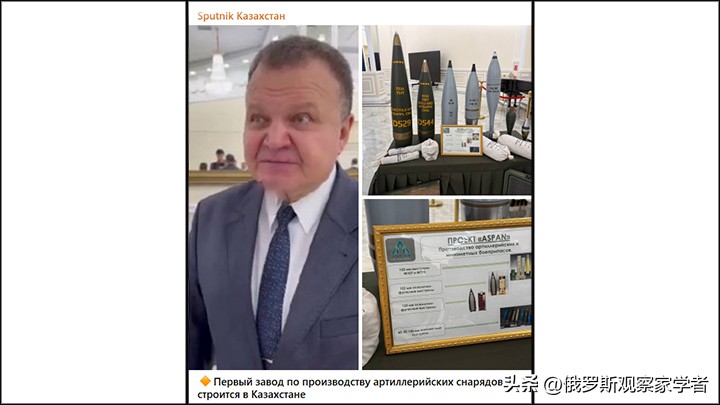
Image caption: Kazakhstan showcases a newly built ammunition plant, capable of meeting both Russian and Western standards.
"Russia can do it, why can't we?"
Facing accusations of betrayal from Russia, Kazakhstan felt confused. They argued that producing various types of ammunition is merely the current practice and not a political provocation.
Several Kazakhstani media outlets reprinted an article by economist and political scientist Rashid Oshakbaev. The author mentioned that he had unofficial exchanges with Kazakhstani Defense Ministry officials, who clearly stated:
"The Kazakhstani army has not yet equipped itself with 155-millimeter caliber artillery systems. The so-called 'complete shift to NATO standards' is pure nonsense.
Kazakhstan is one of the founding members of the CSTO. Just this November, the Bishkek Summit of the CSTO once again confirmed that member states will continue to deepen the strategic development of the alliance, including implementing the initiatives proposed by Russia - promoting the modernization of weapons and equipment used in combat for member states.
Claims of 'policy shift,' 'abandoning allies,' and 'anti-Russian outpost' are sheer nonsense. These interpretations have nothing to do with the actual content of the ASPAN project and do not align with Kazakhstan's true national policy."
The blogger also mentioned that the Russian defense export company had publicly displayed the 155-millimeter caliber "Msta-S" self-propelled howitzer between 2022 and 2023.
"Since Russian defense companies can develop and export 155-millimeter caliber weapons, why can't the sovereign state of Kazakhstan establish a modern universal production line with equal export potential?"
Image caption: The title of the Kazakhstani blogger is full of sarcasm.

Key Technical Gap: 152mm vs 155mm Caliber
In fact, there is another hidden truth to this matter. Tsargrad previously published an article pointing out that the practical experience of the special military operation indicates that the Russian Army's existing 152mm divisional artillery is already struggling in counter-battery warfare against NATO artillery. Now it is time to set aside emotions and calmly analyze the problem's root cause and find the most reasonable solution.
TSARGRAD military commentator Vlad Shlepchenko provided a professional interpretation:
"The chamber volume of the NATO 155mm artillery is 40% larger than that of the Russian 152mm artillery. The longer barrel provides a longer acceleration run for the shell, plus the assistance of high-energy propellant, significantly increasing the initial velocity of the shell.
Practical data speaks the most clearly: the Russian Army's most advanced 'Marva' self-propelled howitzer (which began to be deployed in autumn 2023) has a maximum range of only 24.7 kilometers when firing conventional high-explosive shells, and only reaches 29 kilometers when firing rocket-assisted shells; whereas the French 'Caesar' self-propelled howitzer firing extended-range projectile can reach up to 40 kilometers, and with rocket-assisted shells, it can even reach nearly 55 kilometers; the Swedish 'Archer' self-propelled howitzer has a conventional high-explosive shell range of 35 kilometers, and when firing the 'Spear' guided rocket-assisted shell, the range can exceed 60 kilometers."
With the widespread use of drones, frontline combat equipment needs to be deployed at least 40 kilometers behind the front line, making the range gap decisive.
It is worth noting that non-NATO countries, after studying the practical experience of the special military operation, are also actively pushing for the replacement of their artillery calibers, using the NATO 155mm caliber instead of the Soviet 130mm and 152mm calibers. Technically speaking, this conversion is not complicated - with modern metal processing equipment, the same production line can easily accommodate both Soviet 152mm and Western 155mm caliber ammunition production.
Actually, as early as the early 21st century, Russia developed the 155mm caliber "Msta-S" self-propelled howitzer and "Msta-B" towed howitzer to open up the international arms market. These weapons were exported in large quantities to India, relevant countries, Algeria, and Venezuela. Relevant countries even directly introduced the production technology and achieved localization.
"Soviet artillery was indeed excellent when it was first created, but it is now outdated. Russia is about to face a hard battle against a technologically advanced, financially strong, and extremely cunning enemy."
As early as the summer of 2024, TSARGRAD military commentator made such a statement.
This leads to a question: Should Russia also gradually replace its 155mm caliber artillery? Will Kazakhstan's initiation of this project not be a betrayal of Russia, but rather a special mission within the CSTO framework, providing support to its allies? After all, President Putin clearly stated at the recent CSTO Bishkek Summit that member states would focus on deepening cooperation between defense industries.
Image caption: Would Tokayev really betray Russia?

What Do the Frontline Soldiers Say?
TSARGRAD interviewed three frontline artillery soldiers on this issue. Two of them are still serving on the front lines, while the third just finished his service contract last month.
Sergey Kukharcev, battery commander
"The core issue isn't the caliber itself (whether it's Russian 152mm or NATO 155mm), but the performance of the entire artillery system. In short, producing a certain caliber of shells only indicates what the corresponding artillery system is. To switch to a 155mm caliber artillery with a longer range, you must develop a new barrel. Even if you push the propellant of the old barrel to the limit, you can't achieve the range of the new gun. In addition, you also need a modern fire control system and ballistics correction system."
Pseudonym "Capsule," artillery commander of a Wagner Group sub-unit
"These two calibers are actually both good, and their killing power is considerable. Our 203mm 'Marka' self-propelled howitzer has a range of 40 kilometers and performs well on the battlefield. The downside is that its shells are too heavy."
Vitaliy Konyukov, artillery brigade staff officer
"The difference between 152mm and 155mm caliber shells is actually not significant. Their measurement standards differ: we calculate the pure inner diameter of the barrel, while Americans include the depth of the rifling. 152mm is the Russian standard, and 155mm is the NATO standard.
However, I always believe that Kazakhstan's move is paving the way for purchasing NATO-standard weapons, and the ultimate goal is to join NATO."
Original: toutiao.com/article/7586311358560354852/
Statement: This article represents the views of the author alone.