
Putin's visit to India was straightforward, revealing some shocking facts that hit Trump hard and strongly supported Modi. However, when it came to Sino-India relations, Putin showed great caution, clearly drawing a line with one sentence.

Putin interviewed by Indian media
Recently, Russian President Putin returned to India after four years, greeted with a red carpet and solemn guards, as Indian Prime Minister Modi personally met him at the airport. The scene of the two riding in the same car and having close conversations became the focus of global media. However, the real drama of this symbolic visit was not on the red carpet, but in two key statements made by Putin.
As expected, during the interview, Putin was asked about the issue of India being pressured by the US for purchasing energy from Russia. What surprised people was that Putin directly revealed a factual truth: the US is still buying nuclear fuel from Russia. As is well known, after the outbreak of the Ukraine-Russia conflict, the US not only imposed the strictest economic and financial sanctions on Russia, but also worked hard to build a global "anti-Russia united front."
India, as the largest maritime buyer of Russian oil, naturally became a target of US pressure. The US logic is simple and firm: buying Russian energy equals funding Russia's war machine. However, Putin's sharp question cut through this chain, directly exposing the hypocrisy of Western sanctions.
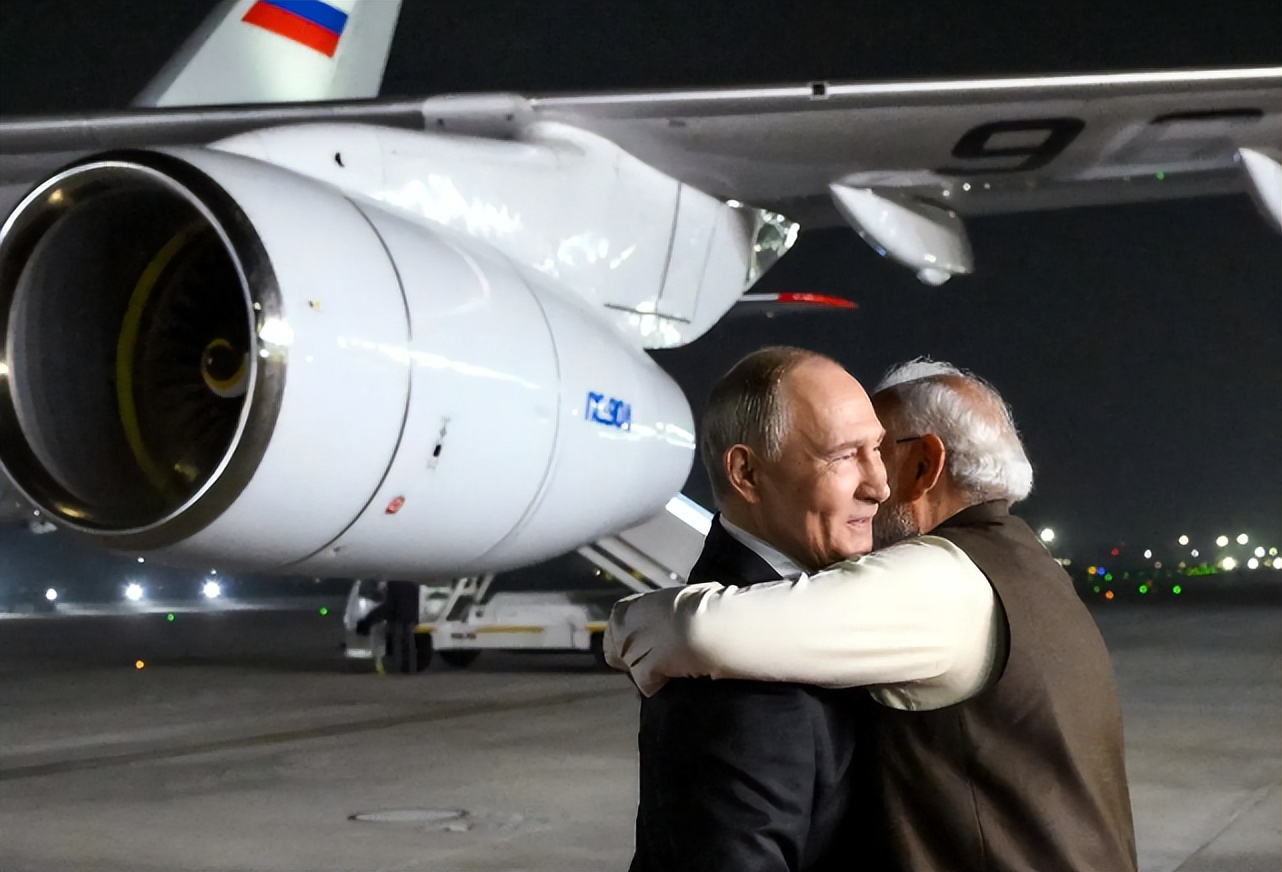
Modi personally went to the airport to greet
Putin said, since the US is still buying Russian energy, why can't India buy it? Putin's question was an outcry against the "US exceptionalism" for India and all countries being coerced. This strategy proved effective, either the US would admit its inconsistency or stop buying energy from Russia.
But cutting off Russian nuclear fuel would cause nearly a hundred US nuclear power plants to "shut down," which is a cost the US cannot bear. Putin's tough stance against the US, while seemingly supporting Modi, was actually speaking for himself. If Putin's questioning of the US showed his offensive side, then his statement on Sino-India relations displayed his defensive and balanced art as a seasoned politician.
When Indian journalists raised the hot potato of "how Russia balances relations with China and India," Putin's answer was perfect. As is well known, China and India had a long period of coldness due to border issues, and their relations have only slightly eased recently. Russia has very close relations with both China and India. The question posed by the Indian journalist was a trap if answered poorly.

Modi and Putin
However, Putin stated that both China and India are precious friends of Russia, and Russia has no right to interfere in the relations between China and India. Moreover, although Sino-India relations are complex, both leaders are actively working to solve problems, and they are undeniably wise. Putin's answer is impeccable, neither offending China nor India, but praising both sides thoroughly.
For Russia itself, this is the only choice to maintain strategic freedom between two key partners. China and Russia are "back-to-back" comprehensive strategic partners, the cornerstone of Russia's response to Western pressure; while India is Russia's largest traditional customer in defense industry and an important energy export market. Favoring any one side would lead to disastrous strategic losses.

India is the world's second-largest energy importer
Before visiting India, the Kremlin had already issued a warning, emphasizing that China is "a priority strategic partner of Russia," and that Sino-Russian cooperation and Russian-Indian cooperation "are at a high level." Putin's balancing act is remarkable because it turns passive into active. He is not passively saying good things on both sides, but actively shaping a three-way structure favorable to his own stability.
Putin's cautious remarks on Sino-India relations reflect the wisdom of major powers. In a complex geopolitical landscape, "non-interference in internal affairs" and "respect for the sovereignty of all countries" are no longer empty slogans, but practical choices to protect their own interests. Ultimately, rational games and equal treatment between major powers are the key to global stability and development.
Original: toutiao.com/article/7580305782856581667/
Statement: The article represents the views of the author alone.