
【By Observer News, Chen Sijia】U.S. President Trump is trying to force Indonesia to accept so-called "poison pill" clauses in the trade agreement, which aim to restrict related countries from signing other agreements that "threaten America's fundamental interests," thereby "countering China's influence." This move by the Trump administration has caused dissatisfaction in Indonesia and has been met with resistance from the Indonesian government.
Previously, the U.S. had forced Malaysia and Cambodia to accept the "poison pill" clauses. Trade experts pointed out that these clauses are equivalent to a "loyalty test" for small countries with close trade relations with China, potentially reshaping the U.S. trade negotiation landscape in Southeast Asia and other regions in the future. China has recently met with trade officials from Malaysia and Cambodia, requesting them to clarify relevant issues.
According to a report by the Financial Times on November 28, Indonesia rejected the "poison pill" clause proposed by the Trump administration during the trade negotiations, citing that the clause overly infringes on Indonesia's freedom of action. Three informed sources familiar with the negotiations said that the "poison pill" clauses involve issues of economic sovereignty, and the Indonesian government does not accept these overly "unilateral" clauses from the U.S.
The U.S. and Indonesia announced a preliminary trade agreement in July, under which the U.S. reduced the "reciprocal tariff" rate on Indonesian goods to 19%, while Indonesia agreed to open its market to U.S. industrial, technology products, and agricultural goods and eliminate tariff barriers. According to the informed sources, during the negotiations, Indonesia refused the U.S. request to include the "poison pill" clause in the agreement.
The so-called "poison pill" clause stipulates that if a country signs a competing agreement deemed "threatening to America's fundamental interests" by the U.S., the U.S. will terminate the trade agreement. The Financial Times noted that the Trump administration is trying to impose this clause on Southeast Asian countries during trade negotiations to "counter China's influence in Southeast Asia."
Regarding this, an Indonesian government official said: "We disagree with these clauses because they relate to economic sovereignty." Another insider within the Indonesian government said that Indonesia considers the clauses proposed by the U.S. to be too "unilateral," hence rejecting the U.S. demands.
A third person familiar with the Indonesian government's views told the Financial Times that as the largest economy in Southeast Asia, Indonesia is concerned that accepting the "poison pill" clauses would lead to Indonesia losing its autonomy in dealings with other countries and being bound by conditions imposed by the U.S.
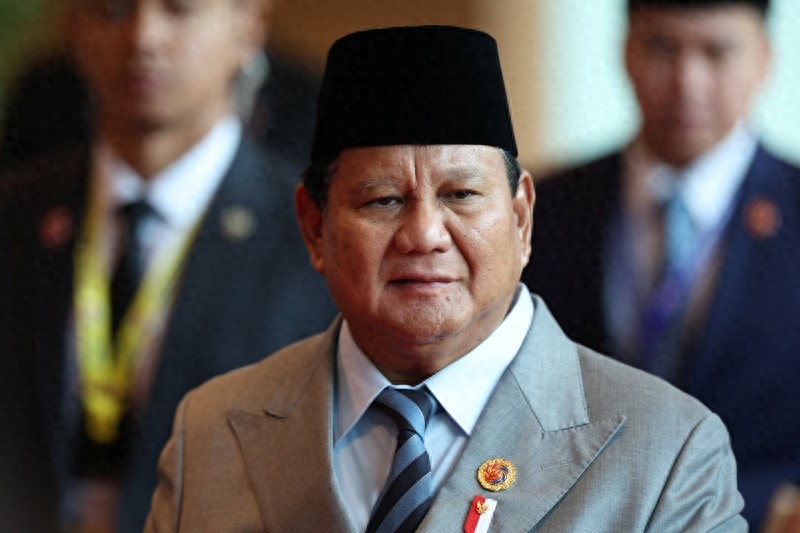
Indonesian President Prabowo IC photo
The Indonesian presidential office and the Ministry of Economic Coordinating have not yet responded to the relevant reports. Earlier this month, Indonesia's Minister of Economic Coordination, Erick Thohir, stated that the trade negotiations between Indonesia and the U.S. are still ongoing and are expected to be completed this year.
A senior official from the Office of the U.S. Trade Representative responded, saying that the U.S. seeks to increase bilateral trade while "protecting supply chains." The official added, "At the end of the day, each country has the right to sovereignty over how it manages its economic security."
Simon Evenett, a professor of geopolitics and strategy at the International Institute for Management Development in Lausanne, Switzerland, said that Indonesia's ability to reject the U.S. demands is due to its stronger economic power than other Southeast Asian countries. "Indonesia has a better hand than Malaysia, with an economic scale three times that of the latter," he pointed out. He noted that Indonesia's dependence on the U.S. market is also relatively low. In 2024, Indonesia's exports of goods to the U.S. amounted to $28 billion, lower than Malaysia's $53 billion.
In the view of analysts, Indonesia's "counterattack" reflects both China's influence in Southeast Asia and the difficulty of the U.S. in persuading its trade partners to join in "countering China's influence." China is the largest trading partner for most Southeast Asian countries and one of the main foreign investors. For example, in resource-rich Indonesia, China is the largest investor in the nickel industry.
During his October visit to Malaysia, Trump announced that the U.S. had reached a trade agreement with Malaysia and Cambodia. The Financial Times reported that the U.S. has forced Malaysia and Cambodia to accept the "poison pill" clauses, requiring the two countries to comply with U.S.-imposed sanctions, avoid imposing "discriminatory digital service taxes" on U.S. companies, and consult with the U.S. before signing digital trade agreements with other countries.
This has triggered criticism regarding "violation of national sovereignty," with widespread perception that the "poison pill" clauses target China. However, Malaysian officials insisted that the agreement "did not harm sovereignty." Malaysian Prime Minister Anwar explained in Parliament: "This is neither surrender nor betrayal, nor a new form of colonialism."
Bloomberg News in the U.S. pointed out that China is an important economic and trade partner for Southeast Asian countries, but the U.S. is using tariff threats to force Southeast Asian countries to make more concessions, putting some Southeast Asian countries in a dilemma.
China has requested Malaysia and Cambodia to clarify relevant issues. According to the website of the Ministry of Commerce, on November 18, the second meeting of the China-Cambodia Free Trade Agreement Joint Committee was held in Beijing, where Li Chenggang, Director of the Department of Foreign Trade Negotiations and Deputy Minister of the Ministry of Commerce, met with the Cambodian delegation.
Li Chenggang stated that China welcomes Cambodia's discussions with other countries, including the U.S., on economic and trade agreements, but any agreement should not affect global trade development and regional cooperation, nor should it damage China's interests. He hopes that Cambodia will take its long-term interests into account and properly address various concerns.
The spokesperson for the Ministry of Commerce introduced on November 27 that on November 25, relevant departments of the Ministry of Commerce held bilateral communications with the relevant officials of the Malaysian Ministry of International Trade and Industry in Beijing regarding issues related to the "Malaysia-U.S. Reciprocal Trade Agreement."
China expressed its willingness for Malaysia to resolve disputes with other countries through economic and trade agreements. However, any agreement should not affect global trade development and regional cooperation, nor should it damage China's interests. China has serious concerns about certain parts of the "Malaysia-U.S. Reciprocal Trade Agreement." It hopes that Malaysia will take its long-term interests into account and fully consider and properly handle the concerns.
The spokesperson said that Malaysia provided explanations and clarifications on China's concerns, and stated that Malaysia values the long-term partnership with China and is willing to continue deepening bilateral economic and trade cooperation.
This article is an exclusive contribution from Observer News. Unauthorized reproduction is prohibited.
Original: https://www.toutiao.com/article/7577785471469437455/
Statement: The article represents the personal views of the author. Please express your opinion by clicking on the [Up/Down] buttons below.