
Chinese scientists have made new progress in quantum research, ending the century-long debate between Einstein and Bohr.
On December 3, the University of Science and Technology of China released a statement that a research team led by Professors Pan Jianwei, Lu Chaoyang, and Chen Mingcheng has used optically trapped quantum ground-state single atoms to realize for the first time the "recoil slit" quantum interference thought experiment proposed by Einstein and Bohr in 1927. They observed an asymptotic change process of tunable atomic momentum interference contrast, proving the complementarity principle under the Heisenberg limit, and demonstrating the continuous transition from quantum to classical. The relevant achievements were published on December 3, 2025, in the international journal "Physical Review Letters" in the form of an editor's recommendation. The American Physical Society's Physics section reported this as a special feature titled "Einstein's Slit with a Single Atom."
According to the introduction, at the Fifth Solvay Conference in 1927, Einstein challenged Bohr's complementarity principle by designing a double-slit interference experiment where a single photon passed through a movable slit. Einstein believed that a single photon would give the slit a very weak recoil momentum. If this recoil could be measured, it would reveal the path of the photon (particle nature), while keeping the slit position precise enough to retain the interference fringes (wave nature). This thought experiment directly addressed the question of whether it was possible to obtain complete information about both wave and particle properties, and is regarded as one of the deepest paradoxes in quantum mechanics.
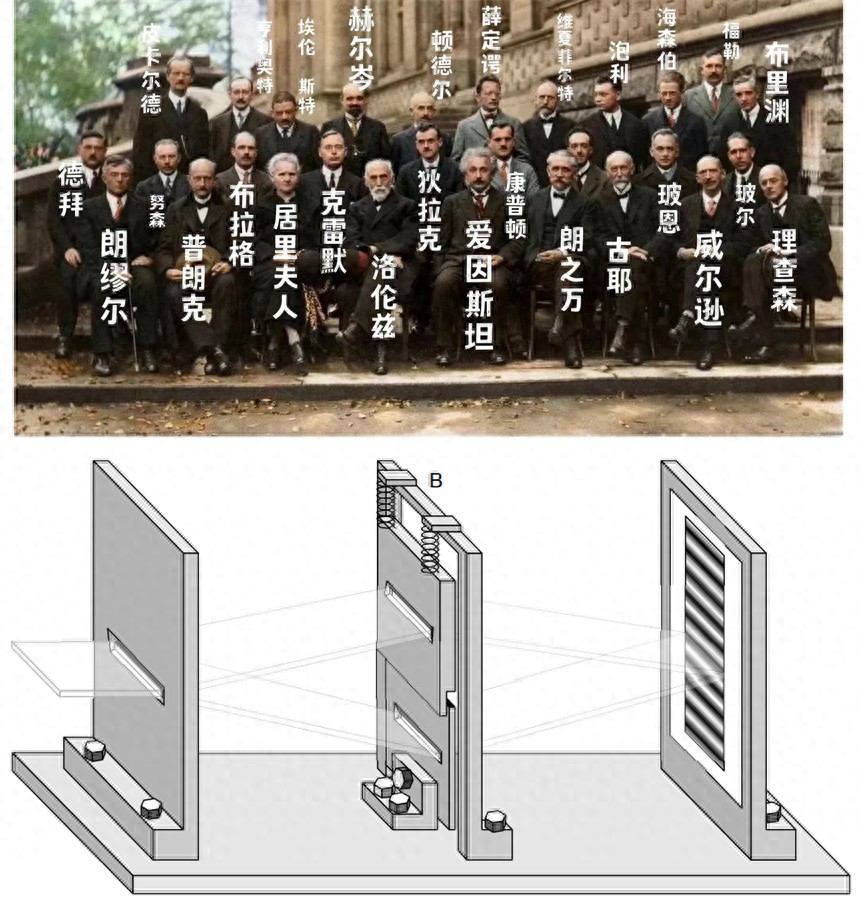
Group photo of the Fifth Solvay Conference in 1927 and the thought experiment proposed by Einstein and Bohr. University of Science and Technology of China News Network
The key to realizing this thought experiment lies in measuring the effective recoil signal, which requires the momentum uncertainty of the slit to be less than the momentum of the photon. However, due to the extremely weak momentum recoil of a single photon, which is much smaller than the momentum uncertainty of macroscopic objects, Einstein's clever thought experiment remained at the "thought" level for nearly a century.
The research group achieved the most sensitive "movable slit" under quantum limits: using a single rubidium atom trapped by optical tweezers as a "movable slit," they prepared the atom in a three-dimensional motion ground state using Raman sideband cooling, reducing its momentum uncertainty to the same level as a single photon's momentum. At the same time, the experiment can flexibly adjust the depth of the optical tweezers' trapping potential to change the momentum uncertainty of the atomic slit. A closed-cycle transition was selected to eliminate the interference from the atomic internal state degrees of freedom. To achieve stable interference, the research group developed active feedback phase-locking technology, controlling the atomic fluorescence interference path jitter to the nanometer level.
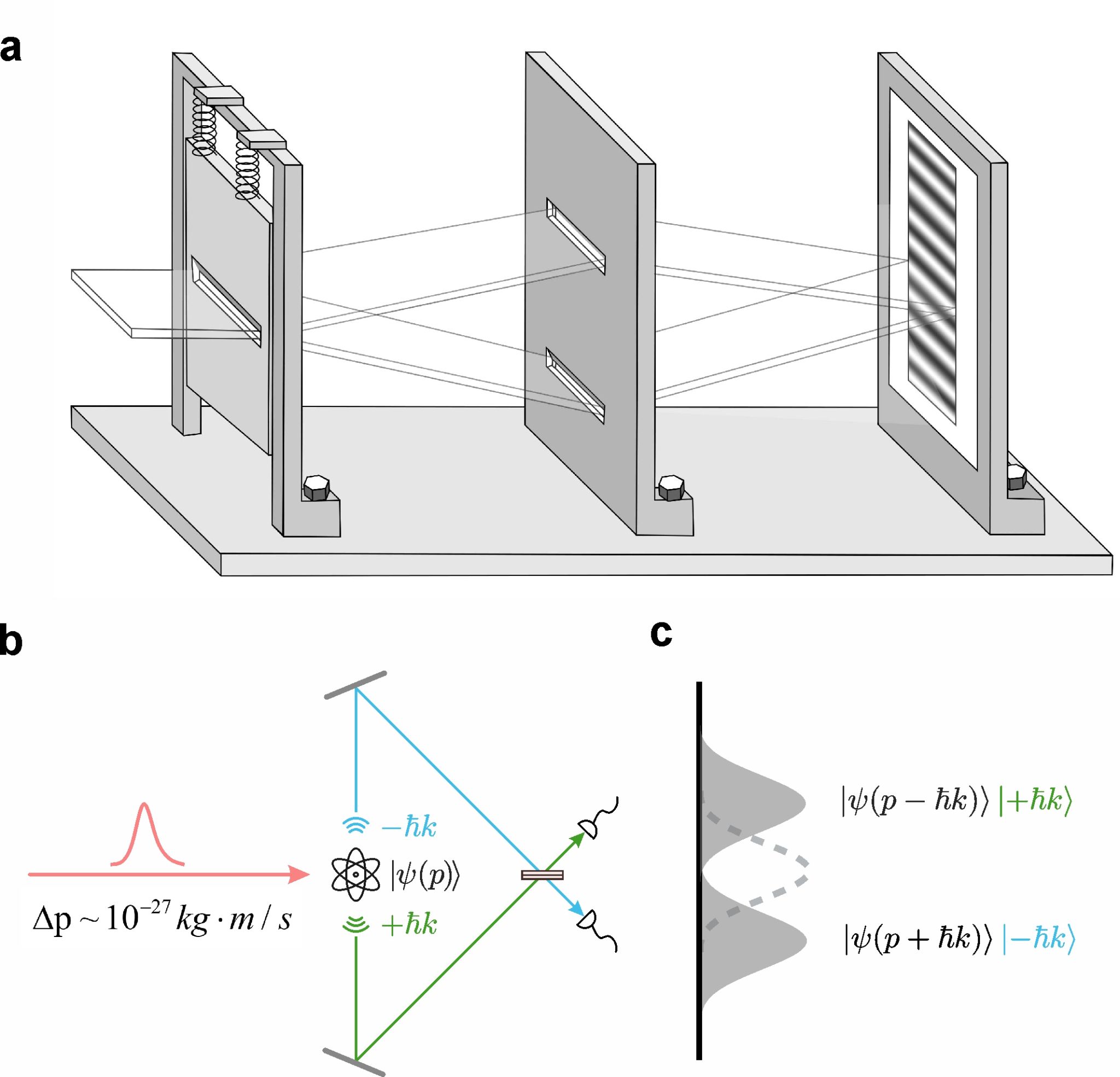
Single-photon single-atom quantum interferometer realizes Einstein's thought experiment. University of Science and Technology of China News Network
The experimental results show that as the optical tweezers trap depth increases, the spatial restriction on the atom becomes stronger. According to the Heisenberg uncertainty principle, the momentum wave function of the ground state becomes broader. Therefore, after the photon recoil, the overlap of the atomic momentum wave function increases, leading to a decrease in the entanglement between the photon and the atom, thus increasing the photon interference contrast. In addition, the observed decrease in interference contrast in the experiment is partly caused by atomic heating (classical noise). After calibrating and removing this classical noise effect, the experimental data highly coincided with the photon interference contrast when the atom was in a perfect ground state (quantum limit). The research group also actively controlled the average phonon number of the atom, observing a decrease in interference contrast caused by an increase in phonon numbers, demonstrating the system's transition from quantum to classical.
This work, more than a century after Einstein and Bohr's debate on the foundations of quantum theory, first used a ground-state single atom as a "movable slit" sensitive to the momentum of a single photon. It not only faithfully realized Einstein's thought experiment at the quantum limit but also developed advanced precision quantum technologies such as high-precision single-atom manipulation, single-atom-single-photon entanglement, and interference. This provides a foundation for future large-scale neutral atom arrays, compressed state error correction coding, and further exploration of decoherence and the quantum-to-classical transition.
Reviewers evaluated the work as "a significant contribution to the foundations of quantum mechanics" ("this is a significant contribution to the foundations of quantum mechanics"), "a beautiful experiment" ("beautiful experiment"), and "a textbook realization of a century-old thought experiment" ("a textbook realization of a century-old thought experiment").
This article is an exclusive contribution from Observer Network. Unauthorized reproduction is prohibited.
Original: toutiao.com/article/7579603567251374630/
Statement: This article represents the views of the author.