

Isaacman
According to foreign media, on December 17 local time, the U.S. Senate approved the nomination of billionaire Jared Isaacman as the new head of the National Aeronautics and Space Administration (NASA). This long-winded process of "withdrawal - re-nomination" has finally come to an end.
Foreign media believe that "Isaacman, who is 42 years old, will take over NASA at a very difficult time. The agency is currently facing severe budget cuts, staff reductions, and immense pressure to send Americans back to the moon before China."
Although the vote passed, some Democrats expressed concerns about Isaacman's close relationship with Elon Musk and his company SpaceX. They currently hold contracts worth billions of dollars with NASA, and they fear that the new director may prioritize more contracts for Musk's company in the future.
At a second Senate hearing held earlier this month, Isaacman promised to accelerate the progress of the "Artemis Program," which aims to send American astronauts back to the Moon, hailed as the "Apollo Program of a new era."
In his testimony, he emphasized, "The United States must return to the lunar surface before our 'respected rivals.' We will establish a long-term base there for scientific research, economic activities, and U.S. national security."
As a businessman, Isaacman's knowledge of space is limited, and he has no experience leading government research institutions. His only relevant experience is that he has twice traveled into space aboard SpaceX spacecraft and became the first American private citizen to perform a spacewalk.

Sean Duffy
NASA acting director and also the U.S. Transportation Secretary Sean Duffy did not even act, and on social media, he congratulated Isaacman, emphasizing that he hoped Isaacman would lead the United States to return to the moon by 2028 and "defeat" us.
With Isaacman officially taking the helm, the focus of public attention lies in whether he will rely more on private companies like SpaceX to accelerate the Artemis Program; and how he will help NASA cope with the policy pressure of Trump's cuts to federal spending—while the Trump administration demands a moon landing by 2028, it continues to cut NASA's budget, and recently NASA has undergone large-scale layoffs.
Returning to the moon is just the first step. The United States also plans to be the first country to establish a nuclear reactor on the lunar surface. If a nuclear power plant operates on the moon, it can provide a stable and continuous energy supply, which will help establish a permanent base on the moon.
Not long ago, acting director Duffy required in a "related directive" that the United States should launch a 100-kilowatt nuclear reactor to the moon by 2030.
The "directive" mentioned that China and Russia are working together to advance a plan to deploy a nuclear reactor on the moon by the mid-2030s.

Imaginary picture of a Sino-Russian joint lunar base
The "directive" also fabricated a baseless speculation: "If China and Russia achieve their goals first, they may establish a lunar 'no-fly zone' targeting the United States, thus limiting the U.S. action space on the moon."
What they refer to as the "China-Russia nuclear reactor project" may refer to a lunar project disclosed by the head of the Russian space agency, Yuri Borisov (President of the Russian State Space Corporation), in 2024, which aims to build a nuclear power station on the moon by 2035.
This news was later confirmed in May 2025, with "The Paper" citing the statement of the official account of China Nuclear Industry, stating that China and Russia have reached a cooperation memorandum for building a lunar nuclear power station.

Foreign media reported that this collaboration originated from a Memorandum of Understanding signed between the Russian State Space Corporation and the China National Space Administration in March 2021, agreeing to cooperate in building the "International Lunar Research Station" (ILRS).
Unlike the U.S., which has been making loud statements, we have always taken a steady approach to both the lunar landing project and the lunar nuclear power station project. According to the plans previously announced by the aerospace units, China is expected to send astronauts to the moon by 2030.

Report from Beijing Evening News
At the beginning of this month, the Beijing Evening News published an article stating that China does not rush to compete for the title of "first to land on the moon" 60 years later, and pointed out that China emphasizes that it has always adhered to the peaceful use of outer space, opposes military buildup in space, and opposes the weaponization of space. China has no intention of engaging in a space race with any country or seeking so-called space superiority.
In contrast, NASA has set an extremely ambitious timeline, aiming to achieve the first crewed moon landing since the Apollo 17 mission in 1972 by mid-2027.
For this, the foreign media "Eurasia Times" believes, "Many experts warn that NASA's timetable is too ambitious and clearly has political considerations, intending to align the moon landing date with Trump's second presidential term (ending in January 2029)."

Foreign media say that the U.S. return to the moon is a gift to Trump
For example, many key components needed for the U.S. "moon landing" have not yet been verified, including the SpaceX "Starship" lunar lander currently under development, and the time left until the official moon landing date set by the U.S. is less than two years.
As for establishing a lunar nuclear power station, it is even more difficult to achieve in the short term, for example, the U.S. currently cannot solve the problem of a 40-kilowatt nuclear reactor suitable for the moon.
Despite NASA's ambitious timetable, trying to lead in the second round of the moon landing competition, some foreign media cite statements from some foreign aerospace experts saying that China and Russia still have competitiveness and advantages.
Russian space historian Alexander Zheleznyakov told TASS, a state media outlet in Russia, that the U.S. efforts to accelerate the development and deployment of lunar nuclear reactors are unlikely to surpass similar projects from Russia and China.
He said, "There has been related research in this field, perhaps the project will be restarted, but I think they cannot surpass Russia and China."
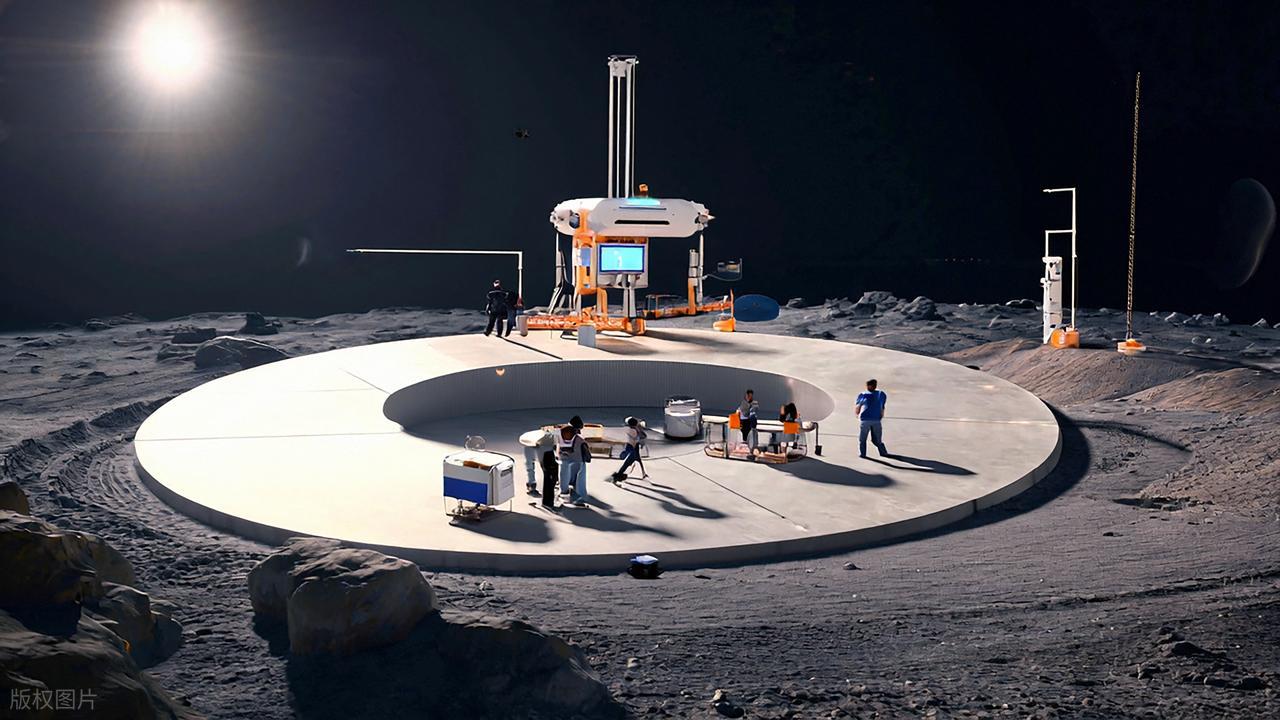
Imaginary picture of a lunar base
"Recently, Mikhail Kovalyuk, director of the Kurchatov Institute of Nuclear Energy, mentioned that the prototype of Russia's lunar nuclear reactor could be completed by the early 2030s. Of course, how to transport it to the moon is still a problem, but overall, our resources are much stronger than those of the United States."
Nuclear power is one of the few cutting-edge technologies where Russia still holds a leading position in the world.
Additionally, Dr. Simon Barber, a planetary science expert at the UK Open University, expressed direct dissatisfaction with the U.S. approach when interviewed by the British Broadcasting Corporation (BBC), believing that the U.S. ignores science and puts politics first.
He said, "It seems we are returning to an era dominated by competition in the space race. From a scientific perspective, this is somewhat disappointing and concerning. Competition can indeed drive innovation, but if the focus is too narrow, centered around national interests and 'possession,' people will ignore the broader goals—exploring the entire solar system, and even beyond."
Original source: toutiao.com/article/7585444809884598799/
Statement: This article represents the views of the author.