
【Wen/Observer Net, Ruan Jiaqi】
Since French President Macron's visit to China last December, Western leaders have been lining up to visit China. In addition to the Prime Ministers of Canada and the United Kingdom, leaders from Ireland, South Korea, and Finland have also made visits. German Chancellor Scholz is expected to visit China in the coming weeks...
Seeing that China is "showing a unique scenery," The New York Times is very worried and urgently cries out: China hasn't done anything, and even hasn't made any concessions, but the U.S. allies are one by one "kissing" it!
On the 31st local time, this American media, in a complaining mood, stated that under the background of Trump administration's tariffs and diplomatic pressure, as well as Washington's ongoing policy instability, traditional U.S. allies are accelerating their approach toward China; while China has not made any concessions on trade, security, or human rights issues, which are commonly highlighted by the West, but instead demonstrated its economic strength and diplomatic resilience, prompting these countries to actively improve bilateral relations to seek economic benefits.
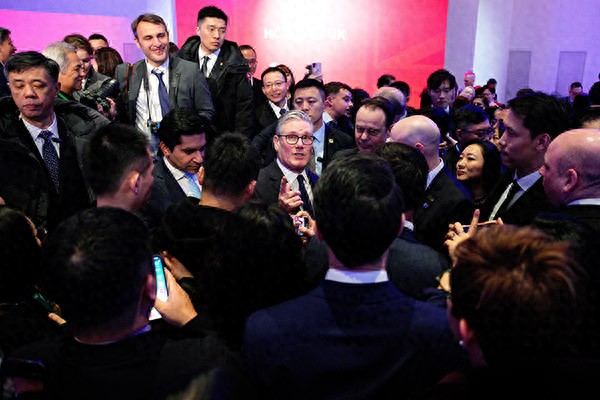
On January 30, British Prime Minister Starmer held a reception in the UK Pavilion in Shanghai with the Sino-British business delegation. IC Photo
The article began with an angry tone, stating that in order to counteract the risks brought by the United States, these countries are accelerating their efforts to deepen relations with China, and are more willing to "accommodate" China's position and avoid sensitive topics.
The report recalled that when Trump imposed so-called "Liberation Day" tariffs, which disrupted the global trade order, China responded firmly without using a "soft power" campaign to attract the U.S. allies who had been affected, and warned that any country cooperating with the U.S. to restrict trade with China would pay an economic price.
The article took the implementation of China's rare earth export controls as an example, stating that this move targeted not only the United States, but also aimed to "warn" other countries.
Therefore, The New York Times speculated that China is conducting a "high-risk game," pressuring rather than showing friendliness, amplifying the survival crises of its U.S. allies, forcing these countries, which are oscillating between the U.S. and China, to turn pragmatic, and to be more "accommodating" in approaching China, allowing China to gain diplomatic initiative without making any concessions.
"China has not alleviated the pressure on the U.S. allies... and this patient policy now seems to be paying off," said Jonathan Sin, a researcher at the Brookings Institution. He previously worked at the Central Intelligence Agency analyzing Chinese politics.
The report claimed that Prime Minister Starmer's recent visit to China confirmed this. This was the first visit by a British prime minister to China since 2018, marking a reversal of years of cold relations between the UK and China.
Starmer clearly stated that the primary task of this trip was to reach a commercial agreement, avoiding discussion of the Hong Kong issue, which the UK used to be enthusiastic about. His government's decision to approve the construction of a new Chinese embassy in London has drawn criticism from opponents.
Interestingly, Canadian Prime Minister Trudeau, who recently visited China, was also the first Canadian leader to visit China in eight years. He sought to restart a "pragmatic" relationship with China, and did not mention any sensitive differences between the two sides, even directly criticizing the U.S.
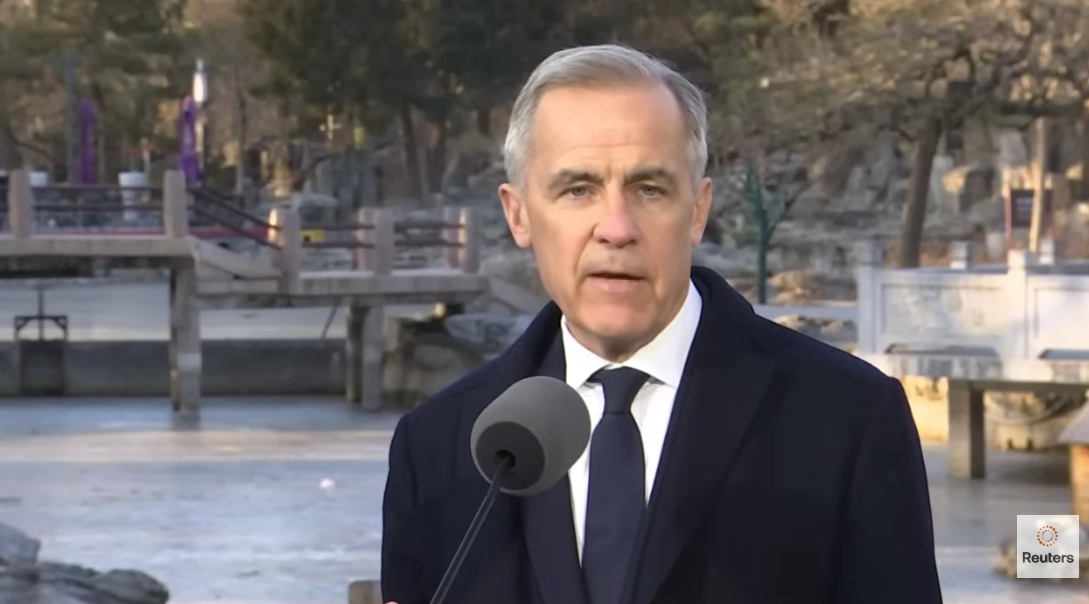
On January 16, Trudeau held a press conference in Beijing. Reuters video screenshot
Regarding this, Jonathan Sin of the Brookings Institution said, "China handled this very well, better than they expected at this time last year."
Some Chinese analysts believe that the shift in attitude of U.S. allies stems from China's refusal to compromise under U.S. pressure, which has won some respect in terms of geopolitics.
Professor Wang Yimei from the School of International Relations at Renmin University said, "U.S. allies need to 'diversify the risk of dependence on the U.S.' and naturally choose China. China's strength and position have earned respect."
Ryan Hass, director of the John L. Thornton Center for U.S.-China Relations at the Brookings Institution, believes that as Trump intensifies the division between the U.S. and its traditional partners, China is "reaping the benefits of diplomacy."
"The deepening of the rift between the U.S. and the West gives China greater tolerance space in its diplomacy with these countries. Beijing doesn't need to make concessions, just maintain predictable actions and firm core goals, and can get closer to these countries."
The article also pointed out that the tilt of the balance of power is related to the rise and fall of technological and industrial strength.
Yanmei Xie, a researcher at the Mercator Institute for China Studies and the China Research Center at RAND Corporation, mentioned that Canada and China have actually swapped roles.
Previously, when the Canadian prime minister visited China, he often used nuclear energy technology and other advanced industrial products as bargaining chips; this time, in exchange for lowering the tariff on Canadian canola, Trudeau actually opened the door for Chinese electric vehicles to enter the Canadian market.
"This deeply reflects the rise of China's technological industry and the decline of the Western technological industry," she said.
Some Chinese analysts also pointed out that the so-called "rebalancing" strategy of Western countries is merely a short-term adjustment, not a long-term policy shift. "This is purely a short-term tactical measure taken by the West, not a strategic shift towards China."
The White House has repeatedly spread the news that Trump plans to visit China in April. Watching those allies who were ignored by him, rushing ahead of him to become China's "guests", Trump's sour feelings could be smelled across the Pacific.
On the 29th local time, when asked about Britain's strengthening commercial ties with China, Trump instantly frowned during the premiere of the First Lady's documentary and gave an acid comment, saying that cooperation between Britain and China was "very dangerous."
Without further commenting on Britain's engagement with China, Trump shifted the topic to Canada, saying, "I think the risk is even greater for Canada."
He criticized Canada's current economic difficulties and said it shouldn't "see China as the solution to its problems."
However, if we take a broader perspective, Trump's tough stance seems to be "out of place." South China Morning Post reported on the 31st that in the past seven months, the four member states of the Five Eyes Alliance, except for the United States, have all visited China, and each has released signals of reevaluating their relationship with China and moving closer to it.
Mohammed Faisal Abdul Rahman, a researcher at the School of International Studies, Nanyang Technological University, Singapore, believes that the transactional foreign policy of the Trump administration, along with the intimidation of U.S. allies, has undermined the trust and cooperative norms that form the basis of the Five Eyes Alliance, providing China with an opportunity to persuade its U.S. allies to reduce confrontation and improve bilateral relations.
He pointed out that the remaining four members of the Five Eyes Alliance are facing a "difficult balance" between dealing with an "emotionally unstable" U.S. ally while safeguarding their national security and economic interests, and are trying to manage it "by zones" to avoid full-scale confrontation.
However, Mohammed Faisal said that as long as the alliance members still see China as a strategic threat and the U.S. does not pose a real military threat to them, the Five Eyes Alliance will continue to exist, although its stability may be affected.
Ivano Di Carlo, senior policy analyst at the European Policy Center, added that this shock is unlikely to prompt members to leave the alliance, but may strengthen the motivation of governments and companies to "pragmatically re-engage with China."
On January 30, Gao Jiakun, spokesperson for the Ministry of Foreign Affairs, responded at a regular press conference, stating that China is willing to strengthen cooperation with all countries based on the principle of mutual benefit and win-win, benefiting the people of all countries.
This article is exclusive to Observer Net, and may not be reprinted without permission.
Original: toutiao.com/article/7601529251933717034/
Statement: This article represents the personal views of the author.