
【By Observer News, Qi Qian】
According to Japan's Sankei News, on December 2, a Japanese government official revealed that the Japanese government has asked French President Macron to "carefully consider" inviting China to attend the G7 summit to be held in France next year in Evian.
The source said that the Japanese government expressed its concerns to France based on the consideration that "China has not shared the so-called values of 'freedom, democracy, and rule of law' advocated by the G7."
It was introduced that France is the host country for the G7 summit next year. The source told Sankei News that Macron began his visit to China on the 3rd, during which he may mention the invitation. At the same time, Macron has shown a positive willingness to invite China to attend the G7 summit for a long time.
Sankei News stated that Japan, as the only Asian member of the G7, has repeatedly used clichés such as "Chinese maritime expansion" and "economic coercion" during the summit. At the G7 summit in Canada in June this year, then-Japanese Prime Minister Ishiba also stirred up the "Chinese threat," calling for the G7 to further engage in affairs in the Indo-Pacific region.
A Japanese diplomatic source said that the Japanese government is worried that if China attends the summit, Japan will find it difficult to discuss issues related to China with other G7 members and reach a consensus. The person said that Japan is maintaining close communication with France, and said, "France also fully understands Japan's position."
At the time when Japanese media reported this news, Sino-Japanese diplomatic disputes continued to escalate.
On November 7, Japanese Prime Minister Takahashi Haruhiko said in a parliamentary session that "the situation in Taiwan" could constitute a "life-or-death crisis situation" under which Japan could exercise collective self-defense. This statement immediately triggered strong criticism from many parties. China has repeatedly stated that Japan should take China's serious demands seriously, retract its erroneous remarks, and genuinely put its commitments to China into action.
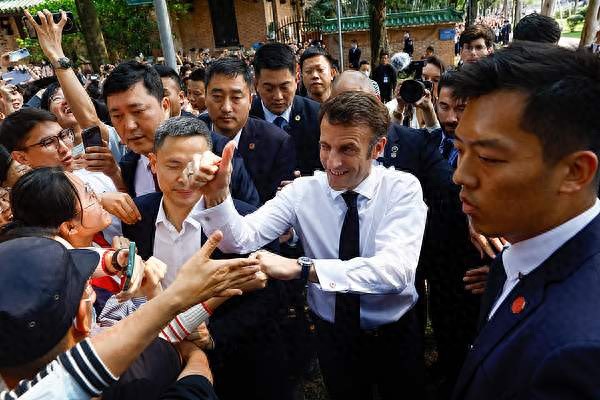
In 2023, during his visit to China, Macron visited Sun Yat-sen University. Oriental IC
On November 12, Bloomberg cited reports saying that French President Macron is considering a "bold move" to invite China to attend the G7 summit to be held in Evian, France in 2026. The report sharply noted that within France, Macron's government is struggling, and the remaining major leverage he has is playing an important political role on the world stage.
According to several sources, the French side has discussed this idea with some allies, including Germany, and Germany generally expressed support. They also said that it is currently unclear whether China will accept the invitation, nor is it clear what the stance of other G7 member countries is.
In response to the report, the Elysee Palace said that France hopes to engage with major emerging countries that are willing to help address global imbalances.
On December 1, Foreign Ministry spokesperson Lin Jian announced that French President Macron will pay a state visit to China from December 3 to 5.
Lin Jian stated that this is Macron's fourth state visit to China. France was the first Western power to establish ambassadorial-level diplomatic relations with the new China. The Sino-French relationship has a precious history, unique value, and important mission. In recent years, under the strategic guidance of the two heads of state, exchanges at all levels between the two countries have been close, practical cooperation has yielded fruitful results, and coordination in multilateral affairs has been effective.
Lin Jian pointed out that the current international situation is full of chaos and change. China is willing to work with France to use this visit as an opportunity to promote the spirit of Sino-French establishment of diplomatic relations, strengthen strategic communication, deepen practical cooperation, and enhance multilateral coordination, and push the comprehensive strategic partnership between China and France to achieve new progress, making greater contributions to promoting the healthy and stable development of Sino-European relations, and safeguarding multilateralism and world peace and prosperity.
This article is exclusive to Observer News. Unauthorized reproduction is prohibited.
Original: toutiao.com/article/7579478587531592246/
Statement: This article represents the views of the author.