
On December 8, 2025, Micron submitted a response to the United States Patent and Trademark Office (USPTO) regarding Changjiang Storage's reply to the USPTO on whether the USPTO should reject Changjiang Storage's patent invalidation request, arguing that Changjiang Storage is listed on the Entity List.
This is also seen as the first time the USPTO has introduced the concept of "national security" in the qualification of a patent invalidation requester, aiming to curb Chinese companies (especially those on the Entity List) from challenging US patents for invalidity in the US.
This reform measure by the USPTO first appeared in a memo issued by USPTO Director Squires on October 28, which first introduced the concept of national security in patent invalidation challenges. It specifically mentioned DJI, Huawei, ByteDance, Changjiang Storage, and SMIC, which have filed many patent invalidation cases in the US.
Afterward, Changjiang Storage became the first Chinese company to receive an Order to Show Cause from the USPTO.
On November 10, 2025, the USPTO required Changjiang Storage to provide reasons within 14 days why the USPTO should accept its two invalidation cases against Micron's patents.
At this point, the USPTO's "national security review" of Changjiang Storage officially started.
In response to this action, which violates international intellectual property rules, the spokesperson for China's Ministry of Commerce answered reporters' questions on November 18, stating that the US is using "national security" as an excuse to violate its international obligations related to intellectual property rights. China will closely monitor the situation and take necessary measures to protect the legitimate rights and interests of Chinese enterprises.
On November 24, 2025, Changjiang Storage submitted a response to the Order to Show Cause to the USPTO.
Changjiang Storage argued in two points that its request should be accepted by the USPTO: first, Changjiang Storage believes that the USPTO continuing to examine its invalidation case against Micron's patents serves the public interest, such as the precedent in past U.S. cases stating that "removing invalid patents from the public domain has significant public policy benefits." Second, Changjiang Storage pointed out that Micron's use of the "Entity List" to shift attention away from the substantive issues in the case and seek improper advantages should be rejected; the "Entity List" is irrelevant to the validity of Micron's patents.
Regarding these two points, the US responded to the USPTO, stating that Changjiang Storage presented only two arguments, neither of which addressed the core content of the Order to Show Cause: first, Changjiang Storage provided a generalized argument that "removing invalid patents" is important public policy, which is unrelated to the director's Order to Show Cause; second, Changjiang Storage focused on an irrelevant issue related to evidence discovery in a district court, which is also unrelated to the Order to Show Cause.
Additionally, Micron believes that Changjiang Storage did not deny that the director has the authority to exercise discretion to dismiss the request.
In summary, Micron believes that Changjiang Storage has not provided any relevant arguments that require Micron to respond.
Therefore, "Micron respectfully requests the director to revoke the decision of the Patent Trial and Appeal Board to initiate the case and exercise discretion to dismiss the request," meaning Micron hopes the USPTO will continue to implement the "national security review" on Changjiang Storage.
Factually, the two patents involved in the invalidation request, IPR2025-00098 (US8,945,996 B2) and IPR2025-00099 (US10,872,903 B2), had already been confirmed by the USPTO to be initiated previously. However, due to the sudden new regulation issued by the USPTO director in October, implementing the "national security review," these two patent invalidation applications may be "intercepted" mid-way, changing from "initiated review" status to "rejected initiation."
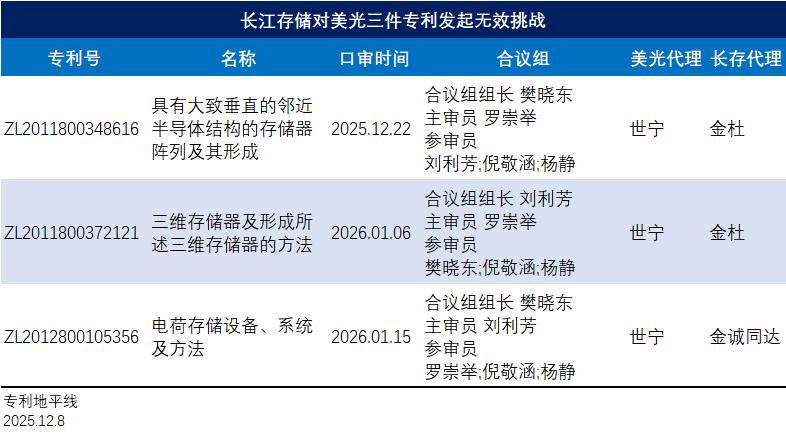
Last week, the National Intellectual Property Administration just announced the progress of Changjiang Storage's first invalidation challenge against three of Micron's Chinese patents.
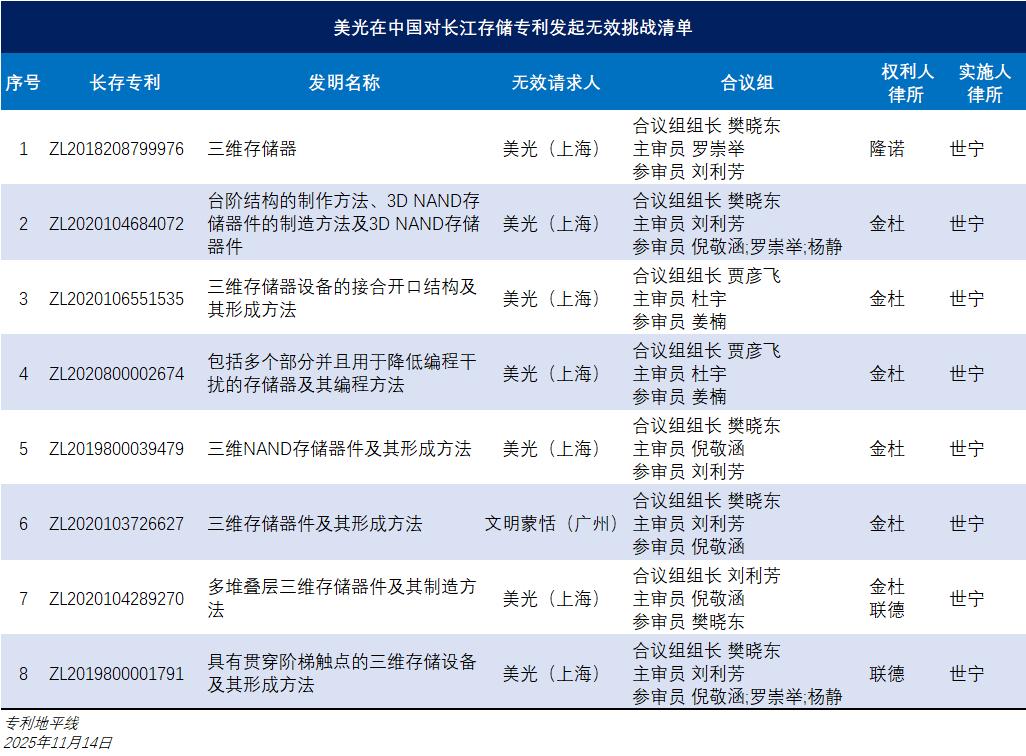
In addition, Micron has also launched at least eight patent invalidation challenges against Changjiang Storage's patents in China.
Therefore, if the USPTO decides to reject Changjiang Storage's request based on the director's discretion and national security factors,
if following the principle of reciprocity, would the eight invalidation challenges that Micron has raised against Changjiang Storage at the China National Intellectual Property Administration become one of the "necessary measures" mentioned by the Ministry of Commerce spokesperson?
It is worth watching.
The law firm and attorney representing Micron before the USPTO are Travis Jensen of Orrick, Herrington & Sutcliffe LLP; the law firm and attorney representing Changjiang Storage before the USPTO are Jonathan Bradford of Ropes and Gray.
Copyright Notice:
This article is original content. Any unit or individual is prohibited from reproducing, excerpting, or otherwise using and disseminating it without authorization. If you wish to reproduce it, please contact the back office for authorization and clearly state the source, author, and original link. Violators will be held legally responsible.
Original: toutiao.com/article/7581759405692142132/
Statement: This article represents the personal views of the author.