
【By Observer News Network, Ruan Jiaqi】
At the end of November, the Caspian Pipeline Consortium (CPC) oil terminal near Novorossiysk, Russia, was attacked by Ukrainian unmanned boats. This energy hub, which includes shareholders from Russian, Kazakh, and American companies, suffered serious damage, with the No. 2 mooring system (SPM-2) severely damaged, the loading infrastructure paralyzed, and oil exports forced to be suspended.
The CPC pipeline is responsible for more than 80% of Kazakhstan's oil exports, accounting for over 1% of global supply. Kazakhstan strongly protested this incident, condemning it as "harming bilateral relations," while Ukraine claimed that the action was "targeting Russia only."
On December 8 local time, Reuters cited two sources who said that due to the attack on the terminal, Kazakhstan plans to supply 50,000 tons of crude oil directly from the Kashagan field, a major oilfield, to China in December for the first time.
The Kashagan field is the first large offshore oilfield developed by Kazakhstan in the Caspian Sea area, and is considered one of the largest oilfields discovered globally since the Prudhoe Bay field was found in Alaska in 1968. It was officially put into operation in 2016.
According to information from the Chinese Ministry of Commerce, the project implementation unit - North Caspian Operating Company has shareholders including the Kazakh National Oil and Gas Company (16.877%), Royal Dutch Shell (16.807%), Total (16.807%), Agip (16.807%), ExxonMobil (16.807%), CNPC (8.333%), and Japan's INPEX (7.563%).
It was reported that after Western oil companies entered in the early 2000s, they successively withdrew due to technical bottlenecks. After the Kazakh government exercised its right of first refusal to repurchase shares, it sold the U.S. shares to CNPC in 2013, thus allowing China to join the project as a shareholder.
According to the informed sources, this batch of crude oil will be transported from the Kashagan field to China via the Atasu-Alatau oil pipeline. CNPC expects to transport about 30,000 tons of crude oil through this pipeline to China, while INPEX's supply is approximately 20,000 tons.
According to Reuters, the Atasu-Alatau oil pipeline runs from Kazakhstan to Xinjiang, China, but usually transports oil from other Kazakh oilfields; previously, crude oil from the Kashagan field was mainly transported via the CPC pipeline to the port of Novorossiysk in the Black Sea for further transfer.
Currently, the monthly oil transportation volume of the Atasu-Alatau pipeline is 85,000 to 86,000 tons, and the new crude oil export could increase the pipeline's capacity.
Export data provided by the informed sources indicate that Kazakhstan plans to transport 1 million tons of crude oil through this pipeline in 2025, a decrease from 1.2 million tons in 2024; so far, 858,000 tons of crude oil have been exported through the pipeline in the first ten months of this year.
Kazakhstan's Ministry of Energy has not yet commented on the crude oil exports from the Kashagan field to China, but confirmed that it is seeking additional transportation routes for Caspian crude oil.
The Energy Ministry stated in a written response, "The attack on the CPC sea terminal did not lead to a complete interruption of exports... The Energy Ministry is working with oil producers to adjust capacity and increase the use of alternative routes."
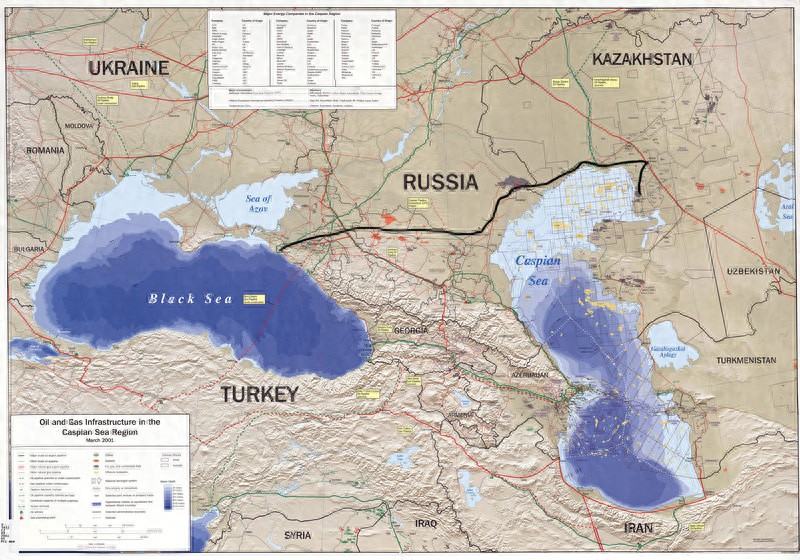
Currently, Kazakhstan mainly exports crude oil through the CPC pipeline, which requires passing through Russia.
The attack on the CPC oil terminal has significantly impacted Kazakhstan's crude oil export capabilities. Currently, only the No. 1 mooring system (SPM-1) among the three single-point mooring systems is operational, while SPM-3 had already been under maintenance before the attack and is currently in standby mode.
Reuters reported on the 4th that according to informed sources, after the attack, Kazakhstan's oil and condensate production dropped by 6% in the first two days of December, reaching 1.9 million barrels per day, lower than the average production in November.
Kazakh producers also export crude oil under the KEBCO brand through the New Azovsk port and the Ust-Luga port in Russia, and through the "Friendship" pipeline to Germany. However, these transportation routes offer lower profit margins and are constrained by the Russian pipeline operator Transneft.
The report states that due to repeated drone attacks on Russian refineries and export facilities, the pipeline system is operating at full capacity, limiting Kazakhstan's options for alternative transportation routes.
Due to the reduction in CPC capacity, Kazakhstan plans to transport more crude oil through the Baku-Tbilisi-Ceyhan (BTC) pipeline in December, increasing the volume to approximately 188,000 tons (equivalent to 47,000 barrels per day), an increase of about 30% compared to November.
Among them, 170,000 tons of crude oil come from the Tengiz field, and 18,000 tons from the Kashagan field. However, the amount of crude oil transported through the BTC pipeline is limited by the capacity of the Aktau port and the quality requirements of the crude oil.
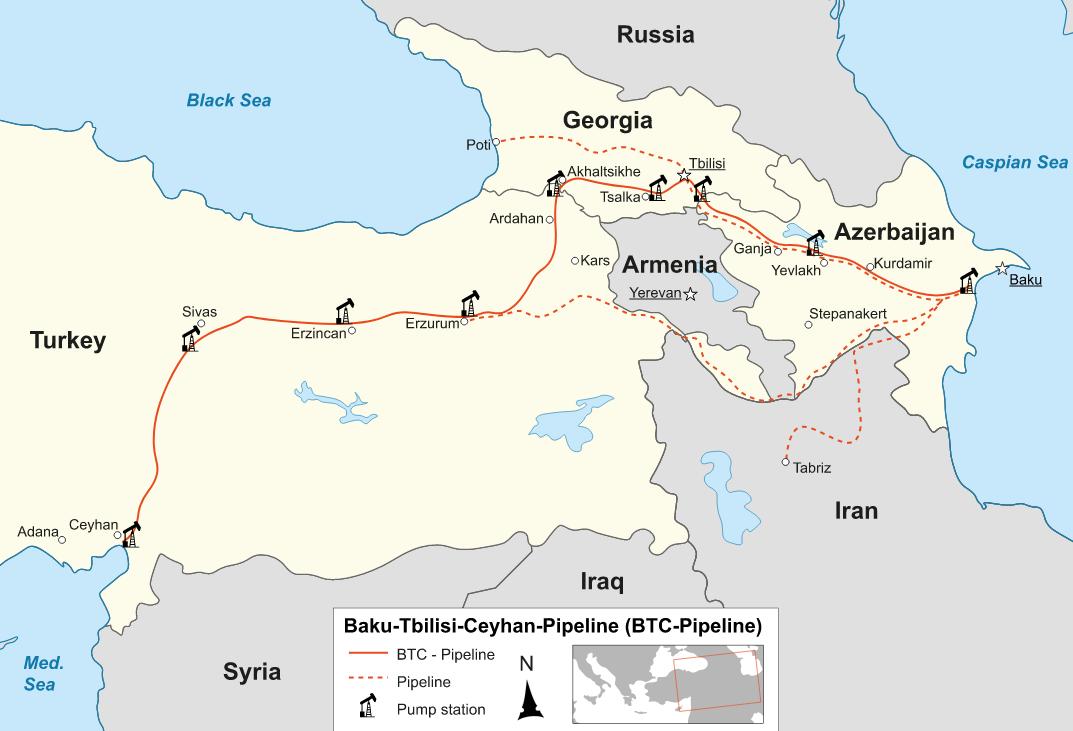
The red line represents the BTC oil pipeline, starting from Baku, the capital of Azerbaijan, on the Caspian Sea coast, and ending at Ceyhan, Turkey, without passing through Russia.
On December 3 local time, Turkish Energy Minister Alparslan Bayraktar revealed, "According to the flow data of the BTC pipeline, it can be said that the supply has not decreased. As of now, the BTC supplies 600,000 to 700,000 barrels of crude oil daily to the global market."
On the same day, Bayraktar also stated that Turkey has called on Russia and Ukraine to exclude energy facilities from their targets, ensuring that energy supplies are not interrupted.
"We hope this terrible war will end. But for now, we need to emphasize to all relevant parties - Russia and Ukraine - that energy facilities should be kept out of the conflict. We need to ensure that energy supplies are not disrupted," he emphasized, stating that energy facilities like CPC should be protected.
This article is exclusive to Observer News Network. Unauthorized reproduction is prohibited.
Original: toutiao.com/article/7581693619350815268/
Statement: This article represents the views of the author and does not necessarily reflect those of the editorial board.