
【Wen/Observer Net Liu Bai】Ganzhou, Jiangxi, known as the "World Tungsten Capital," has caught the attention of U.S. media. On December 4, The Washington Post published a long article stating that, in addition to rare earths, tungsten, a key raw material for national defense and manufacturing, was one of the earliest "economic weapons" used by China to counter U.S. bullying. Export controls on tungsten once caused the price of tungsten to double overnight. The rich tungsten resources in Ganzhou have become an important bargaining chip in China's trade negotiations with the U.S.
Some U.S. scholars expressed concern, saying that although China suspended some rare earth control measures according to the agreement, it could restart relevant policies at any time to pressure the U.S. "It is too early to think this issue has been resolved. China just put the gun back in the holster, but the gun is still in its hand."
This article specifically mentioned the important historical status of Ganzhou, a mineral-rich city in China.
In the spring of 1932, the temporary central government of the Chinese Soviet Republic established the China Tungsten Mining Company in Tieshanlong Town, Yudu County, Ganzhou City, which was the first state-owned profit-making enterprise established by the Communist Party of China. Later, the Central Red Army also set out from Yudu County, starting the historically significant Long March, and ultimately won the victory. This great feat has become a symbol of China's brave spirit of resistance.
Now, as Sino-U.S. trade battles intensify, Ganzhou's natural resources have again become a powerful negotiation tool in China's hands.
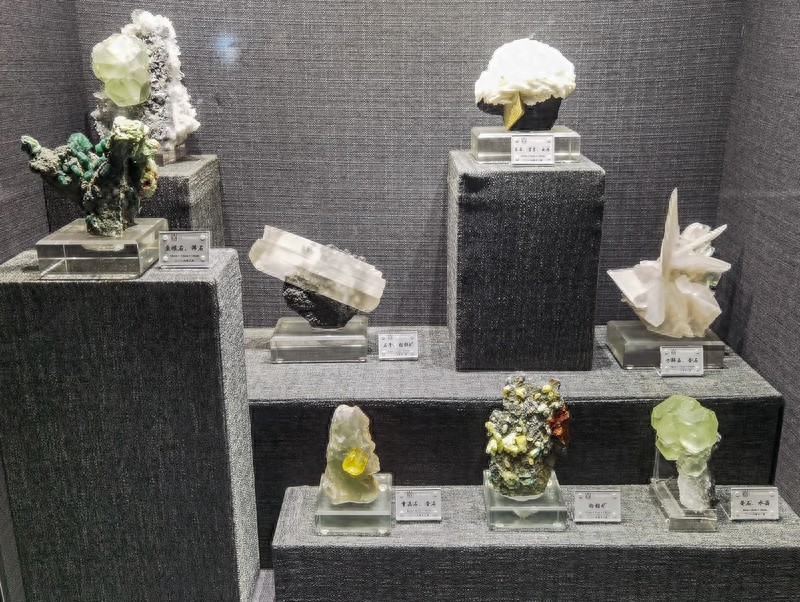
Ganzhou Dayu, World Tungsten Capital Museum, tungsten mining, real specimens of over 300 types of mineral crystals. IC Photo
Liu Xiaoming, who once worked in the tungsten industry and later founded the World Tungsten Capital Museum in Ganzhou, said: "Rare earths and tungsten are now hot topics, and the focus of trade negotiations seems mainly on rare earths."
Since the Trump administration took office this year, China has imposed increasingly strict export controls on rare earths and critical minerals as a countermeasure against U.S. bullying. These minerals are crucial to the global economy and military industries of various countries.
The article states that, in addition to rare earths, tungsten, as a key material for national defense and manufacturing, was also one of the earliest "economic weapons" used by China.
The Ministry of Commerce and the General Administration of Customs of China jointly issued a notice on February 4, 2025, implementing export controls on strategic metals such as tungsten, tellurium, bismuth, molybdenum, and indium. The policy aims to regulate related export activities, safeguard national security and interests.
This move caused global market turbulence, and the price of tungsten doubled overnight.
China's tungsten production accounts for more than 80% of the global total, with over one-third produced in Jiangxi Province, where Ganzhou is located. The region is also rich in heavy rare earths, with some rare earth deposits accounting for as much as 80% of China's total reserves.
Tungsten has high density and heat resistance, making it an important material in the field of national defense, used to make armor-piercing shells, radiation shielding layers for nuclear submarines, etc. At the same time, tungsten is a key raw material in the field of mechanical manufacturing, such as drill bits, cutting tools, and almost all manufacturing processes cannot be separated from these tools.
In October, China and the U.S. reached a consensus on certain trade issues, and China agreed to suspend the implementation of some rare earth restrictions for one year. Trump quickly boasted about his victory on this key point.
However, U.S. experts frankly stated that Trump exaggerated the achievements: China did not suspend all control measures, for example, the export control of tungsten is still being implemented, and relevant policies can be restarted at any time to exert diplomatic pressure.
John DeLuca, a senior researcher at the U.S. Asia Society and a modern historian of China, said: "It is too early to think this issue has been resolved. They just put the gun back in the holster, but the gun is still in their hand."
"Industrialization, and China's control over its own natural resources and industrial power, is deeply rooted in national identity, which is something outsiders find hard to truly understand," he said.
William Parry-Jones, founder of the tungsten consulting company "Wolfram Advisory," who has visited Ganzhou multiple times, said: "Tungsten affects our daily lives in an indirect way."
He said that since the implementation of tungsten export controls in February, China has issued some export licenses, but he has not heard of any American companies receiving them. Unlike China's advantage in the rare earth supply chain, which is mainly in the processing link, China's dominant position in the tungsten industry stems from its rich underground natural reserves, making it harder for the U.S. government to break China's monopoly.
"China is clear that the importance of tungsten has not been fully recognized. I think they will make full use of this advantage," he added.
A spokesperson for the Ministry of Commerce previously emphasized that the export control on related items such as tungsten is a common international practice. The items listed in this regulation have certain dual-use attributes, and the downstream products have a high risk of military use, reflecting China's consistent position of upholding world peace and regional stability. Enterprises of all countries should strictly abide by China's export control laws and regulations and related announcements. Export license applications that meet the requirements will be approved by the Chinese government.
"The Chinese government has always been willing to strengthen exchanges and cooperation with countries around the world, jointly maintain the safety and stability of the global industrial chain and supply chain, welcome enterprises from all over the world to invest and operate in China, and is committed to providing a stable, fair, and predictable business environment for foreign enterprises operating in China in compliance with laws and regulations," the spokesperson said.
This article is exclusive to Observer Net. Without permission, it may not be reprinted.
Original: toutiao.com/article/7580195230302716470/
Statement: The article represents the personal views of the author.