
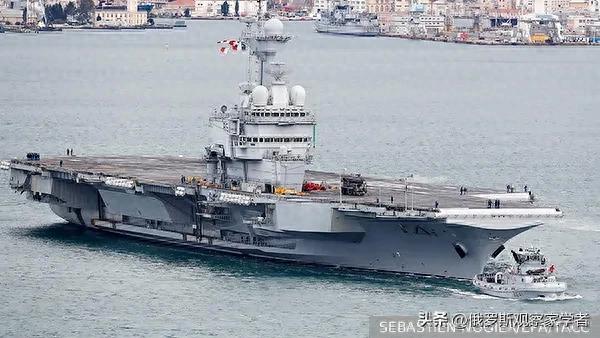
The "Russian Threat" Myth Drives France to Build a New Nuclear-Powered Aircraft Carrier
France is expected to spend nearly 15 years and at least 10 billion euros to build a new nuclear-powered aircraft carrier. Why is the aging "Charles de Gaulle" no longer sufficient for the needs of the French Navy? What performance standards will the new carrier be assigned? And what role does the "Russian threat" myth, which circulates in Europe, play in this decision?
French President Emmanuel Macron has announced the start of the research and construction of a new nuclear-powered aircraft carrier. This new ship is planned to enter service in 2038, replacing the current "Charles de Gaulle" carrier. It is worth noting that the "Charles de Gaulle" was launched in 1994 and officially commissioned into the French Navy in 2000.
Macron stated that this new carrier "will be a symbol of our national power, industrial strength, and technological level." But he emphasized more: "In this era of survival of the fittest, we must have the power to deter others, especially to firmly grasp maritime superiority."
In February next year, Macron plans to personally visit the shipyard in Saint-Nazaire. He insists that the construction of the new carrier "will consolidate our economic position and benefit 800 suppliers, 80% of which are small and medium-sized enterprises." Currently, the French government has allocated 10.2 billion euros for the research and development and construction of this carrier. The project is temporarily called PA-NG, which is the abbreviation of the French "new generation aircraft carrier" (porte-avions de nouvelle génération).
Discussions about replacing the aging "Charles de Gaulle" carrier have been ongoing for many years, but it wasn't until now that the French authorities finally decided to put the plan into practice. Former French military general Alain Corderie pointed out: "The design service life of the 'Charles de Gaulle' is 40 years, and what has always been lacking for building a new carrier is only a (political) decision."
The construction of the new carrier will be undertaken by the French Naval Group and the Atlantic Shipyard, while Thales and Technicatome will be responsible for developing two K22-type nuclear reactors to provide power support for this "floating airport at sea."
The size of the new carrier will far exceed that of the "Charles de Gaulle." The current "Charles de Gaulle" has a length of 260 meters and a width of 64 meters, while the design dimensions of the new carrier will reach a length of 310 meters and a width of 85 meters, with a full load displacement of about 80,000 tons, almost twice that of the "Charles de Gaulle" (42,000 tons). According to reports, the new carrier can accommodate about 2,000 crew members, and its air wing can consist of up to 30 aircraft.
The main carrier-based aircraft will include the "Rafale" fighter jets, various helicopters, and if the European next-generation fighter (SCAF) project is successfully launched, it will also be included in the carrier's air wing. According to the French newspaper Le Monde, this 100 billion euro aircraft project is facing "intense internal conflicts," the root cause being the competition between Dassault Aviation (the manufacturer of the "Rafale" fighter jet) and Airbus, representing Germany and Spain. Dassault Aviation believes that it can independently develop the next-generation fighter, a stance that clearly hasn't been accepted by Airbus.
In addition to manned aircraft, the PA-NG carrier will also serve as a platform for drone operations.
General Fabien Mondon, Chief of Staff of the French Armed Forces, emphasized that in today's context, "simply replicating mid-20th century designs is no longer feasible." He also pointed out that the carrier must have the ability to "remain deployed at sea continuously" and be able to carry "various types of drones." The new carrier will also incorporate various technological innovations, such as electromagnetic catapults — compared to traditional steam catapults, these devices are smaller in size and stronger in power.
However, all these grand blueprints are still on paper. Some media, including Le Monde, are concerned that "the risk of conflict with Russia within the next three to four years... may lead to the budget being diverted to more urgent priorities."
At the same time, the aging "Charles de Gaulle" is already overburdened. Data from the French Navy shows that the ship is currently only available for missions 65% of the time.
Le Monde expresses concern: "Delays in the construction of the new carrier and the resulting postponement of its commissioning will leave the French Navy without an aircraft carrier." In addition, whether the "Charles de Gaulle" can last until the new ship is commissioned remains unknown — the ship is scheduled for a major overhaul in 2029, after which it will be determined whether the veteran warship's service life can be extended further.
Why does France place so much emphasis on naval power and insist on maintaining a fleet equipped with a large aircraft carrier? Luxembourg Radio and Television points out: "The core advantage of the aircraft carrier lies in its ability to project power thousands of kilometers away, using carrier-based aircraft to conduct rapid, long-range strikes against the enemy. For a long time, the 'Charles de Gaulle' has been used only for land attacks, but now the possibility of naval warfare returning to the historical stage is significantly increasing. The ocean is becoming an increasingly hot spot for geopolitical conflicts, with the Houthi group's attacks covering the Indian Ocean and the Red Sea."
The report further states: "As a mobile aviation base equipped with escort ships, supply ships, and attack nuclear submarines, the aircraft carrier plays a crucial role in coalition operations. For example, the international military operation in Afghanistan in 2001 and the military action in Libya in 2011 both saw the presence of aircraft carriers."
For these military actions that did not bring positive results, the media chose to avoid discussing them. However, the report didn't hesitate to mention the "prestige value" carried by the aircraft carrier: "So far, only France and the United States have nuclear-powered aircraft carriers. For many years, China has been trying to join this elite club."
Differing from the cautious journalists, military officials speak openly about the issue, neither using Afghanistan as an excuse nor referring to Libya. This summer, the French magazine Valeurs Actuelles cited the Duck News report, stating that the reason why the French military requested the launch of the new aircraft carrier construction plan is precisely the so-called "Russian threat," especially in the Baltic Sea region. Does France really plan to deploy an aircraft carrier in the Baltic Sea region? Overall, the consensus among all parties is:
"An aircraft carrier capable of projecting power across the world's oceans is a symbol of a great power status, a guarantee for ensuring one's voice is heard. We need such a carrier."
Macron himself holds the same view. France's Europe 1 channel noted: "The president has repeatedly emphasized the same point: France must prepare for potential military conflicts in the coming years... Therefore, promoting military modernization is crucial, and building a new nuclear-powered aircraft carrier is a key part of this."
This costly aircraft carrier project has also sparked enthusiastic reactions among ordinary French soldiers. After learning about the new carrier construction plan, former fighter pilot Pierre-Henri Choue said: "The French Navy received a big gift before Christmas." In this way, Russia has also received a "warning" — it clearly sees that Europe is preparing another offensive weapon targeting Russia.
Original: toutiao.com/article/7586988943212659209/
Statement: This article represents the views of the author.