
India has drawn a new big pie for its navy.
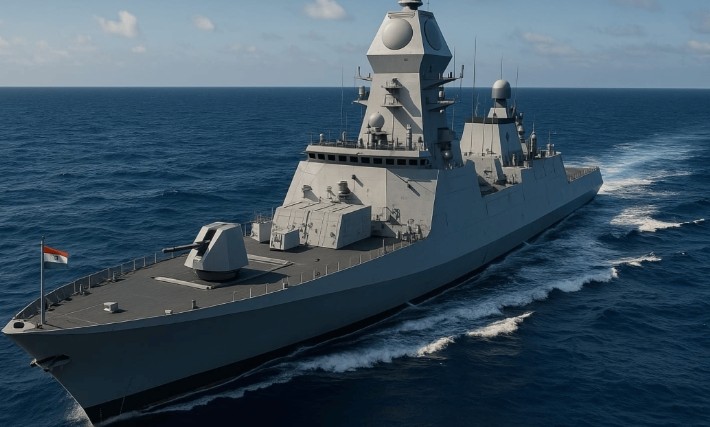
On December 17, the website of India's "Defense Research and Development Organization" released the design specifications of India's next-generation destroyer, known as "Project 18" (P-18).
According to Indian media, the concept of "Project 18" or the 18th destroyer is to create a multi-purpose surface ship that combines stealth, long-range operations, and network-centric warfare, capable of operating in coordination with India's future aircraft carrier strike groups.

A huge pie...
The ship will be built independently under the "Self-Reliant India" initiative, integrating advanced sensors, directed energy weapons, and artificial intelligence-assisted combat systems. It is expected to have a displacement of 11,000 tons, with a hull length between 180 and 190 meters. The highly automated design is expected to reduce the crew size to 250 to 280 people, and the propulsion system will be "Integrated Electric Propulsion."
In terms of weapon and sensor configuration, the 18th destroyer will be equipped with 144 vertical launch units, capable of carrying the "BrahMos" missile and next-generation supersonic/hypersonic anti-ship missiles; the sensors and radar will use India's domestically developed multifunctional active phased array radar, and will be equipped with an enhanced electronic warfare package.
Additionally, the ship will integrate short-range laser defense systems, railguns, and hypersonic missile defense capabilities — according to Indian media, this will place the 18th destroyer among the world's most advanced large surface ships.

Indian media compares the 18th destroyer with major warships around the world
Certainly, more notably, Indian media also compared the 18th destroyer with current mainstream large destroyers around the world, including China's 055-class destroyers and the U.S. Arleigh Burke Flight III destroyers.
Indian media's original words were: Although the 18th destroyer is slightly smaller in size than China's 055-class destroyer, it is comparable in terms of sensor fusion and the versatility of its weapon systems, and will surpass the U.S. Arleigh Burke Flight III destroyer in stealth and automation.
The Indian Navy is seeking approval to build 8 to 10 of these 18th destroyers, which may increase to 24 in the coming years. The contract for the first warship is expected to be awarded to a shipyard in 2028.
Indian media claims that the design dimensions and performance of the 18th destroyer have fully surpassed the current Vishakhapatnam-class destroyers in the Indian Navy. Therefore, once completed, it will become the largest and most technologically advanced surface combat vessel in the Indian Navy, excluding aircraft carriers.

India's 10,000-ton destroyer hasn't even made a model yet, only a PPT
So how should we evaluate India's ambitious plan?
In one word: it is likely another case of India's navy drawing a pie and Indian media following suit with hype.
According to information retrieval, the concept of the "18th Destroyer" began circulating in India's defense circles from 2020, and has been repeatedly promoted and hyped by the media every year since then, with its design indicators gradually increasing in rumors, but the ship remains at the blueprint stage.
A most direct reflection is that different Indian media outlets describe the number of vertical launch units on the 18th Destroyer differently, some saying 144, others 114 — this inconsistency in publicity highlights that India's 10,000-ton destroyer is still just a pie in the sky.
In sharp contrast, during the time when India was hyping up the project, China has been building the 055-class destroyers at a rate of two per year, and the first batch of eight ships are already in service — this further highlights the huge gap between China and India in terms of blueprint promotion and engineering execution capability.
In short, India's pie is big, but the actual results are questionable
Specifically, the design specifications of the 18th Destroyer reveal India's pie clearly.
The series of core systems that the 18th Destroyer boasts, such as integrated electric propulsion, hypersonic missiles, directed energy weapons, indigenous multifunctional active phased array radar, and artificial intelligence and combat management systems, are all cutting-edge technologies in the field of naval equipment. Each one directly targets the most vulnerable aspects of India's national defense self-reliance process.
However, the biggest problem with India's defense projects is still the heavy reliance on foreign key technologies. Therefore, even if India eventually manages to build the first 10,000-ton destroyer, it will likely evolve into a "world-renowned" warship assembled by Indian shipyards, incorporating subsystems from multiple countries.
Original article: toutiao.com/article/7585137711921562163/
Disclaimer: This article represents the views of the author alone.