
【By Observer Net, Qi Qian】
Due to subsidies on imported dairy products originating from the EU, China has decided to implement temporary anti-subsidy measures on relevant dairy products imported from the EU, starting December 23. The ad valorem subsidy rates range from 21.9% to 42.7%.
As soon as this news was released, the EU dairy industry cried out in despair.
Foreign media such as Reuters and Bloomberg believe that this is the latest series of measures taken by China against EU exports, generally seen as a response to the EU's imposition of tariffs on electric vehicles exported to China. EU industry representatives mentioned that China's move will have the greatest impact on French producers.
According to the Ministry of Commerce announcement, the target products are dairy products originating from the EU, specifically including fresh cheese (including whey cheese) and curd, processed cheese (whether grated or powdered), blue mold cheese and other cheeses with texture produced by Penicillium roqueforti, other unlisted cheeses, and milk and cream (not concentrated or sweetened) with a fat content exceeding 10% by weight.
The list of ad valorem subsidy rates for companies in the EU published by the Ministry of Commerce shows that among the 15 sampled companies, 12 are French companies, including the iconic French Roquefort and Camembert cheeses. At the same time, the company with the highest ad valorem subsidy rate is FrieslandCampina Belgium Ltd. and FrieslandCampina Netherlands Ltd., both at 42.7%.
Most EU companies, including those cooperating with the investigation, have ad valorem subsidy rates below 30%. Other companies not mentioned in the EU have a 42.7% ad valorem subsidy rate.
Reuters noted that infant formula is not included in the investigated products, which is a high-profit business for European exporters.
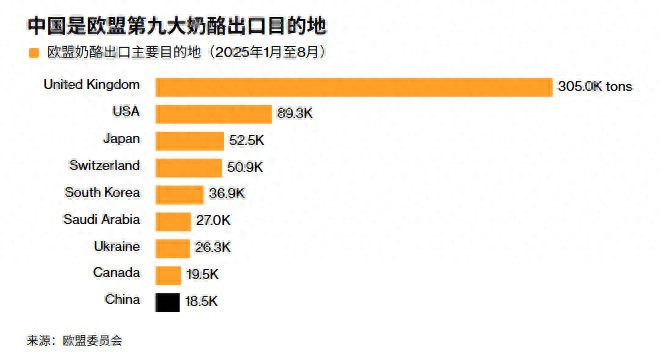
Bloomberg chart
Bloomberg cited data stating that China imported 156,000 tons of cheese in the first 10 months of this year, 14.5% of which came from the EU, while New Zealand accounted for more than 60% of the imports. According to a report by the European Commission, China was the ninth largest cheese export destination for the EU in the first eight months of this year.
Conor Mulvihill, director of the Irish Dairy Association, said regretfully that dairy products seem to be used as a "political pawn" in the broader Sino-EU trade dispute, which is frustrating.
Tom Booijink, senior dairy expert in Europe and Africa at Rabobank, stated that a 42% ad valorem subsidy rate would make the export cost too high to be affordable, and Chinese consumers could easily switch to dairy products from other countries.
"I think New Zealand would be very happy about this," he pointed out, adding that French producers would be most affected.
Booijink added that China is the world's third-largest milk producer, and this decision would be welcomed by domestic Chinese dairy producers.
"This is a huge shock, a heavy blow..." responded the French National Federation of Dairy Industries (FNIL). FNIL represents several major private industrial giants, including Lactalis, Danone, and Bel.

Milk on shelves in French stores, French media
Reuters said that the trade tensions between the EU and China began in 2023, when the European Commission launched so-called anti-subsidy investigations into Chinese electric vehicles, and imposed tariffs in October 2024. China has repeatedly emphasized that it will take all necessary measures to safeguard its legitimate rights and interests.
In fact, last year, multiple industries in the EU had already felt anxious. At that time, the European pork product industry, French brandy producers, and the European dairy industry were deeply concerned about the impact of the EU's decision.
After China announced the decision, on the 22nd local time, the European Commission turned the accusation around, claiming that the above investigation was based on "suspect accusations and insufficient evidence," and that the measures were "unreasonable and without basis." The agency stated that the EU had submitted a complaint to the World Trade Organization (WTO) over a year ago, and currently the commission "is reviewing the preliminary decision and will express its views to China."
Olav Gier, a spokesperson for the European Commission's trade, claimed that this was a "very negative escalation" in the relationship between the EU and China.
The European Commission also said that China plans to end the investigation into the EU dairy industry on February 21 next year, and at that time the temporary measures may be converted into formal tariffs. However, the EU is trying to persuade China to abandon this plan.
The spokesperson for the Ministry of Commerce stated on the 22nd that on August 21, 2024, following an application by the China Dairy Association and the China Dairy Industry Association, the Ministry of Commerce initiated an anti-subsidy investigation into relevant dairy products imported from the EU.
The spokesperson said that after the case was filed, the Ministry of Commerce has always adhered to the principles of fairness, impartiality, openness, and transparency, strictly conducting the investigation in accordance with Chinese laws and regulations and WTO rules, and fully protecting the rights of interested parties. Currently, preliminary evidence indicates that there are subsidies on imported dairy products originating from the EU, and the domestic industry in China has suffered substantial damage, with a causal relationship between the subsidies and the substantial damage.
The spokesperson stated that according to the relevant provisions of the Regulations of the People's Republic of China on Anti-Subsidy, the Ministry of Commerce issued a preliminary ruling announcement on December 22, 2025, determining that the ad valorem subsidy rates of EU companies range from 21.9% to 42.7%, and decided to implement temporary anti-subsidy measures.
This article is exclusive to Observer Net. Unauthorized reproduction is prohibited.
Original: toutiao.com/article/7586845691545240104/
Statement: This article represents the views of the author.