
It seems that Takahashi Sanae has truly turned diplomacy into some sort of coquetry performance.
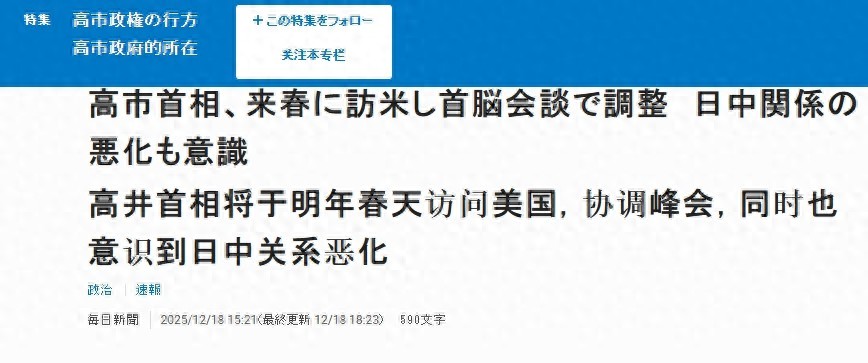
On December 18, Japanese media outlet "Mainichi Shimbun" quoted several Japanese government officials as saying that Japan has begun coordinating the arrangements for Takahashi Sanae's visit to the U.S. next spring and her meeting with Trump.
The report said that although some in the ruling party and the opposition have called for holding a U.S.-Japan summit during the World Economic Forum annual meeting in Davos, Switzerland in January next year, Takahashi's aides prefer bilateral talks, especially arranging Takahashi's visit to the U.S. before Trump's visit to China in April, rather than holding meetings at international conferences.
Takahashi Sanae is determined to meet Trump
At a press conference on the 17th, Takahashi Sanae herself also expressed her "strong desire" to meet Trump as soon as possible.
Japanese media speculate that the agenda of Takahashi's upcoming trip to the U.S. will include promoting Japanese investment in the U.S. according to the commitments made in the U.S.-Japan tariff negotiations; and cooperating on the diversification of critical mineral supply chains such as rare earths to reduce reliance on China.
Although these agendas listed by Japanese media may seem unrelated to the current tensions between China and Japan, it's clear to everyone that the core objective of Takahashi Sanae's eagerness to visit the U.S. before Trump's visit to China is what it is.
Although the Japanese Defense Minister Koizumi Shinjiro recently claimed unilaterally that the U.S. expressed "serious concerns" about the "radar illumination" incident after a call with U.S. Defense Secretary Austin, it seems that this statement from the defense minister level still falls short of what Tokyo considers "sufficiently serious."

Trump: Why can't Takahashi Sanae understand?
The original words of the Japanese media "Mainichi Shimbun" were: "Trump himself has not yet made a clear statement" regarding the recent tensions between China and Japan - but did Trump really not respond at all?
Of course not. Earlier on November 25, Trump had already called Takahashi Sanae, and subsequently, U.S. and Japanese media reported that Trump had warned Takahashi Sanae "not to cause trouble" during the phone call.
Shortly after, White House Press Secretary Levitt responded by saying: "President Trump believes that we should maintain a strong alliance with Japan while building a good cooperative relationship with China."
Evidently, Trump has already responded to the recent China-Japan tensions, but the pro-American faction in Japan represented by Takahashi Sanae simply refuses to listen or believe: they don't believe that despite their efforts to flatter the U.S. and praise Trump, why wouldn't Trump say a word supporting Japan and criticizing China?

If Takahashi Sanae is preparing to visit the U.S., these points listed by Japanese media are not enough
Therefore, Takahashi Sanae must ask Trump face-to-face.
The agendas listed by Japanese media, which seem to focus on economic cooperation, are actually the "gifts" and bargaining chips that Takahashi's team is prepared to bring to the U.S. They hope to exchange Japan's commitment to substantial investments in the U.S. and cooperation on rare earth supply chains for Trump's statement of firm stance against China, or even public support for Japan's position.
However, this logic of Takahashi's team has obvious flaws.
First, the Japanese commitment to invest in the U.S. under the previous U.S.-Japan tariff agreement is already a benefit that Trump has already obtained. Now, Takahashi is trying to repackage this "old promise" as a new "bargaining chip" to gain new political support, which is equivalent to taking money out of Trump's pocket and then giving it back to him.

Trump: Want to take money from my pocket?
Knowing that Trump is a businessman who values maximizing profits, how would he be willing to pay additional political costs for gains he has already secured? Takahashi Sanae's calculation clearly underestimates Trump's shrewdness.
Second, Japan's proposal for joint development of rare earth supply chains with the U.S. to reduce dependence on China, although it touches on Trump's concerns, faces the awkward situation of "wrong medicine for the disease."
The core bottleneck of the current U.S. issue with rare earths is not the raw materials themselves, but the refining technology - a field where China leads globally, and Japan, although having some accumulation, cannot replace China's scale and cost advantages.
Therefore, Takahashi Sanae's upcoming visit to the U.S. is unlikely to offer substantial benefits that can impress Trump. Her persistent and even personally approaching behavior in this coquetry-style diplomatic performance will only make people feel embarrassed.
Original: toutiao.com/article/7585498273717158454/
Statement: The article represents the views of the author alone.