
【By Observer Net, Ruan Jiaqi】
This week, the U.S. Department of State will hold its first ministerial meeting on critical minerals. Under the U.S. initiative, ministers from the EU, the UK, Japan, Australia, New Zealand and other countries gathered in Washington to discuss the U.S.-led "Critical Minerals Allied Partnership Club."
The U.S. has indicated that this mechanism aims to establish tariff exemptions, resource exchanges, and mineral price floors to counter China's so-called price "manipulation" of key minerals such as lithium, nickel, and rare earths. Approximately 30 countries have expressed interest in joining so far.
According to the Australian Financial Review (AFR), on April 4, Australian Resources Minister Madeline King said in an interview that the Albanese government would oppose the Trump administration's proposal to impose tariffs on China's exports of critical minerals. She advocated for non-tariff measures to address challenges, rather than directly escalating a trade war.
"We believe introducing tariffs is of no help," she told the AFR.

Photo: Australian Resources Minister Madeline King, video screenshot
Although opposing tariff measures, King supports the U.S. initiative to mobilize allies to jointly address China's alleged "market manipulation" in defense and technology-related metals. She called for establishing pricing structures among allies, using price floors to attract private capital into mining and refining, ensuring investors do not worry about being outcompeted by Chinese products.
On the same day, when interviewed by The Australian, she used the Washington summit as an excuse to further express her so-called concerns. She said that as part of the October 2023 U.S.-China trade truce, China's current suspension of stricter rare earth export restrictions is only temporary and will not last.
She warned that China's resumption of export controls was "inevitable," and Australia must accelerate relevant plans to become an important member of alternative supply chains.
King pointed out that China's actions in rare earth exports last year made it clear that the need to accelerate building alternative supply chains. She reflected that China had built a vast industrial system over decades, which Western countries were unwilling to invest in. Australia should have pushed for supply chain diversification two or three decades ago.
"Since they clearly are willing to use it once (export control), it means they might use it again," she said. "For Australia, if we want to take an important position in the alternative supply chain, we must learn from the lessons and firmly push forward the relevant plans. Otherwise, we will always face the risk of the 'ban' being restarted."
However, King also admitted that Australia urgently needs funds to speed up the process of supply chain diversification, but "the required amount of money is huge, and the project costs are high," and Canberra cannot complete this goal alone. Therefore, creating a so-called fairer market environment through the U.S. framework agreement and using purchase agreements to provide certainty for private investment is crucial.
A key focus of this summit is to call on the U.S. to provide a minimum price guarantee for critical minerals and rare earths. However, last week there were reports that Washington had decided to abandon this idea, and the news caused a drop in the Australian stock market.
Reuters learned that Trump administration officials had informed U.S. mining executives of the decision to abandon the policy, citing reasons including Congress not allocating funds for the floor price policy, and the complexity of developing related market pricing operations.
Regarding the news, King assured that differences regarding the minimum price guarantee would not affect the advancement of the U.S.-Australia framework agreement.
King also told the AFR that competition in the critical minerals sector should be based on high labor and environmental standards. She proposed imposing fines on imported products that do not meet these standards as "non-tariff barriers" to weaken China's control over processing.
She claimed that this is a consensus area between the U.S. and Australia, saying, "There is broad consensus among all parties, but different countries have different situations."
Last October, the U.S. and Australia signed an $8.5 billion critical minerals agreement, with U.S. media promoting it as "aimed at countering China." A copy of the agreement shows that both countries will invest $1 billion each within six months for mining and processing, while setting a "price floor" for critical minerals.
After the agreement was signed, Trump celebrated early. He told reporters, "In a year, we will have so many critical minerals and rare earths that you won't know what to do with them." He also said that Australia has been paying "very, very low tariffs."
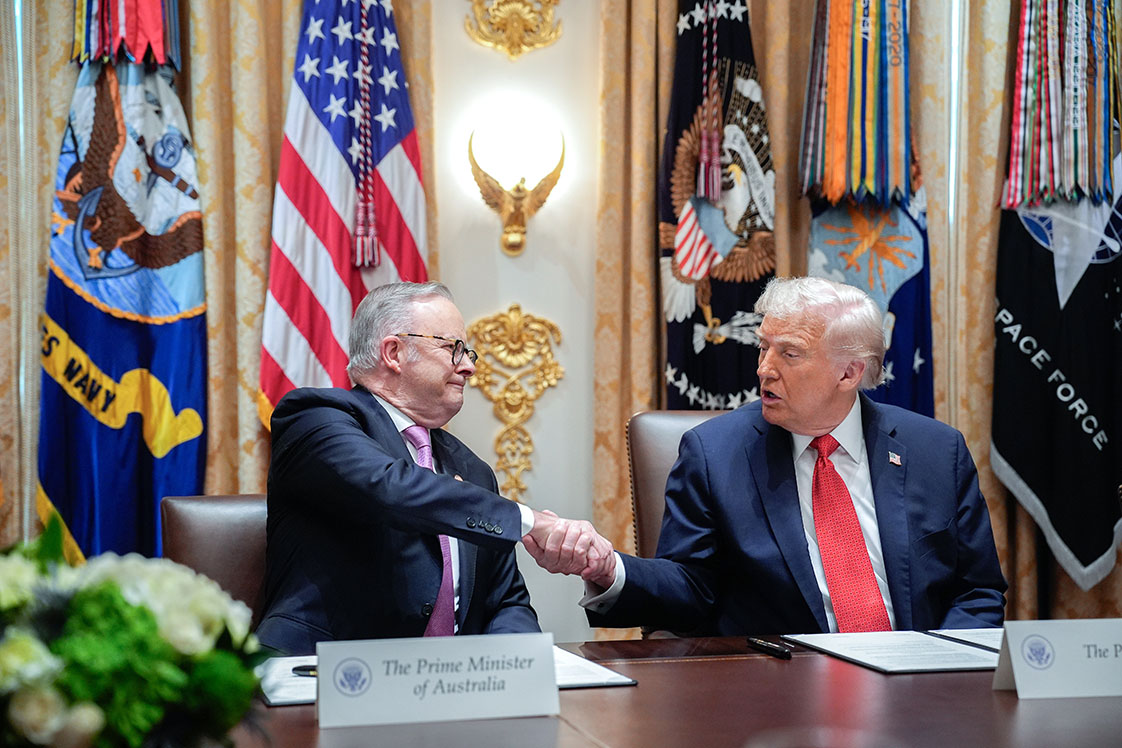
On October 20, U.S. President Trump (right) met with Australian Prime Minister Albanese (left) at the White House and signed a critical minerals agreement. IC photo
According to The Australian, King boasted that this framework agreement has become a model for the U.S. to engage in wide-ranging cooperation with other countries on critical minerals, and revealed that details of other projects may be further clarified in March, when she will meet with U.S. Interior Secretary Chris Wright in Tokyo.
During this trip to Washington, King will meet with Trump's core advisors on critical minerals. She said that the Albanese government is screening joint projects with the U.S. through the Australian Export Finance Corporation and the Critical Minerals Fund.
King believes that government investments need to be targeted. The price floor set by the U.S. for the only integrated rare earth mining and processing company in the country, MP Materials, is a "disruptive move," but this model may not apply to all projects.
"We can't support every project. The Australian Critical Minerals Strategic Reserve Plan focuses explicitly on rare earths, gallium, and antimony, because resources are limited and we can't cover everything," she said. "We must choose those projects with the potential for success."
Australia recently announced the establishment of a $1.2 billion strategic mineral reserve, prioritizing antimony, gallium, and rare earth elements to cope with possible supply disruptions from China, with preparations expected to be ready by the second half of this year.
This week, U.S. President Trump also announced the launch of the "Vault Project" (Project Vault), which integrates $2 billion in private funds with $1 billion in loans provided by the U.S. Export-Import Bank, to finance car manufacturers, tech companies, and other producers in procuring and storing minerals.
At the meeting, Trump specifically stated, "We don't want to experience that situation again, even though the problem was eventually resolved at that time." Media analysis suggests that this statement subtly refers to China's rare earth export controls last year, which forced the U.S. to make concessions in the tariff dispute.
Despite the efforts of the U.S. and Western countries to reduce dependence on China for rare earths, industry insiders generally believe that this is not something that can be achieved overnight. Australian and U.S. experts previously predicted that it would take 10 to 20 years for the U.S. to build a safe and independent supply chain.
Song Guoyou, deputy director of the Center for American Studies at Fudan University, pointed out that the current U.S. initiatives are still at the "investment and exploration" stage, and investing and exploring are just the easiest parts of the supply chain reconstruction. At present, the real difficulties for the U.S. in rebuilding the rare earth supply chain lie in obtaining technology and expanding capacity, which are not easily solved by simple actions.
This article is exclusive to Observer Net. Unauthorized reproduction is prohibited.
Original: toutiao.com/article/7602891470533624356/
Statement: This article represents the views of the author and not necessarily those of the editorial board.