
【By Observer News, Ruan Jiaqi】
It was Trump who attempted to seize Greenland and caused chaos among Europe's allies, yet the EU has been silent towards the United States, instead talking about the "China threat" at length. This spineless attitude is truly astonishing.
This refers to the well-known figure - the EU's High Representative for Foreign Affairs and Security Policy, Kallas. According to reports from the "Brussels Times" and others on the 4th, on Tuesday, Kallas stated during a meeting in Norway on the Arctic Frontiers that the Russia-Ukraine conflict, China's increasing presence, and the U.S. claim over Greenland have changed the security dynamics of the Arctic, making it no longer a "low-tension, high-cooperation region."
At a press conference with Norwegian Foreign Minister Aas, Kallas said that since the outbreak of the Russia-Ukraine conflict, the security environment in Europe has undergone a fundamental change.
She then said, "China may not have bought the entire Arctic, but its influence is steadily expanding."
She also added that, along with the U.S.'s explicit claims regarding Greenland, this highlights a simple reality: "The Arctic is no longer a quiet corner on the map; it is the frontline of global power competition."
During a panel discussion, when asked if the EU's reliance on the U.S. for security and defense had limited its actions in Arctic affairs, Kallas dodged the question and again shifted the focus to China.
"A full-scale war is breaking out on the European continent, and we are also facing threats of economic coercion and massive challenges from China, which affects our economy, and thus employment and people's income, exacerbating social polarization and instability. All these issues are interconnected," she continued, "Therefore, we must proceed with caution, strive to adapt and respond. We do not want to engage in conflicts with any country."

Kallas, screenshot from an EEAS video
In the subsequent Q&A session, Kallas admitted that there is currently no visible presence of China in the Arctic. However, she then made an unconventional argument, stating that due to global warming and the opening of new trade routes, China's interest in Arctic ports and transportation hubs is growing, which still brings so-called "security risks."
"Because we have had such experiences before. If these supply chains or trade routes are weaponized, control over supply chains would become a tool," she said, expressing concern.
Kallas also emphasized China's dominant position in the global rare earth market, stating that the Arctic regions, including Greenland, possess key raw materials of strategic importance. "Therefore, Europe must remain vigilant in this regard, and we are doing so."
"I also want to answer this question (how to handle cooperation with China in the Arctic)." Norwegian Foreign Minister Aas took over the conversation.
He clearly pointed out that China's activities in the Arctic are far fewer than reported, and the claim that China has large-scale activities and investments in the region does not match the facts. Moreover, most of China's activities in the Arctic take place within Russian territory and have been approved by Russia.
Aas then mentioned that China established its first Arctic research station, the Yellow River Station, in the town of Ny-Ålesund, Norway. "We welcome the Chinese researchers there; they comply with the rules we have set. We certainly understand China's interest in Arctic scientific research."
"I think we have handled this issue quite well, and we have not seen any major risks," he emphasized.
However, Aas also expressed concerns about China's stance on the Russia-Ukraine conflict. He said that if China could reduce its relationship with Russia, it would be easier to cooperate with China on other issues, as many global problems cannot be resolved without China's participation.
"Our dialogue with China is currently good," he added, "We believe the current situation is clearly under control."
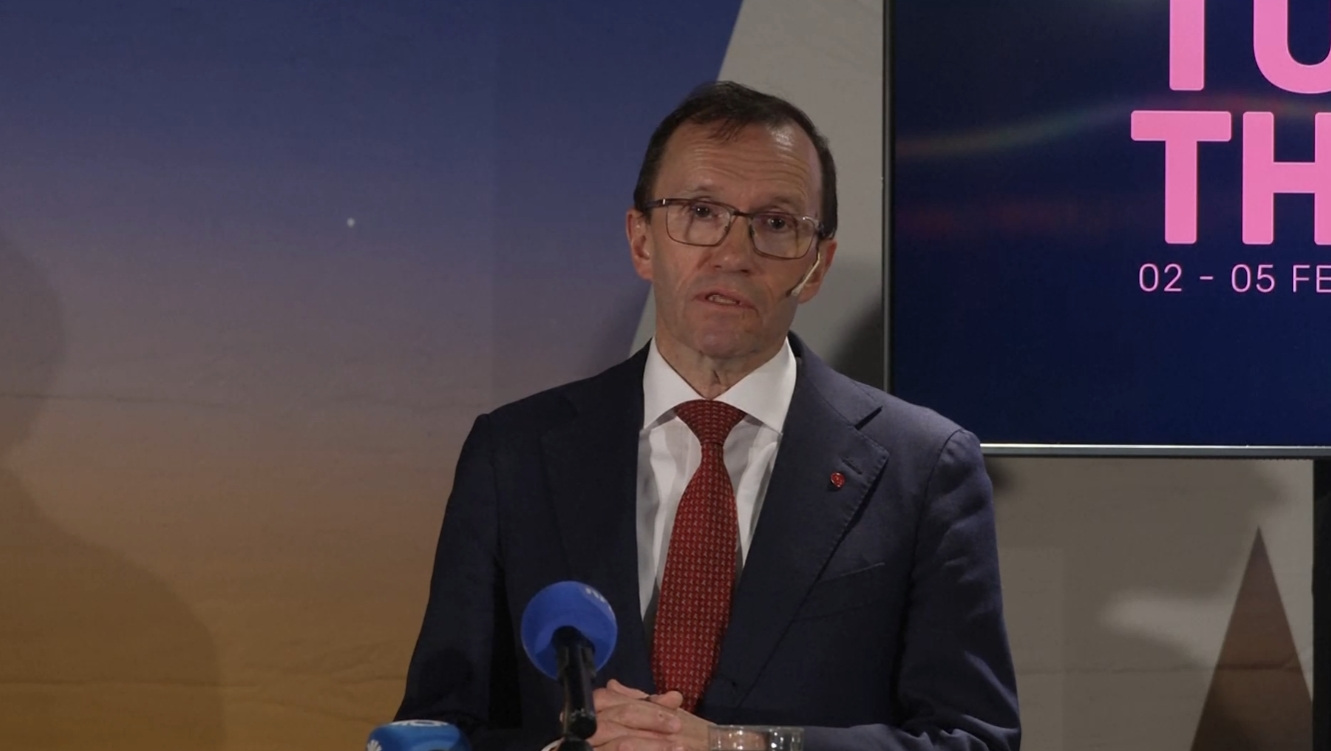
Aas
According to the "Brussels Times" report, Kallas announced at the meeting that the EU is updating its Arctic strategy with member states to reflect the changing security environment, with the Greenland issue becoming a "core pillar" of the revised policy.
She said that the region's security is not only about military strength, but also about resilient societies, trustworthy institutions, secure infrastructure, and sustainable livelihoods, and the EU is contributing through funding support, scientific cooperation, and research tools.
Kallas stated that Norway is one of the EU's closest and most trusted partners, and the EU-Norway security and defense partnership is "moving from paper to action," with closer cooperation in areas such as cybersecurity, maritime security, and protection of critical infrastructure like energy and communication networks.
As an example of deepening relations, she said that the EU's security and defense financing tool will be open to Norway, and Norwegian companies will continue to participate in the European Defence Fund projects.
She also mentioned that the EU's cooperation with NATO will continue to focus on stability, security, and deterrence in the Arctic and high North.
On the same day, Martin O'Donnell, a spokesperson for NATO's Supreme Allied Commander Europe, told Germany's "Der Spiegel" magazine that NATO has launched the "Arctic Sentinel" military plan to "further strengthen NATO's posture in the Arctic and high North," with preparations underway, and he refused to disclose more details.
The report said that NATO defense ministers may hold a meeting in Brussels in the coming weeks to discuss preliminary action plans.
Last month at the Davos Forum, Trump changed his statement, saying he would not use force to take over Greenland, but still insisted on the island's control rights. After meeting with NATO Secretary General Jens Stoltenberg, he claimed to have reached a "framework" agreement to protect American interests in the Arctic, while withdrawing the tariff threats against eight European countries.
Although the situation seems to have eased, Greenland remains cautious. On Monday, Greenland Prime Minister Jens Frederik Jensen warned that the U.S. is still seeking "a way to own and control Greenland."
He stated that although the U.S. recently denied the possibility of military takeover of Greenland, its fundamental position has not changed, with the goal of annexing Greenland and ruling it.
Jensen pointed out that such statements come not only from Trump, but also from other key U.S. decision-makers and American close allies. He reiterated that the U.S. continuous pressure on Greenland is "unacceptable" and condemned the U.S. for being "arrogant and creating division."
He also said that despite the tense situation, Greenland has opened dialogue with the U.S. through high-level official channels, and the autonomous government will work to achieve "concrete results" through dialogue.
This article is exclusive to Observer News. Unauthorized reproduction is prohibited.
Original: toutiao.com/article/7602856647664386570/
Statement: The views expressed in this article are those of the author and do not necessarily reflect the views of Observer News.