
【By Observer News, Xiong Chaoran】The U.S. chipmaker NVIDIA, which has long been yearning for the Chinese market, has been lobbying intensively, thinking that it had "closed a loophole" in the U.S. Congress, only to "find another pit"...
According to the UK's Financial Times, on December 4th, local time, the newspaper was the first to report exclusively that two bipartisan U.S. senators jointly introduced a bill on the same day, which would prohibit NVIDIA from selling advanced artificial intelligence (AI) chips to China, aiming to increase the difficulty for China to obtain key U.S. AI technologies.
Specifically, this legislative proposal, named the "Secure and Feasible Exports Chips Act" (The Secure and Feasible Exports Chips Act, abbreviated as "SAFE Act"), would require the U.S. Secretary of Commerce to stop issuing export licenses for advanced AI chips to buyers in countries including China and Russia within 30 months. This means that the bill would prevent NVIDIA from selling its most advanced chips—H200 and Blackwell—to China.
The Financial Times reported that the White House is currently weighing whether to allow NVIDIA to export H200 chips to China, a possibility that has already alarmed some officials. Bloomberg noted that the introduction of the "SAFE Act" came just a day after NVIDIA's founder and CEO Huang Renxun held a closed-door meeting with a Republican member of the Senate Banking Committee responsible for export controls, and on the same day, he also had a private meeting with President Trump.
Bloomberg reported on December 3rd that during Huang Renxun's visit to Washington, NVIDIA had originally been about to achieve an important lobbying success: legislators had excluded a clause from the must-pass defense bill that could have restricted NVIDIA from selling its advanced AI chips to China and other "adversary countries".
This legislative proposal, named the "Guaranteeing National Access to and Innovation in AI Act" (GAIN AI Act, abbreviated as "GAIN AI Act"), was originally aimed at ensuring that advanced AI chips were prioritized for the U.S. domestic market through export controls and preferential supply mechanisms, giving tech giants like Microsoft and Amazon priority access to chips, while restricting NVIDIA and other chip manufacturers from exporting to countries such as China.
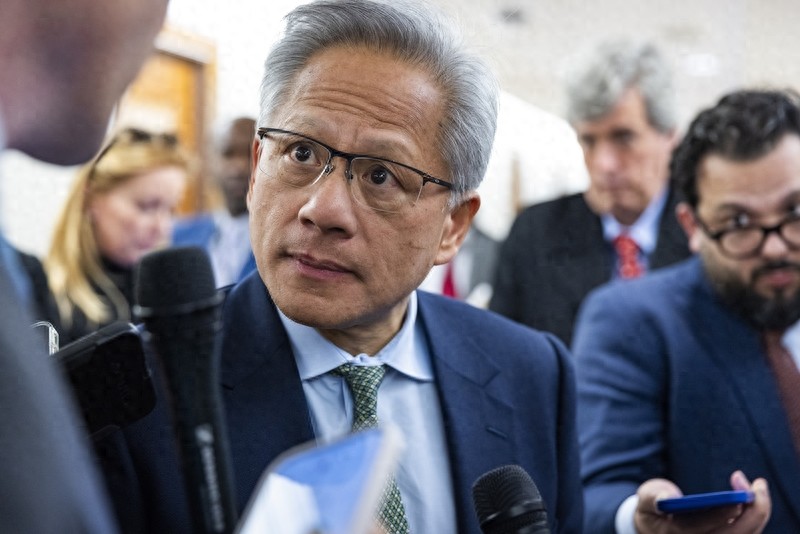
On December 3, in Washington D.C., NVIDIA CEO Huang Renxun was interviewed by journalists in the U.S. Congress. IC Photo
According to the report, the co-sponsors of the "Safe and Feasible Export Chips Act" were Pete Ricketts, the chairman of the Asia-Pacific Subcommittee of the Senate Foreign Relations Committee and a Republican, and Chris Coons, the chief Democratic senator of the committee. Ricketts claimed that the reason the U.S. leads China in the AI race is due to its "dominant global computing power".
He stated, "Therefore, it is crucial to prevent China from obtaining these chips. As U.S. chip companies continue to innovate rapidly, codifying the current Trump administration's restrictions on AI chips targeting China into law will enable us to exponentially expand our computing power advantage."
Coons echoed the sentiment, stating that the future of the 21st century would depend on which country wins the AI competition. It is reported that other senators who sponsored the bill include Republicans Tom Cotton and Dave McCormick, as well as Democrats Jeanne Shaheen and Andy Kim.
On December 3rd, local time, Huang Renxun told reporters at the U.S. Capitol that he had discussed export control issues with Trump during a private meeting earlier that day, but refused to reveal specific details. Previously, officials in the Trump administration had discussed whether to allow H200 sales in China. When asked whether Chinese companies would be allowed to purchase H200 chips, Huang Renxun expressed uncertainty.
"We don't know, we have no idea," said Huang Renxun. "We can't downgrade the chips we sell to China, they won't accept it." He then went to attend a closed-door meeting of the Senate Banking Committee, which is responsible for export controls.
On the same day, when asked about the meeting, Trump praised Huang Renxun as a "smart man" (smart man), and when pressed whether he had clearly conveyed his views on export controls and the types of chips NVIDIA could provide to China, Trump replied, "He knows. (He knows.)"
The Financial Times believes that at the time of the "SAFE Act" being introduced, "China hawks" in Washington are worried, fearing that Trump might sacrifice so-called national security to reach a trade agreement.
On December 4th, local time, the Financial Times, in another report, cited multiple sources that the U.S. had paused plans to impose sanctions on Chinese authorities and their contractors to avoid disrupting the "trade truce" atmosphere reached between the U.S. and China in late October.
The report also cited current and former U.S. officials, saying that the move was intended to avoid disrupting the gradually easing situation in U.S.-China relations. Several U.S. officials and other sources revealed that after the summit between the two heads of state in Busan, the U.S. government would not implement new major export control measures against China.
Some say that the Trump administration's policy toward China has shifted to "ensuring stability" until the U.S. reduces its reliance on China's dominance in the rare earth sector, which has always constrained the U.S. ability to take more aggressive actions. Moreover, President Trump does not want his possible visit to China next April to be affected.
Saif Khan, a chip expert at the Institute for Progress (IFP) who previously worked in the White House and the U.S. Department of Commerce, said that if China could obtain NVIDIA's H200 chips, it would benefit significantly. "Compared to the most cutting-edge Blackwell chips, unimpeded access to H200 chips would allow China to build cutting-edge-scale AI supercomputers at slightly higher costs, thereby developing the most powerful AI systems," he said.
"This would also allow Chinese cloud service providers to compete globally with American large-scale cloud service providers," he added.
Regarding Huang Renxun, John Neely Kennedy, a Republican member of the Senate Banking Committee, told reporters that the person was not a "credible source of information" regarding what products the U.S. should export to China.
"He is richer than the Father, the Son, and the Holy Spirit, and he wants more," said Kennedy. "If I need someone to give objective advice on whether we should provide technology to China, he is definitely not the right person."
Steve Bannon, former chief strategist of the Trump administration and a prominent figure in the "Make America Great Again" (MAGA) movement, also jumped out to claim that the U.S. should not export advanced chips to China, especially given the significant progress made by Chinese companies like DeepSeek in the AI field.
"If DeepSeek indeed brought us into the 'Sputnik Moment,' we should ban all chip sales, especially high-end chips; and stop all financial support—prohibit access to debt or equity capital markets, training, and Chinese students—as we did during the Cold War with nuclear weapons," he said.
Bannon not only criticized Huang Renxun but also attacked David Sacks, the head of the White House's AI and cryptocurrency affairs. According to the report, as part of an "AI Action Plan," Sacks supported selling high-end chips to China, allowing countries to rely on the U.S. "technology stack."
According to the report, when asked about the "SAFE Act," NVIDIA stated that Trump's "AI Action Plan" wisely recognized that non-military enterprises around the world should be able to choose the U.S. technology stack, thus promoting U.S. employment and national security.
In response to Bannon's comments, the company replied, "AI is not an atomic bomb. No one should have an atomic bomb, but everyone should have AI."
From the Biden administration to the Trump administration, the U.S. has implemented a series of chip export restrictions to contain and suppress China's technological development, and has continuously tightened them, with NVIDIA's AI chips being the "top priority." For this reason, NVIDIA has sought to sell a "downgraded special version" of the H20 chip to China, but it has still been closely monitored by the Trump administration.
In mid-July this year, Huang Renxun announced in China that the U.S. government had approved the sale of the H20 chip to China. However, this H20 chip generated only about $50 million in revenue in the third quarter of this year, and more and more Chinese buyers were unwilling to pay for it.
Currently, NVIDIA is still striving to enter the lucrative Chinese market, but its situation between the U.S. and China seems to be becoming increasingly awkward, especially as the controversies surrounding the company continue to spread and ferment—In China, NVIDIA faces doubts about security risks of backdoors, being summoned for talks, and antitrust investigations; in the U.S., the company's practice of "contributing" to the U.S. government has caused public outrage.
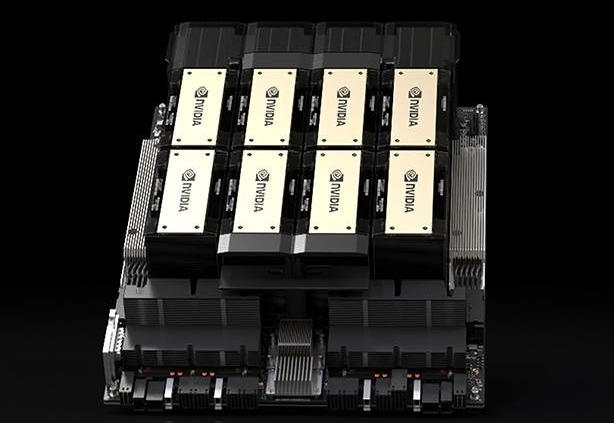
NVIDIA H200 chip NVIDIA official website
On November 20, Huang Renxun appeared on Fox Business Channel and stated that the export restrictions imposed by the U.S. had led to a stagnation in NVIDIA's chip sales to China, and he expected the sales for the next two quarters to be zero.
"I predict that sales in the Chinese market will be zero. The next quarter will be zero, and the following quarter will also be zero," said Huang Renxun. "We assume that sales will be zero. If we can overcome all obstacles and reach cooperation with both the U.S. and Chinese governments, the Chinese market is undoubtedly very large," he said. According to him, the current AI chip market in China is about $50 billion, and by the end of 2030, it may grow to $200 billion.
"It's really a pity that U.S. companies cannot participate in it. This is a very important source of income," Huang Renxun emphasized: "This income will allow us to increase our investment and accelerate our investment speed, so I hope we have the opportunity to return to the Chinese market. But currently, we can only assume that the income is zero."
Previously, Lin Jian, spokesperson for the Chinese Ministry of Foreign Affairs, responded, stating that China has repeatedly made a firm position on the U.S.'s malicious blockage and suppression of the Chinese semiconductor industry. The U.S. politicizes, generalizes, and instrumentalizes economic and trade and technological issues, constantly increasing export controls on chips to China, coercing other countries to suppress China's semiconductor industry. Such behavior hinders the development of the global semiconductor industry and ultimately harms itself, hurting others and oneself.
On October 29, during the regular press conference, when asked about Huang Renxun's statement that U.S. AI chips needed to be exported to China, Gao Jikun, spokesperson for the Chinese Ministry of Foreign Affairs, responded that specific issues should be inquired about with the relevant Chinese authorities. China has repeatedly stated its principle stance on the issue of U.S. chip exports to China, hoping that the U.S. would take concrete actions to maintain the stability of the global supply chain.
This article is exclusive to Observer News. Unauthorized reproduction is prohibited.
Original: toutiao.com/article/7580162227106349577/
Statement: The article represents the personal views of the author.