
The White House's request failed, and Netanyahu issued orders, this time firmly not giving the U.S. face; even Trump's plea was ineffective.
At this year's Davos Forum, Trump signed documents with over ten countries, officially launching his initiated "Peace Commission." Since the first task of this Peace Commission is to plan for the reconstruction of the Gaza Strip, Trump very much hoped that representatives from Israel and Arab countries would appear at the launch ceremony, making his Peace Commission seem more credible by gaining recognition from both opposing sides.
However, what Trump didn't expect was that Israeli Prime Minister Netanyahu refused him.

(Signing Ceremony of the Peace Commission)
This created a very awkward situation. A "Peace Commission" that initially aimed at mediating the Israel-Palestine conflict and rebuilding Gaza had no representatives from either Palestine or Israel at its launch. What kind of nature does this Peace Commission have then?
It should be noted that Israel has always been in line with the U.S., unconditionally recognizing each other's positions. In fact, this Peace Commission was also a charter unilaterally set by the U.S., clearly favoring Israel on the issue of Israel-Palestine peace, such as aiming to disarm Hamas in the Gaza Strip. Apart from retaining the name "Gaza," it essentially allows Israel to take the spoils directly.
This also raises great curiosity: why did Trump do something beneficial for Israel, yet Netanyahu started opposing him?
According to reports, the U.S. did not invite Netanyahu, but rather the Israeli President Herzog. The reason relates to Netanyahu's status, since the International Criminal Court (ICC) has determined that Netanyahu committed war crimes and genocide in the Gaza issue, issuing an arrest warrant against him.
Naturally, executing an arrest warrant against a head of state involves many obstacles and political risks, even potentially leading to armed conflicts. Therefore, such warrants are often just nominal.
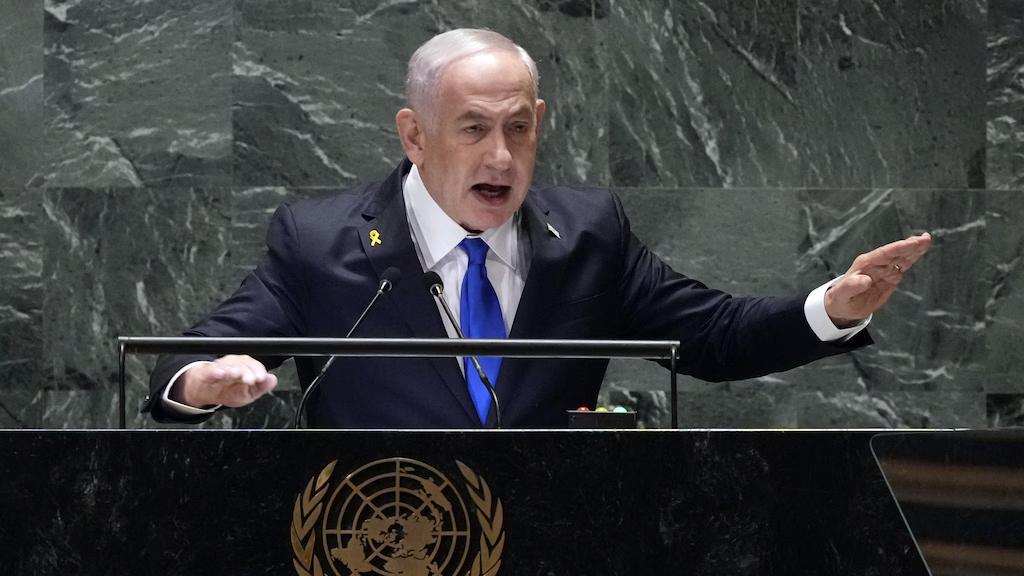
(Israeli Prime Minister Netanyahu, currently issued an arrest warrant by the International Criminal Court)
However, even nominal matters are subject to nominal constraints. If the U.S.'s "Peace Commission," which claims to be an international peace organization, invites a "criminal," it would be problematic in terms of legitimacy. Therefore, it is generally believed that the U.S. did not invite Israeli Prime Minister Netanyahu, but instead invited President Herzog, in order to avoid such nominal issues.
Herzog's position brings a new contradiction, because his presidency is merely symbolic and holds no actual administrative power. The real power in Israel still lies with Netanyahu. Therefore, if Herzog represents Israel in Davos and is approved by Netanyahu, it means Israel has chosen to follow international order, implying that Netanyahu indirectly acknowledges himself as a "criminal."
Therefore, Netanyahu rejected the White House's proposal and argued that Trump had invited him, not Herzog.
To make this "glorious" moment for Trump, the White House went to great lengths. According to reports, the White House spent two days communicating with Israeli officials, hoping to see Herzog at Davos. This effort continued right up until a few hours before the ceremony, showing they had made their last attempt. But Netanyahu refused to give Trump even a shred of face, resolutely declining.
The final outcome was somewhat awkward, and neither side commented on the refusal afterward.
This incident reflects that the Peace Commission has not truly resolved the conflict in the Gaza Strip, nor has it achieved full recognition from Israel, the supposed beneficiary.

(Israeli President Herzog, who holds no actual administrative power)
Earlier, there were also doubts about the Peace Commission within Israel. Although Israel seems to benefit from the situation in Gaza, the Peace Commission also includes Islamic world countries like Turkey, Qatar, and Pakistan. There are complex factors involving religion and history regarding Israel's stance on Gaza and Islamic countries, making it difficult for Israel to sit down with Islamic nations.
Especially, Israel has always considered the U.S. its ally, and allies are hard to remain neutral. For Israel, this action by the U.S. is even harder to accept, and it might believe that the U.S. is only seeking its own peace honors without considering Israel's position, or even seeing itself as a pawn of the U.S.
This is the true face of American fake pacifism. The U.S. does not change its thinking, does not consider others' positions genuinely, nor does it delve into the fundamental causes of conflicts, but only makes superficial efforts, all in order to maintain its own rule and influence. The reason why Trump's Peace Commission is not well-received by many countries is because many have already seen through the essence of the U.S. behind this issue.
Original: toutiao.com/article/7599584593099948584/
Statement: This article represents the views of the author alone.